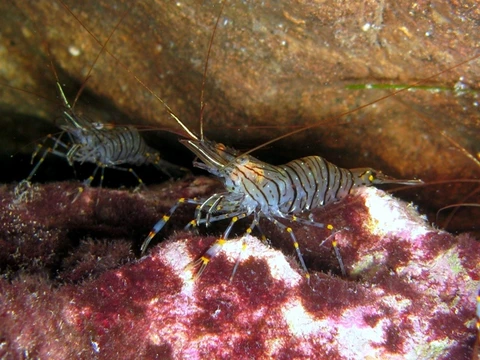
Macrobrachium australiense
A widespread Australian freshwater and estuarine prawn.

Macrobrachium australiense, commonly called the Eastern longarm shrimp, is a prawn from the family Palaemonidae that lives in both freshwater and estuarine settings. It is found across eastern Australia, occupying rivers, streams, and brackish coastal waters. This species is among the most widely distributed freshwater invertebrates on the continent.
These prawns are small to medium in size, with a translucent brownish-green shell and a maximum length of about 7 centimeters. Their most distinctive feature is the elongated second pair of legs, which in mature individuals can grow longer than the body itself. These legs end in small claws used for grasping and defending territory. Males and females look different: males develop noticeably larger second chelipeds than females.
The species occurs throughout most of eastern and inland Australia, commonly turning up in freshwater catchments as well as in estuarine and mangrove habitats along the east coast. In New South Wales, it has been recorded as an indicator species in estuarine systems like the Manning River, where it lives in both natural mangrove forests and modified or hybrid shorelines.
Taxonomically, it belongs to the genus Macrobrachium. A major revision in 2004 confirmed *M. australiense* as a valid species and lumped several previously named forms under it.
Molecular studies have revealed that this prawn shows species-specific differences in gene expression when exposed to salinity, compared to related species. Mitochondrial DNA analyses also indicate large genetic divergence between populations from different Australian freshwater drainage basins, reflecting long-term separation between inland and coastal groups.
Ecologically, *M. australiense* is an omnivore that feeds on organic material, helping to cycle nutrients in freshwater and estuarine ecosystems. It also serves as prey for fish and other aquatic predators in Australian river systems.
Quick Facts
- Taxon
- Macrobrachium australiense
Facts from the source article.
Lore & Background
Macrobrachium australiense is a small to medium-sized prawn with a translucent brownish-green shell, growing up to about 7 cm long. It is characterized by elongated second legs, which become particularly prominent in mature specimens and can exceed its body length. These long second legs have small claws at the end, used for grabbing and defending its territory. The species exhibits sexual dimorphism, with males typically developing larger second chelipeds than females.
It is one of Australia's most widespread freshwater invertebrates, found in most of eastern and inland Australia. It commonly occurs in freshwater catchments, as well as estuarine and mangrove-associated habitats along the eastern seaboard. In New South Wales, it has been recorded as an indicator species in estuarine systems including the Manning River, where it occurs in both natural mangrove forests and modified or hybrid shoreline environments.
Taxonomically, Macrobrachium australiense belongs to the genus Macrobrachium. In 2004, a major taxonomic revision of Australian Macrobrachium recognised M. australiense as a valid species and synonymised several previously named forms under it. Comparative transcriptomic studies found it exhibited species-specific differences in gene expression when exposed to salinity, relative to related species. Mitochondrial DNA analyses found large genetic divergence among populations across Australian freshwater drainage basins, reflecting long-term isolation between inland and coastal regions.
Reader's Guide
Macrobrachium australiense holds significance as one of Australia's most widespread freshwater invertebrates, occurring across eastern and inland Australia in rivers, streams, and estuarine environments. Its presence in both natural mangrove forests and modified shoreline habitats, such as in the Manning River in New South Wales, has led to its use as an indicator species in estuarine systems. Ecologically, it is an omnivorous prawn that consumes organic material, thereby contributing to nutrient cycling in freshwater and estuarine ecosystems. It also serves as part of the diet of fish and other aquatic predators in Australian river systems. The species' taxonomic history includes a 2004 revision that confirmed its validity and synonymised several previously named forms under it. Molecular studies have revealed species-specific differences in gene expression related to salinity exposure, as well as large genetic divergence among populations across drainage basins, indicating long-term isolation between inland and coastal regions. These findings underscore its role in understanding evolutionary and ecological processes in Australian aquatic environments.
Did You Know?
- Macrobrachium australiense is also known as Eastern longarm shrimp.
- Its elongated second legs can exceed its body length and are used for grabbing and defending territory.
- Males typically develop larger second chelipeds than females, showing sexual dimorphism.
More in Marine Shrimp 1-24
Spotted an error? Know more?
Reader corrections go straight into our review queue. Suggest an edit · How this site is sourced