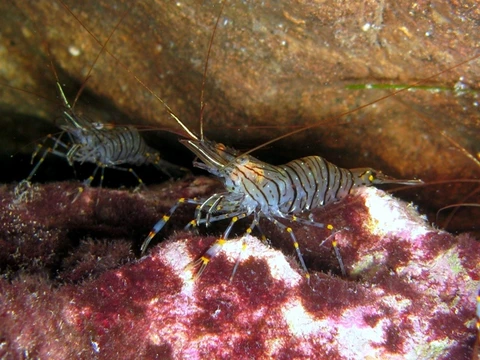
Ascidonia flavomaculata
A translucent endosymbiotic shrimp with yellow spots and green organs.

Ascidonia flavomaculata is a small caridean shrimp from the Palaemoidae family that associates with a variety of other invertebrates like sea sponges, sea anemones, gorgonians, corals, mollusks, echinoderms, and ascidians. It is notable for its translucent body with yellow spots and visible green internal organs, and for its reduced eye complexity compared to free-living pontoniine shrimps.
Quick Facts
- Taxon
- Ascidonia flavomaculata
Facts from the source article.
Lore & Background
Ascidonia flavomaculata is a small caridean shrimp from the Palaemoidae family that associates with a variety of other invertebrates like sea sponges, sea anemones, gorgonians, corals, mollusks, echinoderms, and ascidians. Its eye morphology is reduced compared to free-living forms, a trait influenced by its endosymbiotic lifestyle. The species is gonochoric, with females having a larger abdomen and carapace than males, while males have larger claws; both sexes possess one larger claw. They range from 2 to 20 mm in length. This shrimp occurs in coastal marine environments, typically in shallow subtidal zones, across the northeastern Atlantic, broader eastern Atlantic, and Mediterranean regions. It associates with a variety of invertebrates including sea sponges, sea anemones, gorgonians, corals, mollusks, echinoderms, and ascidians, but is most commonly found in the branchial chamber of the solitary ascidian Phallusia mammillata. Ascidonia flavomaculata exhibits a symbiotic lifestyle within ascidian hosts. Individuals usually live alone inside the branchial chamber. For reproduction, males leave their host to find a female, stay with her for a period, then return to their own host. Females carry eggs in their swimmerets until hatching; larvae float planktonically and develop through zoeal and mysis stages before reaching juvenile form, after which they find their own host. They occasionally leave the host to scavenge for debris and detritus.
Reader's Guide
Ascidonia flavomaculata is significant as an example of an endosymbiotic pontoniine shrimp whose morphology and behavior are shaped by its association with ascidians. Its reduced eye complexity, relative to free-living relatives, illustrates how lifestyle influences sensory evolution. The species' reproductive strategy—males leaving their host to find a female, then returning—reflects the constraints of living solitarily within a host. Its larvae develop through planktonic stages before settling into a host, and juveniles can be selective about their host organism. The shrimp's occasional scavenging outside the host suggests a facultative component to its symbiosis. As a member of the family Palaemonidae, which includes a large clade of tunicate and other endosymbiotic shrimp, A. flavomaculata contributes to understanding the diversity and ecological roles of symbiotic crustaceans in coastal marine environments.
Did You Know?
- Ascidonia flavomaculata has visible green internal organs through its translucent body.
- Males have larger claws than females, but both sexes have one larger claw.
- It is most commonly found inside the branchial chamber of the sea squirt Phallusia mammillata.
- Larvae develop through zoeal and mysis stages before becoming juveniles.
More in Marine Shrimp 1-24
Spotted an error? Know more?
Reader corrections go straight into our review queue. Suggest an edit · How this site is sourced