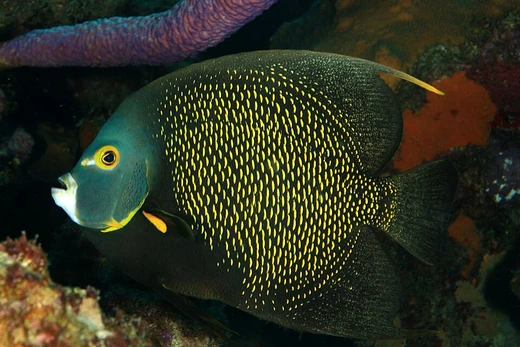
Pomacanthus zonipectus
Eastern Pacific angelfish with distinct juvenile and adult color patterns.

The Cortez angelfish, *Pomacanthus zonipectus*, is a marine angelfish from the family Pomacanthidae. It lives in the Eastern Pacific and sometimes appears in home aquariums.
This species was first scientifically described in 1862 by American ichthyologist Theodore Nicholas Gill, who originally placed it in the genus *Pomacanthodes*. The type location is San Salvador, El Salvador. Some experts consider it part of the subgenus *Pomacanthus*. Its scientific name combines *zona* ("belt") and *pectus* ("breast"), referring to the dark brown band across its chest behind the pelvic and pectoral fins.
Its range in the eastern Pacific stretches from Puerto Peñasco in the northern Gulf of California, Mexico, down to Peru. It has been spotted as a stray in southern California, the Galapagos Islands, Cocos Island, and Malpelo Island, but not at Clipperton Island.
The Cortez angelfish has a deep, compressed body, a short blunt snout, and a small mouth filled with many tiny, bristle-like teeth. A large spine sits at the corner of the preoperculum, which has a smooth vertical edge; there are no spines under the eye or on the operculum. It can reach about 46 cm (18 inches) in total length.
Like other *Pomacanthus* species, juveniles and adults look very different. Adults have the rear half of the body covered in a crisscrossing line pattern, with a yellowish-green tail. A large yellow arc sits behind the pectoral fins, and a bright yellow saddle crosses the nape. The middle of the flanks is pale grey. Juveniles are brownish-black with six vivid vertical yellow bands running from the face to the caudal peduncle, and parallel blue bars between the yellow bands. The dorsal and pelvic fins have bright blue edges. The dorsal fin has 11 spines and 24–25 soft rays; the anal fin has 3 spines and 20–22 soft rays.
This species lives at depths of 6 to 50 meters (20–164 feet). It is diurnal and feeds on items from the substrate, mainly sponges, but also tunicates, algae, bryozoans, hydroids, and fish eggs. Adults form pairs that roam widely, while solitary juveniles are territorial. Spawning occurs from midsummer to early autumn, with juveniles most abundant from August to November. The species appears to be monogamous. Juveniles are also found in tidal pools.
Quick Facts
- Taxon
- Pomacanthus zonipectus
Facts from the source article.
Lore & Background
Pomacanthus zonipectus was first formally described as Pomacanthodes zonipectus in 1862 by American ichthyologist Theodore Nicholas Gill, with the type locality given as San Salvador in El Salvador. Some authorities place this species in the subgenus Pomacanthus. The specific name zonipectus is a compound of zona meaning 'belt' and pectus meaning 'breast', referring to the dark-brown girdle on the breast behind the pelvic and pectoral fins.
This species occurs in the eastern Pacific Ocean from Puerto Peñasco in the northern Gulf of California, Mexico, south to Peru. It has been recorded as a vagrant from southern California, the Galapagos Islands, Cocos Island, and Malpelo Island, though not from Clipperton Island. Adults have the posterior half of the body covered by a matrix of crisscrossing lines, becoming yellowish-green in the tail, with a large yellow arc behind the pectoral fins and a bright yellow saddle across the nape. Juveniles have a brownish-black background with six vertical vivid yellow bands and parallel blue bars between them, with bright blue margins on the dorsal and pelvic fins.
The species is diurnal and feeds mainly on sponges, as well as tunicates, algae, bryozoans, hydroids, and fish eggs. Adults are found in pairs that range widely, while solitary juveniles are territorial. Spawning occurs from midsummer to early autumn, with juveniles most abundant from August to November. Juveniles are also found in tidal pools.
Reader's Guide
Pomacanthus zonipectus is notable for its striking ontogenetic color change, with juveniles displaying vivid yellow and blue bands that transform into the adult's crisscrossing lines and yellow accents. Its distribution spans the eastern Pacific from the Gulf of California to Peru, with vagrant records from several offshore islands. The species is diurnal and feeds primarily on sponges, reflecting its ecological role as a benthic forager. Adults form monogamous pairs that range widely, while juveniles are territorial and inhabit tidal pools. Spawning occurs from midsummer to early autumn, with juveniles most abundant from August to November. Although it occasionally appears in the aquarium trade, its specific habitat requirements and diet may limit its popularity. The species' scientific name, derived from Latin for 'belt' and 'breast,' references a distinctive dark band on the breast. Its presence in the aquarium trade, though occasional, highlights its appeal to marine hobbyists, but the article provides no further details on its captive care or conservation status.
Did You Know?
- The specific name zonipectus means 'belt' and 'breast,' referring to a dark-brown girdle on the breast.
- Juveniles have six vertical vivid yellow bands with parallel blue bars between them.
- Adults are monogamous and found in pairs that range widely.
More in Marine Angelfish, Part 3 1-24
Spotted an error? Know more?
Reader corrections go straight into our review queue. Suggest an edit · How this site is sourced