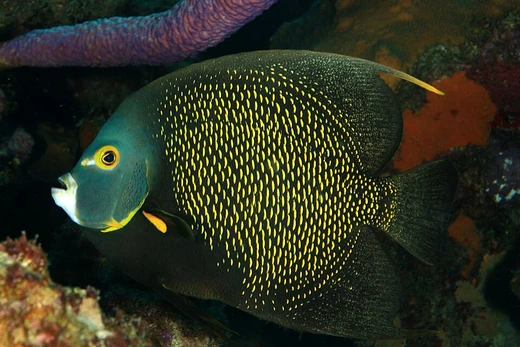
Clarion angelfish
A rare eastern Pacific angelfish restricted to Mexican islands.

Elias Levy · CC BY 2.0
The Clarion angelfish (Holacanthus clarionensis) is a marine ray-finned fish in the family Pomacanthidae. It lives in the eastern Pacific Ocean, almost entirely around islands off Mexico’s Pacific coast.
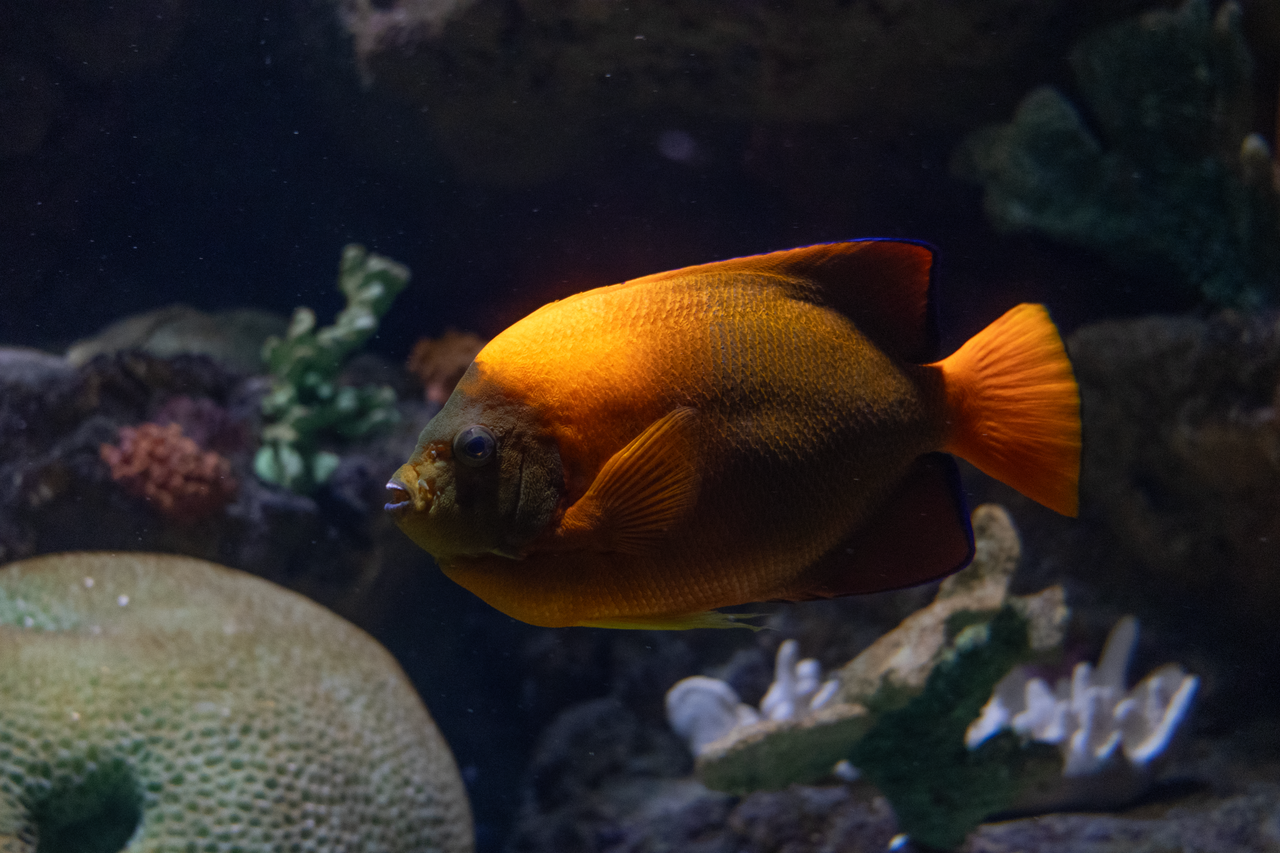
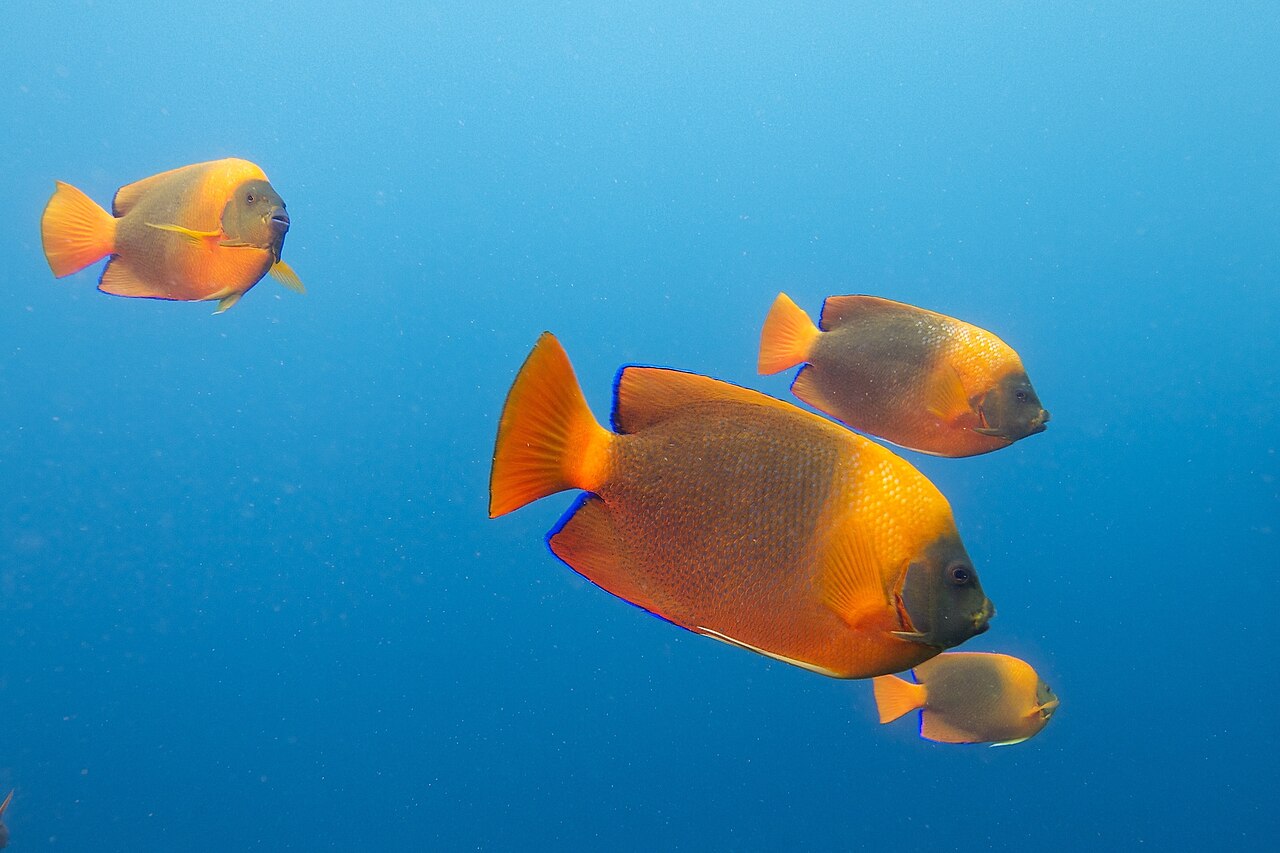
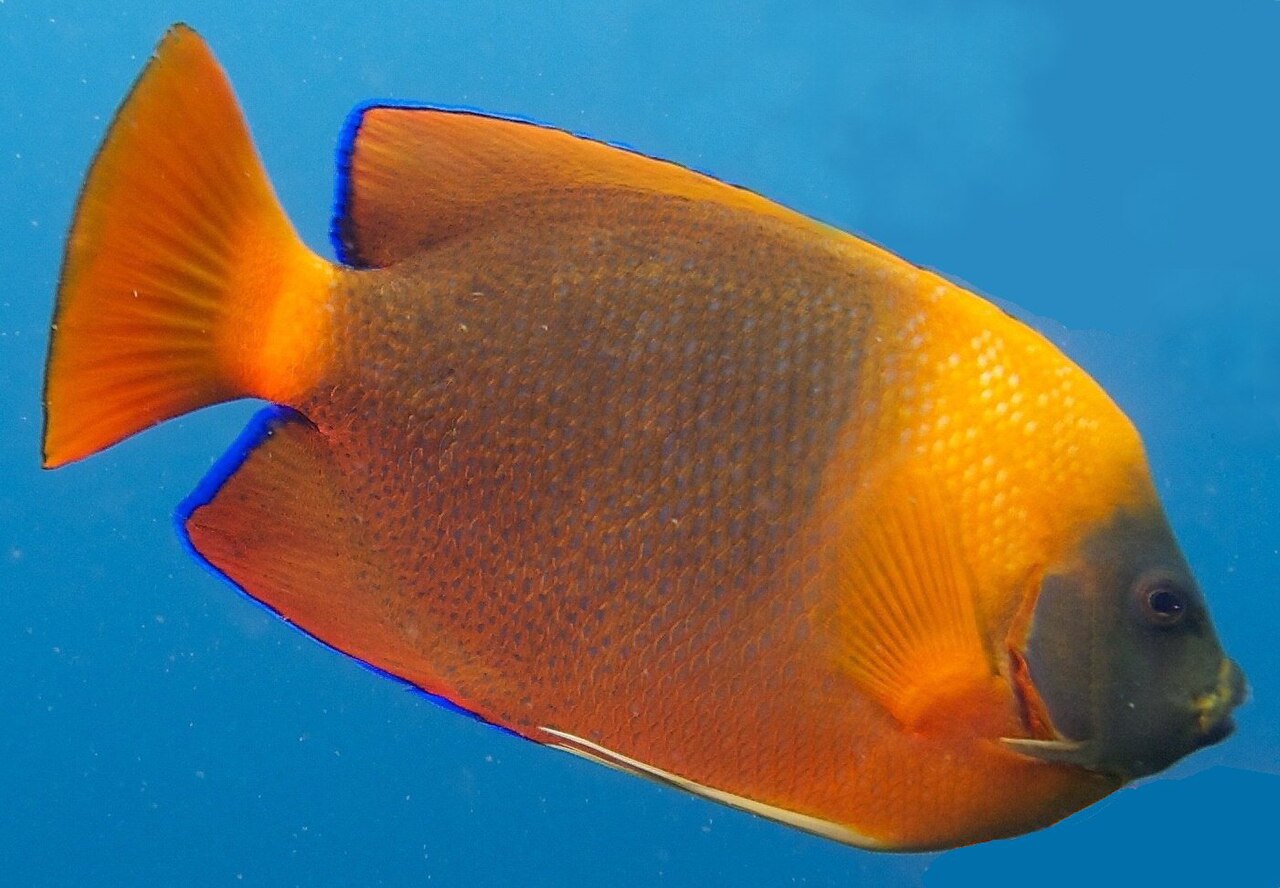
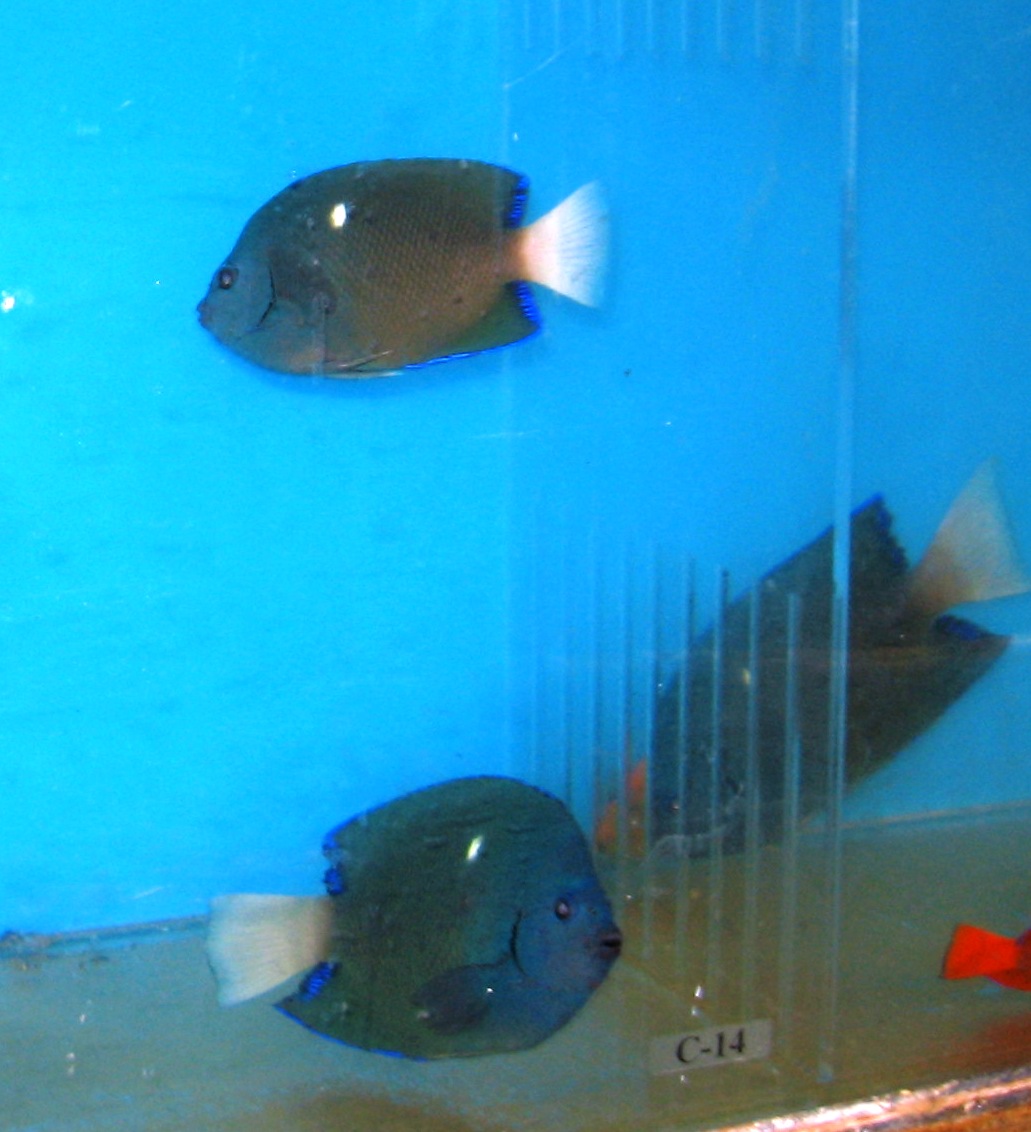
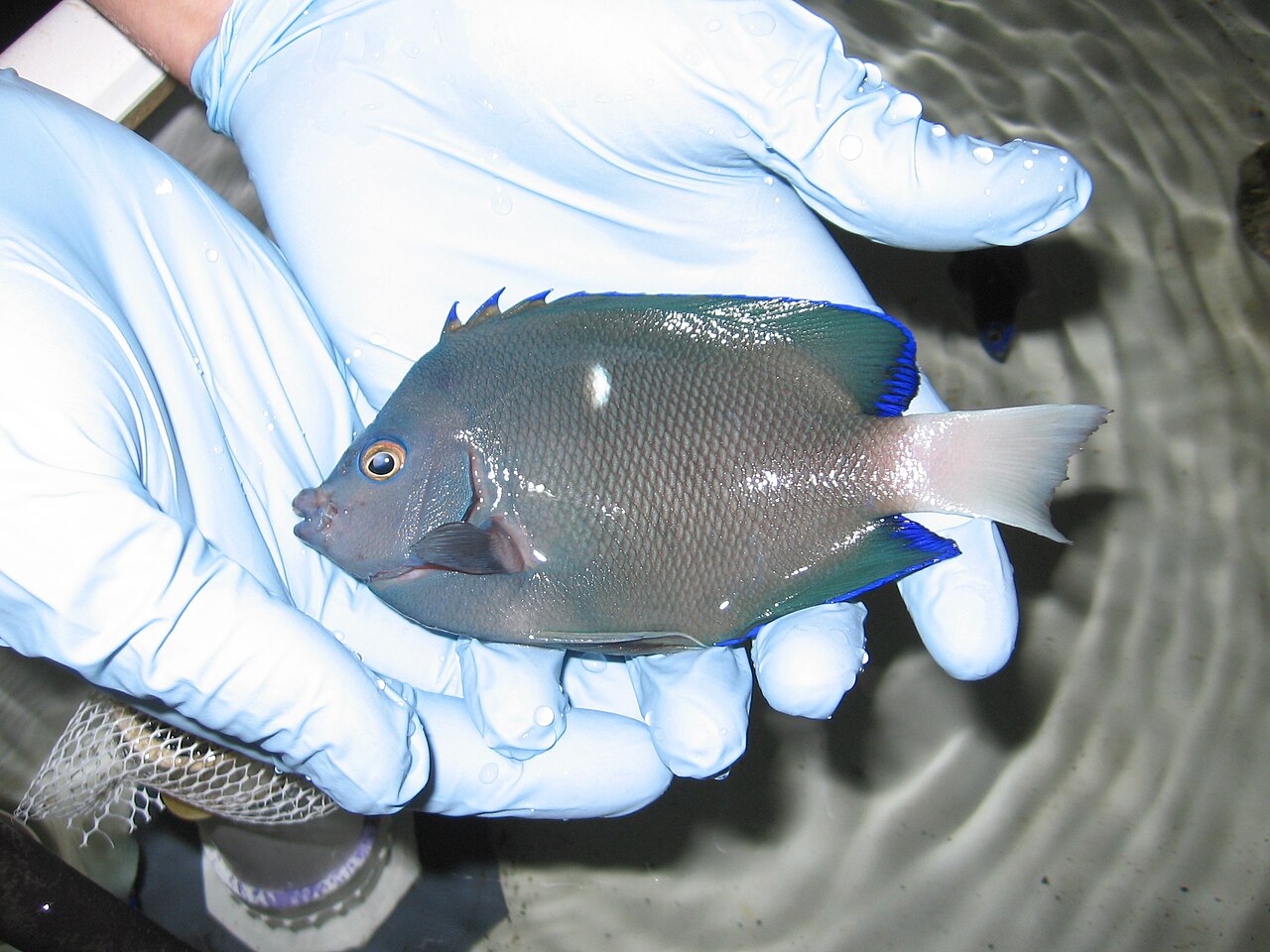
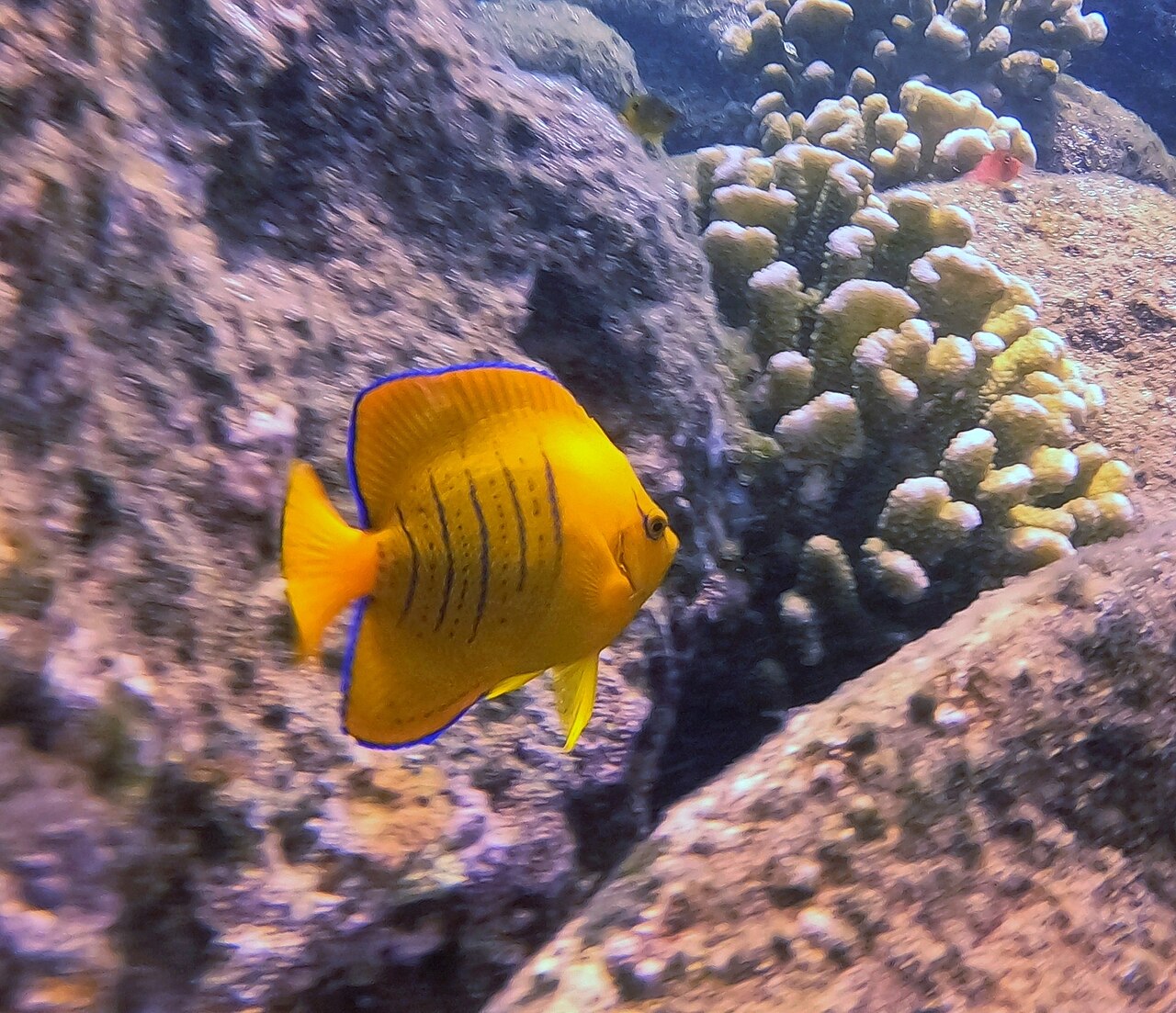
This fish has a flattened, four-sided body and a small mouth lined with bristle-like teeth. It can grow up to 20 centimeters (7.9 inches) long. Young Clarion angelfish are yellowish-orange all over, with several blue vertical bars on the body that gradually vanish as they mature. Juveniles may also have blue lips and blue edges on their dorsal and anal fins. Adults have a brownish face, a reddish-orange area behind it, and a browner rear body. The dorsal and anal fins are bright orange, and the tail fin is vermilion. The dorsal fin has 14 spines and 17 to 19 soft rays, while the anal fin has 3 spines and 19 soft rays.
The species has a very small range in the eastern Pacific, mostly limited to Mexico’s Revillagigedo Islands. Occasionally, stray individuals have been seen near the southern tip of Baja California, the southeastern Gulf of California, and Clipperton Island (a French territory).
Clarion angelfish live on rocky reefs down to about 30 meters (98 feet) deep. They are usually found alone or in small groups. This species has not been studied much.
It was first formally described in 1890 by American ichthyologist Charles Henry Gilbert, based on specimens from Clarion, Socorro, and San Benedicto Islands in the Revillagigedo Islands. Its scientific name refers to Clarion Island.
The Clarion angelfish was once collected for the aquarium trade, but collection became illegal after the Revillagigedo Islands were declared a protected area. Captive-bred specimens have since been produced and are now available in the trade.
Quick Facts
- Taxon
- Holacanthus clarionensis
Facts from the source article.
Lore & Background
The Clarion angelfish has a laterally compressed, quadrilateral body and a small mouth equipped with bristle-like teeth. Juveniles are yellowish-orange with blue vertical bars that fade as the fish matures, and may have blue lips and blue margins on the dorsal and anal fins. Adults have a brownish face, with the adjacent body reddish orange and the posterior body browner; the dorsal and anal fins are bright orange, while the caudal fin is vermilion. The dorsal fin contains 14 spines and 17-19 soft rays, and the anal fin has 3 spines and 19-19 soft rays.
Its distribution is very limited in the eastern Pacific Ocean, largely restricted to the Revillagigedo Islands of Mexico, with vagrants occasionally reported from the southern tip of Baja California, the southeastern Gulf of California, and Clipperton Island. It inhabits rocky reefs at depths up to 30 metres, typically encountered as solitary individuals or in shoals. It is a little studied species.
The species was first formally described in 1890 by American ichthyologist Charles Henry Gilbert, with the type locality given as Clarion, Socorro and San Benedicto Islands in the Revillagigedo Islands. The specific name refers to Clarion Island.
Reader's Guide
The Clarion angelfish was formerly collected for the aquarium trade, but since the Revillagigedo Islands were declared a protected area, collection has been illegal. However, it has been bred in captivity, and captive-bred specimens have entered the trade. Its restricted range—largely confined to the Revillagigedo Islands—and its protected status contribute to its significance. The species is little studied, so much of its biology remains unknown. Its presence as a vagrant in other areas suggests occasional dispersal, but the core population is safeguarded by the protected area designation. The availability of captive-bred individuals offers a sustainable alternative for the aquarium trade without impacting wild populations.
Did You Know?
- The Clarion angelfish attains a maximum total length of 20 centimetres (7.9 in).
- Collection of wild specimens is illegal since the Revillagigedo Islands were declared a protected area.
Evolutionary Origins & Taxonomic History
The queen angelfish's scientific journey began in 1758 when Carl Linnaeus catalogued it under the name Chaetodon ciliaris in his landmark Systema Naturae, assigning it to the Western Atlantic and Caribbean region. Three decades later, French naturalist Bernard Germain de Lacépède reclassified it into the genus Holacanthus, a name drawn from Ancient Greek words meaning "full" and "spine." The species epithet ciliaris, meaning "fringed," nods to the ciliate scales that cover the fish's body. Molecular evidence suggests the broader Holacanthus lineage first appeared between 10.2 and 7.6 million years ago, with the West African Guinean angelfish representing the earliest branch, implying the group originally colonized the Atlantic from the Indian Ocean. The later closure of the Isthmus of Panama, roughly 3.5 to 3.1 million years ago, isolated Tropical Eastern Pacific populations. The queen angelfish itself diverged from its closest living relative, the Bermuda blue angelfish, approximately 1.5 million years ago. Remarkably, the two species still overlap in range and can produce a fertile hybrid known as the Townsend angelfish, which carries blended traits of both parents and can itself breed with either parent species or with other hybrids.
Physical Form & Chromatic Diversity
The queen angelfish presents a broad, laterally compressed oval body capped by a triangular caudal fin, with a short, blunt snout housing small bristle-like teeth. Its dorsal fin carries fourteen spines alongside nineteen to twenty-one soft rays, while the anal fin mirrors this structure with three spines and twenty to twenty-one soft rays, both trailing behind the body. Adults reach up to forty-five centimeters in length and can weigh as much as sixteen hundred grams, with males tending to outsize females. The body is sheathed in blue-green scales tipped with yellow, while the tail, pectoral, and pelvic fins blaze bright yellow. The most striking feature is the cobalt-blue ocellus on the forehead, ringed in electric blue and speckled with additional blue dots — a mark that separates this species from its look-alike Bermuda blue angelfish. Juveniles look entirely different, displaying dark blue bodies with bright vertical stripes and a yellow patch at the pectoral region. Beyond the standard coloration, seven additional morphs have been documented near the Saint Peter and Saint Paul Archipelago, ranging from predominantly gold or orange to all-white, and one cobalt-blue individual with white and orange patches was recorded off Dry Tortugas, Florida, in 2009.
Harem Life & Reproductive Rituals
The social world of the queen angelfish centers on a territorial harem comprising a single dominant male and two to four females. The species is believed to be protogynous, meaning individuals develop as females first; if the resident male vanishes, the largest female in the group may undergo a sex change to assume his role. During the midday foraging period, each female ventures out alone to different spots within the shared territory, while the male shuttles between them, rushing at her, circling, and swimming alongside as she feeds. Spawning takes place throughout the year but is typically timed around a full moon. Courtship involves the male displaying his flank to the female and rapidly flicking his pectoral fins. Once spawning occurs, the transparent eggs are released into the water column where they drift freely until hatching. Juveniles that emerge bear no resemblance to the adults — they are dark blue with vertical striping — and take on an entirely different ecological role as cleaner fish, establishing stations where they pick ectoparasites from the bodies of larger reef fish.
Sponge-Specialist Ecology & Conservation Status
As a benthic reef dweller, the queen angelfish inhabits waters from the shallow shoreline down to seventy meters, favoring soft coral formations across a vast stretch of the western Atlantic — from Florida and the Gulf of Mexico through the Caribbean to Brazil, and as far east as Bermuda and the remote Saint Peter and Saint Paul Archipelago. Dietarily, this species is a committed sponge specialist. Off St. Thomas and Salvador, Bahia, sponges make up roughly ninety percent of adult intake, and even at the Saint Peter and Saint Paul Archipelago, where more than thirty prey types are consumed, sponges still dominate at sixty-eight percent, followed by algae at twenty-five percent and bryozoans at five percent. Notably, the fish appear to be selective rather than opportunistic feeders: the share of each prey type in their diet does not track that type's overall abundance. At the archipelago, they specifically target rarer sponge species such as Geodia neptuni, Erylus latens, Clathria calla, and Asteropus niger. The queen angelfish is also a staple of the aquarium trade and has been heavily exported from Brazil. In 2010, the IUCN assessed the wild population as stable, assigning it a Least Concern status.
Gallery
Frequently Asked Questions
What is the Clarion angelfish?
The Clarion angelfish (Holacanthus clarionensis) is a small marine ray-finned fish belonging to the pomacanthid family, found only in the eastern Pacific Ocean. It is one of the more geographically restricted members of its genus, tied almost exclusively to waters around Mexican Pacific islands.
What does a Clarion angelfish look like?
It has a laterally compressed, roughly four-sided body with a small mouth armed with bristle-like teeth. Juveniles show a bright yellowish-orange body crossed by several blue vertical bars, plus blue lips and blue trim on the dorsal and anal fins; those bars and accents fade as the fish matures into an adult with a brownish face and a predominantly red body.
How large does the Clarion angelfish grow?
Adults reach a maximum total length of about 20 centimeters (roughly 8 inches), making it a modestly sized member of the angelfish family. Its fin formula includes 14 dorsal spines with 17–19 soft rays behind them, and 3 anal spines paired with 19 soft anal rays.
Where exactly can you find the Clarion angelfish in the wild?
Its range is tightly confined to the eastern Pacific, almost entirely surrounding offshore islands along Mexico's Pacific coastline. It inhabits depths reaching up to about 30 metres (98 ft), typically on reef or rocky substrates near those islands.
Why do fans consider the Clarion angelfish a rare or special species?
Because its entire known distribution is limited to a handful of Mexican Pacific islands, it is far less widely encountered than many other pomacanthids. That narrow geographic footprint, combined with its striking juvenile coloration, makes it a prized and hard-to-observe target for marine enthusiasts in the region.
More in Marine Angelfish, Part 3 1-24
Spotted an error? Know more?
Reader corrections go straight into our review queue. Suggest an edit · How this site is sourced