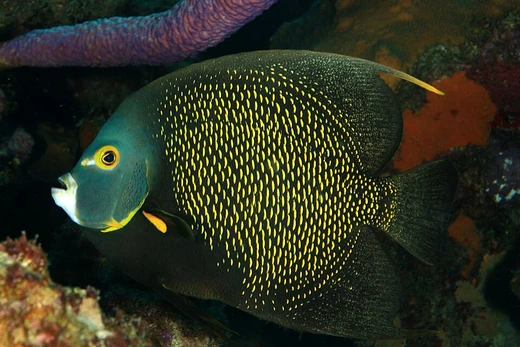
Pomacanthus arcuatus
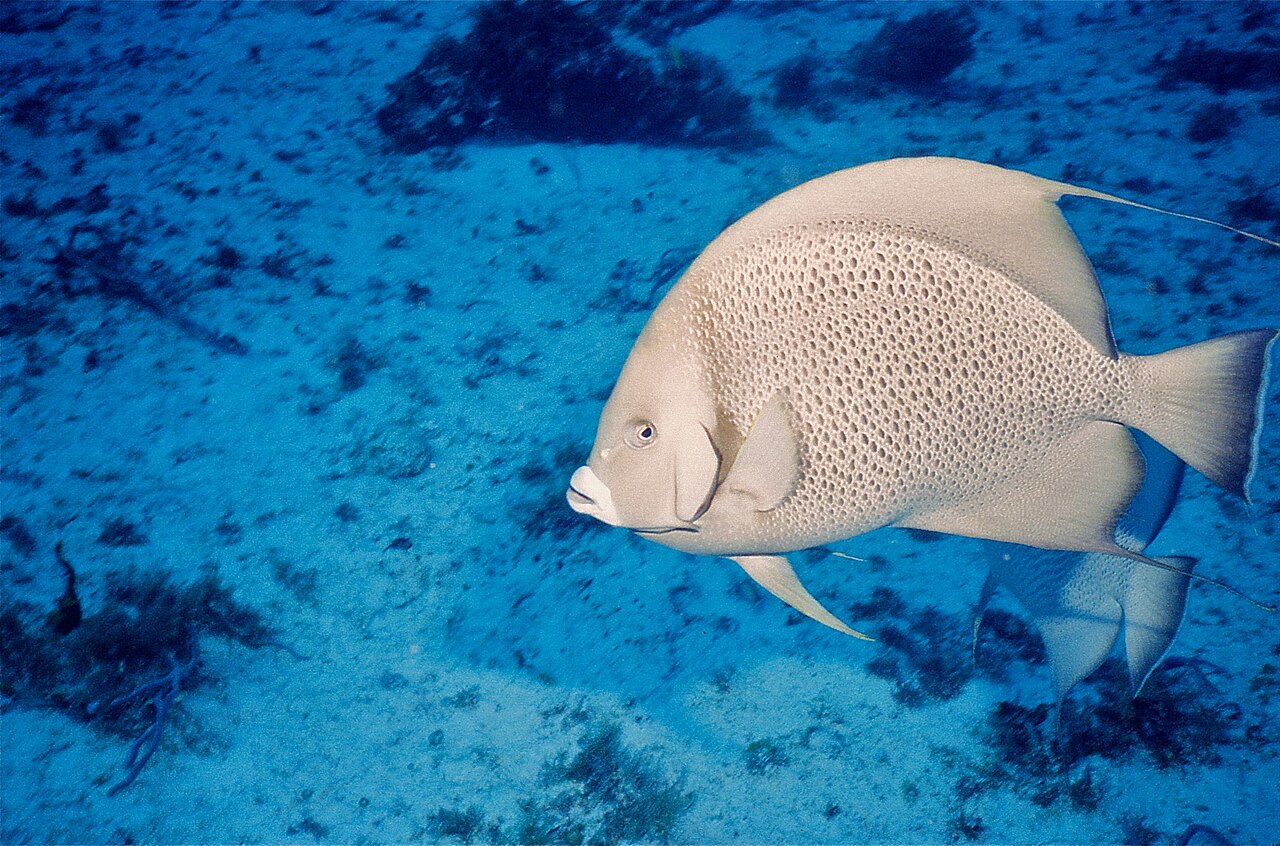
A Western Atlantic angelfish, type species of Pomacanthus.

Andy Blackledge · CC BY 2.0
The gray angelfish (Pomacanthus arcuatus), also called the grey angelfish and known in Jamaica as the pot cover, belongs to the marine angelfish family Pomacanthidae. This ray-finned fish lives in the Western Atlantic Ocean. It holds the distinction of being the type species for the genus Pomacanthus, a status that traces back to its original description by Carolus Linnaeus in 1758.
Linnaeus first formally described this fish in the 10th edition of his *Systema Naturae*, naming it *Chaetodon arcuatus* and listing its type locality as "Indiis." Later, when Lacépède established the genus *Pomacanthus*, he designated Linnaeus's *Chaetodon arcuatus* as the type species. Within the genus, this species is placed in the subgenus *Pomacanthus*. The specific name *arcuatus* means "bowed," a reference to the curved lines running across its body.
The gray angelfish ranges across the Western Atlantic from New York down to Rio de Janeiro, though it rarely appears north of Florida during winter. Its territory includes the entire Caribbean Sea and the Gulf of Mexico. It has also been introduced to Bermuda from the Bahamas.
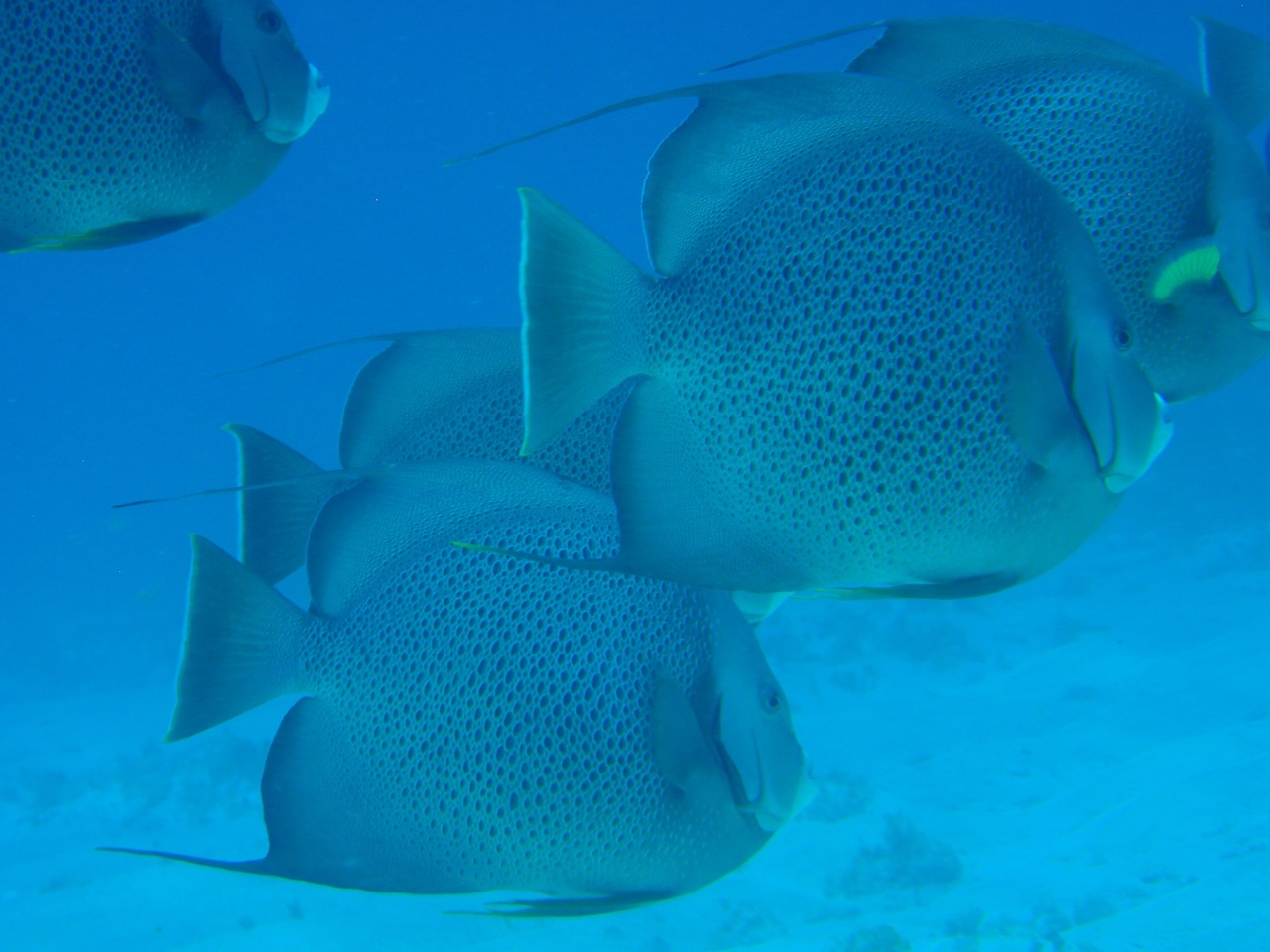
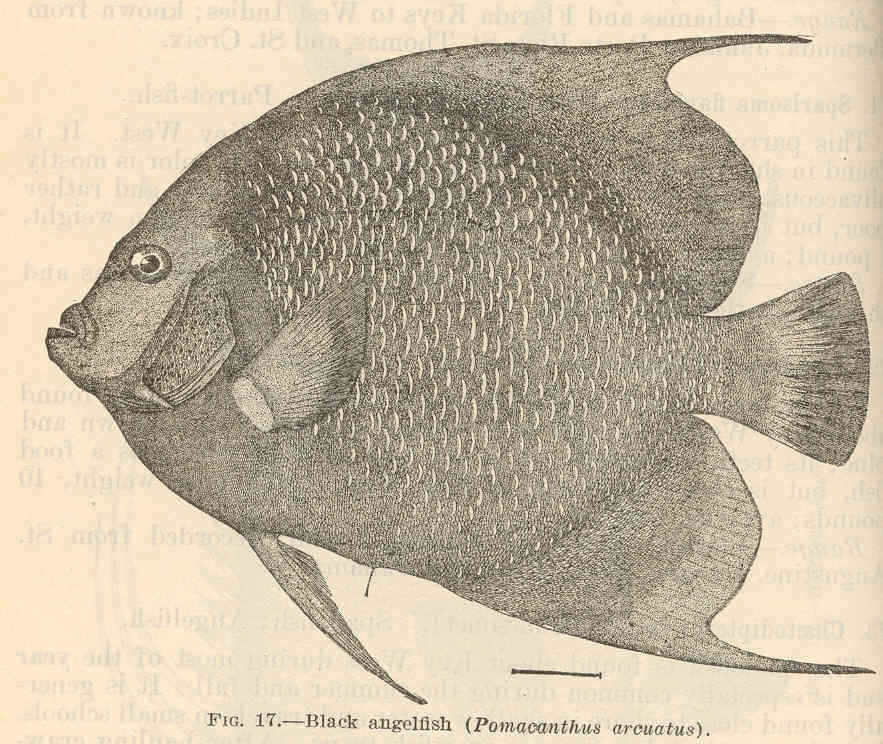
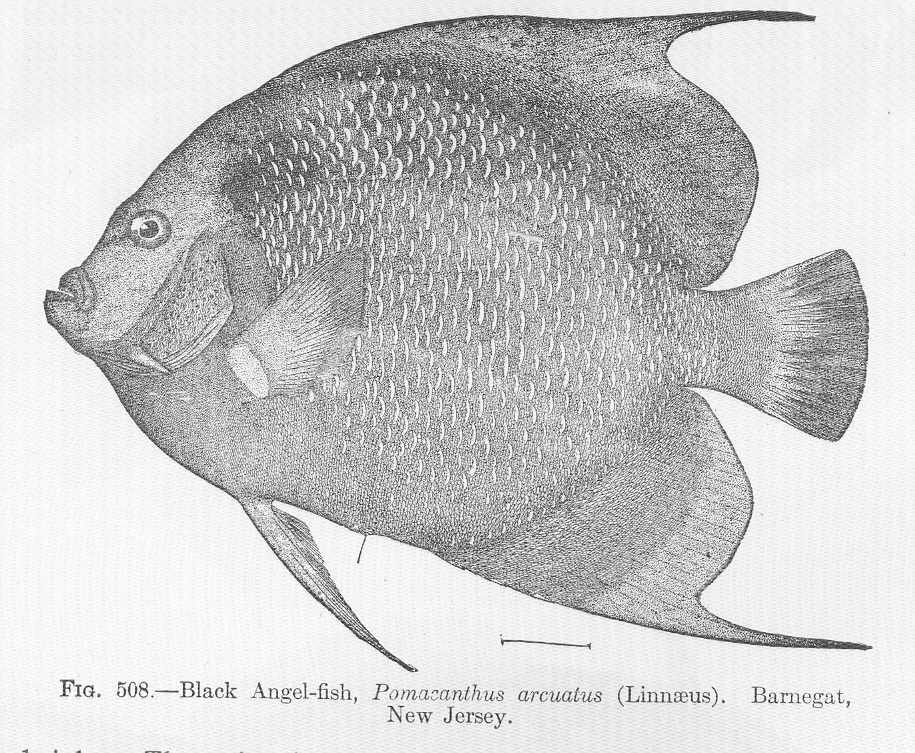
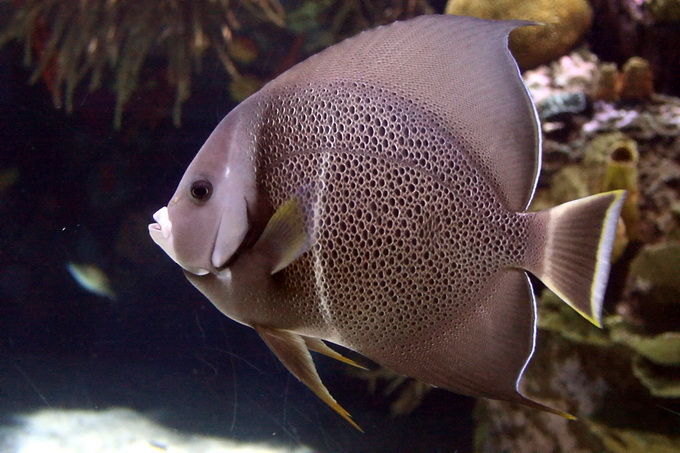
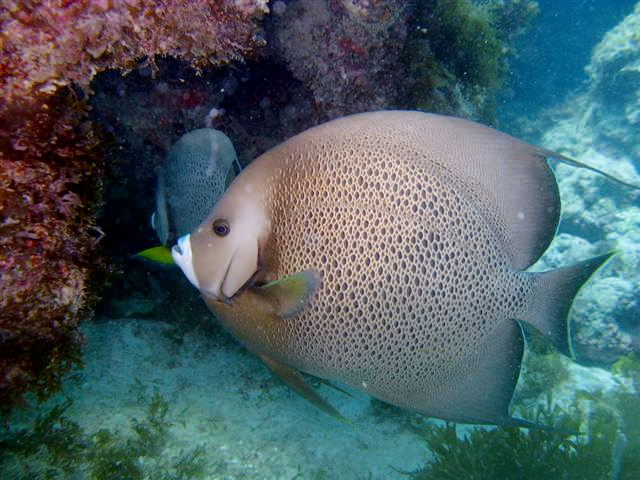
This fish has a disk-shaped, compressed body with a large head and a small snout. At the tip of the snout sits a mouth filled with tiny, bristle-like teeth. A sizable spine marks the corner of the preoperculum, which has a smooth vertical edge. Juveniles display a black body with five vertical yellow stripes—three on the head and two on the body—and a black blotch on the caudal fin that may be elongated or rectangular. Adults are pale gray and covered in black spots, with a plain gray head and a white mouth. The dorsal and anal fins often feature elongated streamers. The dorsal fin has 9 spines and 31–33 soft rays, while the anal fin has 3 spines and 23–25 soft rays. Maximum total length reaches 60 centimeters (24 inches).
The gray angelfish inhabits depths between 3 and 30 meters (9.8 to 98.4 feet) over coral and rocky reefs. Juveniles prefer shallow patch reefs and seagrass beds.
A diurnal species, it hides in the reef at night. Its diet consists mainly of sponges, but it also eats algae, tunicates, zoantharians, gorgonians, hydroids, and bryozoans. Juveniles act as cleaner fish, setting up cleaning stations where larger fish visit to have their ectoparasites removed and consumed.
Quick Facts
- Taxon
- Pomacanthus arcuatus
Facts from the source article.
Lore & Background
The gray angelfish was first formally described in 1758 as Chaetodon arcuatus by Carolus Linnaeus in the 10th Edition of his Systema Naturae, with the type locality given as 'Indiis'. When Lacépède created the genus Pomacanthus, he used Linnaeus's Chaetodon arcuatus as its type species. When Pomacanthus is subdivided into subgenera, this species is placed in the subgenus Pomacanthus. The specific name arcuatus means 'bowed', referring to the curved lines on the body.
Juveniles have a black body marked with five vertical yellow stripes, three on the head and two on the body, and the caudal fin has a black blotch which can be elongated or rectangular. Adults are pale grayish in color and covered in black spots, with a plain pale gray head and white mouth. The dorsal and anal fins frequently show elongated streamers.
The gray angelfish is found in the Western Atlantic Ocean from New York to Rio de Janeiro, though it is typically not found north of Florida during the winter. Its range extends to all of the Caribbean Sea and the Gulf of Mexico. It has been introduced to Bermuda from the Bahamas.
Reader's Guide
The gray angelfish is a popular fish in the aquarium trade, with specimens entering the trade from Florida throughout the year. Between 1995 and 2000 over 12,000 fish of this species entered the trade, which originated in Brazil. The species has been bred in captivity. It is also caught in some areas for food. The consumption of gray angelfish is known to occasionally cause ciguatera poisoning, though the risk is considered low. Ecologically, the species is diurnal, hiding in the reef at night, and mainly feeds on sponges, also recorded feeding on algae, tunicates, zoantharians, gorgonians, hydroids, and bryozoans. Juveniles act as cleaner fish, establishing a cleaning station visited by larger fishes for the removal of ectoparasites. In the northern parts of its range, spawning occurs from April to September, above deep reefs during early morning, with females releasing between 25,000 and 75,000 eggs per event. The eggs are pelagic and hatch after 15–20 hours, with larvae living among plankton until about 15 mm in length before settling on the reef.
Did You Know?
- The gray angelfish is known in Jamaica as the pot cover.
- It was originally described by Linnaeus in 1758 as Chaetodon arcuatus.
- Juveniles act as cleaner fish, establishing cleaning stations for larger fishes.
- Females can release between 25,000 and 75,000 eggs per spawning event.
Taxonomy & Physical Form
The French angelfish was first formally named by Marcus Elieser Bloch, a German physician and naturalist. Bloch assigned the binomial Chaetodon paru, citing Brazil and Jamaica as the type locality. The specific epithet 'paru' derives from the Portuguese name for the fish, and several authorities now place the species within the subgenus Pomacanthus.
Physically, the fish has a deep yet strongly compressed body, appearing flattened when viewed head-on. The head is broad with a short snout ending in a small mouth packed with bristle-like teeth. A single spine marks the preoperculum corner, while the operculum and subocular region remain spineless. The dorsal fin carries ten spines and twenty-nine to thirty-one soft rays; the anal fin holds three spines and twenty-two to twenty-four soft rays. Adults reach roughly forty-one centimetres, males edging slightly larger than females. Both sexes display a dark grey to black body studded with vivid yellow scale tips, a white mouth, and a yellow eye-ring. The pectoral fins bear a broad orange-yellow band, and the dorsal fin extends a long filamentous yellow projection. Juveniles, by contrast, are nearly jet black interrupted by five vertical yellow stripes running the full body height.
Range, Habitat & Daily Rhythm
The French angelfish inhabits a broad swath of the western Atlantic, stretching from Florida through the Gulf of Mexico and southward along the Brazilian coast and throughout the Caribbean, including the Antilles and Roatan. Its range also extends into the eastern Atlantic, where it has been recorded around Ascension Island and St. Paul's Rocks.
In terms of depth, the species is most commonly encountered in shallower waters above roughly four and a half metres, though it has also been reported from the mesophotic zone, a band spanning thirty to one hundred and fifty metres. The fish favours coral reefs and rocky shorelines, where it is typically seen in pairs, often lingering near sea fans.
These are diurnal animals, active throughout the daylight hours and retreating each night to a designated hiding spot. When startled, a French angelfish can produce a distinctive knocking sound. The species is described as slow-growing, and analysis of otoliths—specifically the opaque bands that form on the sagittae with each year of growth—has revealed that the oldest individual examined in a 2016 study was twenty-seven years old.
Feeding Ecology & the Juvenile Cleaner Role
Adult French angelfish are heavily specialised spongivores, with sponges making up roughly seventy percent of their diet. Their comb-like teeth are well adapted for grinding sponge tissue into manageable pieces. Beyond sponges, adults also consume algae, bryozoans, zoantharians, gorgonians, hydroids, coral, and tunicates.
Juveniles, however, follow a very different ecological niche. Young fish feed primarily on ectoparasites, mucus, dead tissue, and other undesirable particles removed from the bodies of larger fish. As a result, they spend a substantial portion of their time hovering at or near cleaning stations. In the Caribbean, certain patches of the seafloor serve as shared cleaning stations where multiple cleaner-fish species coexist, and young green sea turtles also visit to be cleaned. At these stations, juvenile French angelfish specialise in cleaning the turtles' heads, carapace, and plastron.
Documented clients of the juvenile cleaner include jacks, snappers, morays, grunts, surgeonfishes, and wrasses. As juveniles grow larger, their diet shifts: they begin incorporating more sponge species—around twelve to fifteen—mirroring the adult diet. This demonstrates a direct relationship between juvenile size and the proportion of sponges consumed.
Reproduction, Social Life & Parasitology
French angelfish form monogamous pairs, a notable distinction from their closest relative, the grey angelfish, which mates in polygamous groups. There is no obvious courtship display and no clear sexual dimorphism between the sexes. Mating behaviour has been observed only rarely, and every recorded instance occurred around dusk.
The observed ritual involves the pair swimming upward in a wide, shallow curve from the substrate, travelling roughly seven to ten metres horizontally while climbing two to three metres. As they ascend, both angle their bodies slightly, keeping their vents extremely close, even touching. They hold this posture at the apex of the curve before separating on the descent. Neighbouring pairs performed similar movements at roughly the same time, yet no interference was noted. Observers could not confirm whether gametes were actually released during these displays.
The species is a protogynous hermaphrodite: a female can transition to male if no male is present. Pairs are highly territorial, with both members vigorously defending their area from neighbours. In a captive specimen in Georgia, researchers found endoparasites of the genus Enterogyrus attached perpendicularly to foregut folds—an unusual mode of attachment.
Gallery
Frequently Asked Questions
What is Pomacanthus arcuatus?
The gray angelfish is a ray-finned marine angelfish native to the Western Atlantic Ocean, a member of the family Pomacanthidae. In Jamaica, locals give it the colorful common name "pot cover."
Why is Pomacanthus arcuatus significant in fish taxonomy?
It holds the role of type species for the entire genus Pomacanthus, meaning every other species in that genus is defined in relation to it. That foundational status traces back to Carolus Linnaeus's original 1758 description.
How big does Pomacanthus arcuatus get and what does its dorsal fin look like?
Adults can reach a maximum total length of roughly 60 centimeters (about 24 inches). The dorsal fin is elongated, carrying 9 spines followed by 31 to 33 soft rays.
Where does Pomacanthus arcuatus live and at what depths?
This species is found throughout the Western Atlantic Ocean, typically occupying depths between about 3 and 30 metres (roughly 10 to 98 feet).
Who first described Pomacanthus arcuatus and under what name?
Carolus Linnaeus formally described the fish in the 10th edition of Systema Naturae in 1758, originally publishing it under the name Chaetodon arcuatus. He recorded the type locality as "Indiis," even though the species is in fact a Western Atlantic resident.
More in Marine Angelfish, Part 3 1-24
Spotted an error? Know more?
Reader corrections go straight into our review queue. Suggest an edit · How this site is sourced