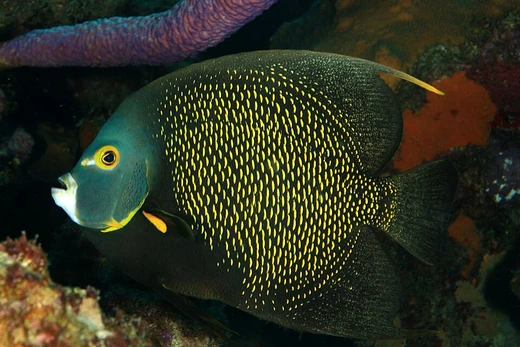
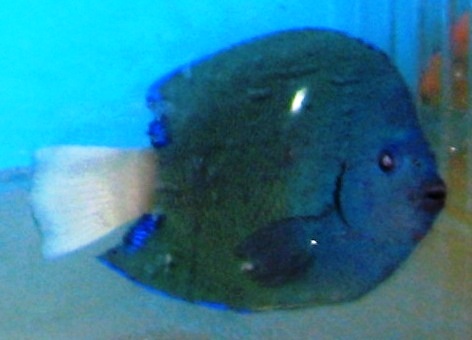
Holacanthus limbaughi
A rare angelfish endemic to remote Clipperton Island.

Pacific Southwest Region USFWS from Sacramento, US · Public domain
The Clipperton angelfish (Holacanthus limbaughi) is a species of marine ray-finned fish in the family Pomacanthidae, endemic to Clipperton Island in the eastern Pacific Ocean. It is notable for its extremely restricted distribution and its rarity in the aquarium trade, where it has commanded very high prices.
Quick Facts
- Taxon
- Holacanthus limbaughi
Facts from the source article.
Lore & Background
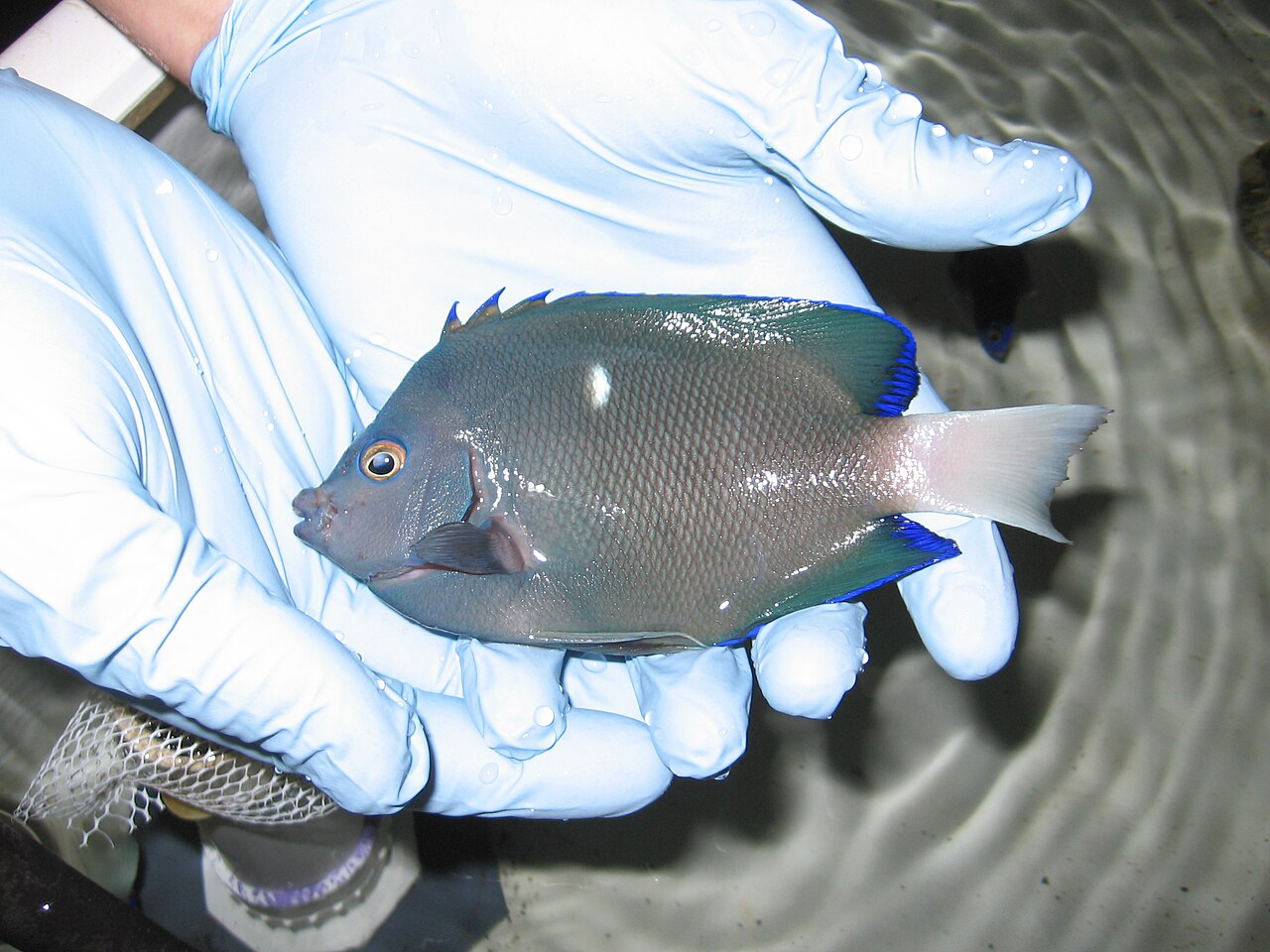
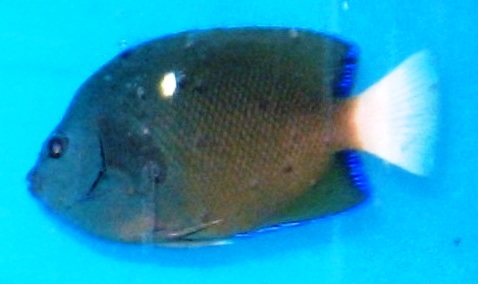
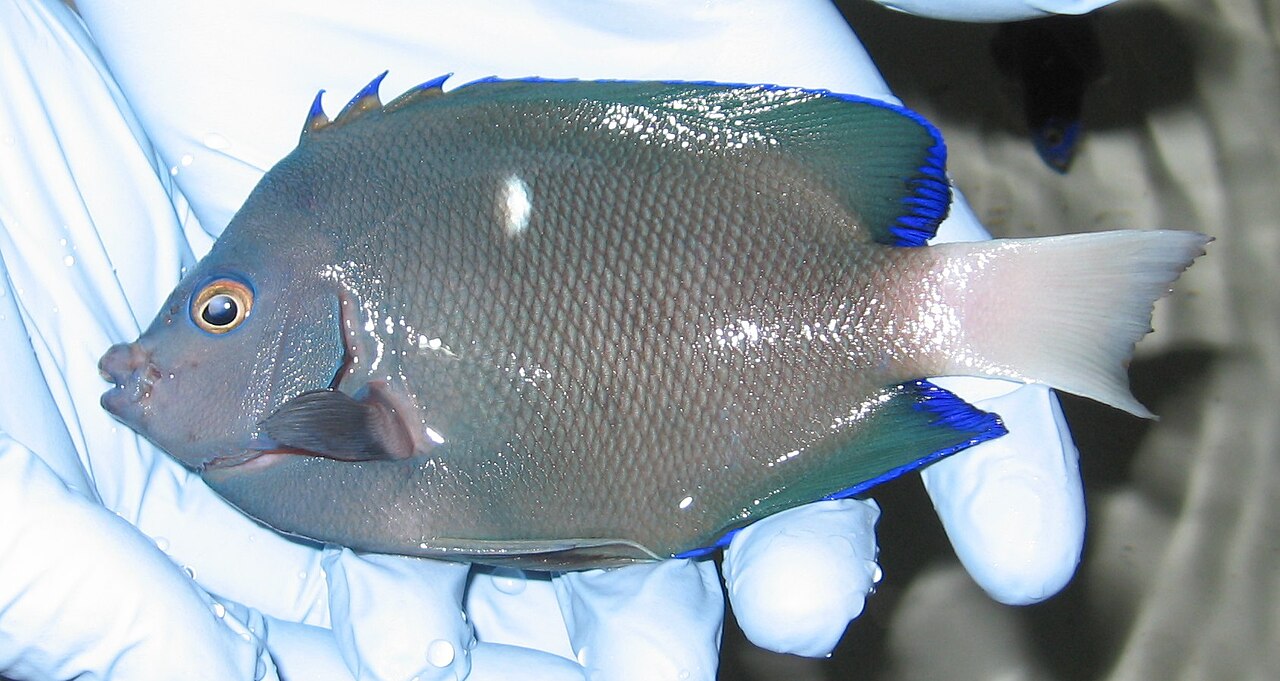
The Clipperton angelfish has a deep, laterally compressed body with a small mouth and bristle-like teeth. Its preoperculum bears a sizeable spine at the corner and a serrated rear margin, with four spines between the preoperculum and operculum. Juveniles are dark bluish-grey with vertical blue bars—two on the head and five on the flanks—that fade as they mature, along with a white spot on the upper side and white caudal and pectoral fins. Adults lack the barring and have vivid blue margins on the dorsal, anal, and pelvic fins.
The species was first formally described in 1963 by American ichthyologist Wayne J. Baldwin. Its specific name honors Conrad Limbaugh, an American scuba diver, zoologist, and underwater photographer who played a vital role in collecting the type specimen. Very little is known about its habitat preferences and biology.
Reader's Guide
The Clipperton angelfish is significant primarily due to its extreme endemism—it is found only in the waters of Clipperton Island, a French possession 2,560 kilometres west of Costa Rica. This remote distribution makes it one of the most geographically restricted marine angelfish species. Its scarcity in the aquarium trade is a direct consequence of this isolation; when specimens have appeared, they have commanded very high prices. A notable incident in 2009 involved a California tropical fish dealer who attempted to smuggle 52 illegally collected Clipperton angelfish into the United States by falsely declaring them as king angelfish, intending to sell each for $10,000. This event underscores both the species' desirability and the legal challenges surrounding its collection. The species' biology remains poorly understood, with only depth range (6 to 100 metres) documented.
Did You Know?
- In 2009, a dealer tried to smuggle 52 illegally collected specimens into the U.S., falsely declaring them as king angelfish.
- The species attains a maximum total length of 30 centimetres (12 in).
Physical Form and the Journey from Juvenile to Adult
The Clipperton angelfish presents a strikingly deep and laterally compressed silhouette, a body shape that speaks to its life among reef structures. Its small mouth is armed with bristle-like teeth, while the preoperculum bears a prominent spine at its corner alongside a serrated rear edge. Four additional spines sit in the gap between the preoperculum and the operculum, adding to the fish's armored appearance. Young specimens wear a dark bluish-grey coat broken by vertical blue bars—two across the head and five along the flanks—along with a pale spot on the upper flank and clean white caudal and pectoral fins. As these bars gradually fade with maturity, adults reveal a different palette: vivid blue edging traces the dorsal, anal, and pelvic fins, giving the fish a luminous outline. The dorsal fin carries fourteen spines backed by seventeen or eighteen soft rays, while the anal fin mirrors this with three spines and a similar count of soft rays. At its largest, the species reaches a total length of thirty centimetres, roughly twelve inches.
A Species Bound to a Single Remote Island
Few marine species are as geographically constrained as the Clipperton angelfish. This member of the family Pomacanthidae is found nowhere else on Earth except the waters surrounding Clipperton Island, a small French overseas territory sitting in the eastern Pacific Ocean. The island lies a staggering 2,560 kilometres—nearly 1,590 miles—due west of Costa Rica, placing it in one of the most isolated stretches of open ocean on the planet. Within that narrow range, the angelfish occupies a depth band from six to one hundred metres, roughly twenty to three hundred and twenty-eight feet below the surface. Despite this known depth window, scientists acknowledge that very little is understood about the species' specific habitat preferences or broader biological behaviour. The combination of extreme remoteness, a single-island range, and a lack of detailed ecological data makes the Clipperton angelfish one of the least-studied marine angelfishes in the Pacific, a ghostly resident of waters that few humans ever visit.
Discovery and the Man Behind the Name
The Clipperton angelfish entered the scientific record in 1963, when the American ichthyologist Wayne J. Baldwin produced its first formal description. The species' specific epithet, limbaughi, was chosen to honour Conrad Limbaugh, an American scuba diver, zoologist, and underwater photographer who lived from 1925 to 1960. Limbaugh played a vital role in the collection of the type specimens that made Baldwin's description possible, meaning the fish bears the name of a man who had already passed away by the time the species was officially recognised. This naming tribute connects the angelfish to the broader era of mid-twentieth-century underwater exploration, when divers and naturalists working together in remote Pacific locations brought countless previously unknown marine organisms to the attention of the scientific community. That the type material came from such a logistically challenging location—thousands of kilometres from the nearest major coastline—underscores how much of the ocean's biodiversity was still being catalogued in the early 1960s.
A Prize Too Rare for the Aquarium Trade
Because the Clipperton angelfish is confined to the waters around a single remote island, it is extraordinarily scarce in the aquarium trade. On the rare occasions when specimens have surfaced in that market, they have commanded exceptionally high prices, reflecting both their beauty and their near-impossible logistics. The species' notoriety in the trade reached a dramatic peak in 2009, when a California-based tropical fish dealer was caught attempting to smuggle fifty-two illegally collected Clipperton angelfish into the United States. To federal wildlife authorities, the dealer had falsely declared the fish as king angelfish, a common and legal species, in an effort to slip the shipment past inspection. The intended retail price was a staggering ten thousand dollars per fish, a figure that speaks to the extreme demand among collectors for a species that essentially cannot be sustainably sourced. The incident highlighted both the vulnerability of a single-island endemic to poaching and the lengths to which the commercial aquarium trade will go to exploit even the most geographically restricted marine species.
Gallery
Frequently Asked Questions
What is Holacanthus limbaughi?
Holacanthus limbaughi, commonly called the Clipperton angelfish, is a marine ray-finned fish in the family Pomacanthidae. It is found exclusively in the waters around Clipperton Island in the eastern Pacific, making it one of the most geographically restricted angelfish species known.
Where does Holacanthus limbaughi live?
This species is endemic to Clipperton Island, a remote atoll in the open eastern Pacific Ocean. Its entire known range is limited to the waters surrounding that single island, which is why it is regarded as one of the most range-restricted marine angelfish.
How large does Holacanthus limbaughi grow?
Adults reach a maximum total length of about 30 centimetres (roughly 12 inches). That places it in the moderate size range for the genus Holacanthus, smaller than some of its more widespread relatives.
Why does Holacanthus limbaughi command such high prices in the aquarium trade?
Because the fish is confined to a single remote island in the open Pacific, sourcing specimens is logistically difficult and the total available population is inherently tiny. This extreme scarcity pushes retail and auction prices far above those of more widely distributed angelfish species.
At what depth does Holacanthus limbaughi occur?
Individuals have been recorded from roughly 6 metres down to about 100 metres (20 to 328 feet). That range spans shallow reef habitats as well as deeper offshore waters around Clipperton Island.
More in Marine Angelfish, Part 3 1-24
Spotted an error? Know more?
Reader corrections go straight into our review queue. Suggest an edit · How this site is sourced