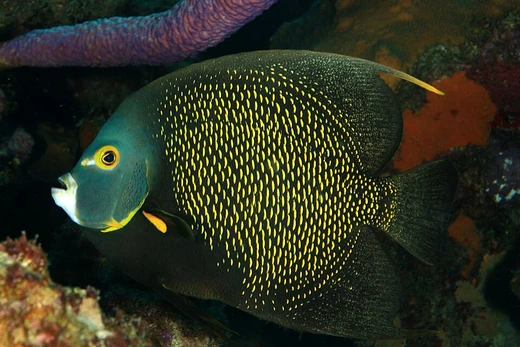
Arabian angelfish
A shy, solitary angelfish of the western Indian Ocean.

Rob · CC BY 2.0
The Arabian angelfish (Pomacanthus asfur) is a species of marine ray-finned fish belonging to the family Pomacanthidae. It is notable for its striking color transformation from juvenile to adult, and for being a protogynous hermaphrodite.
Quick Facts
- Taxon
- Pomacanthus asfur
Facts from the source article.
Lore & Background
Pomacanthus asfur was first formally described in 1775 by Danish zoologist Johan Christian Fabricius, though it has commonly been attributed to Peter Forsskål. The type locality is Al-Luhayya, Yemen, and the specific name 'asfur' is the species' Arabic name in Yemen. Some authorities place it in the subgenus Arusetta, of which it is the type species.
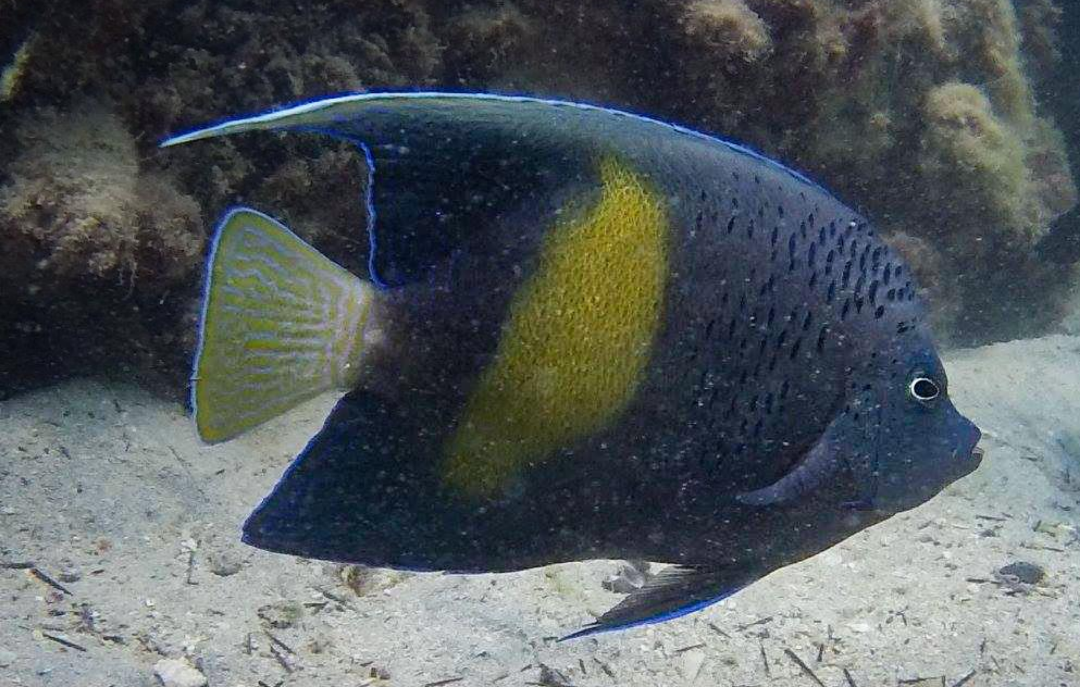
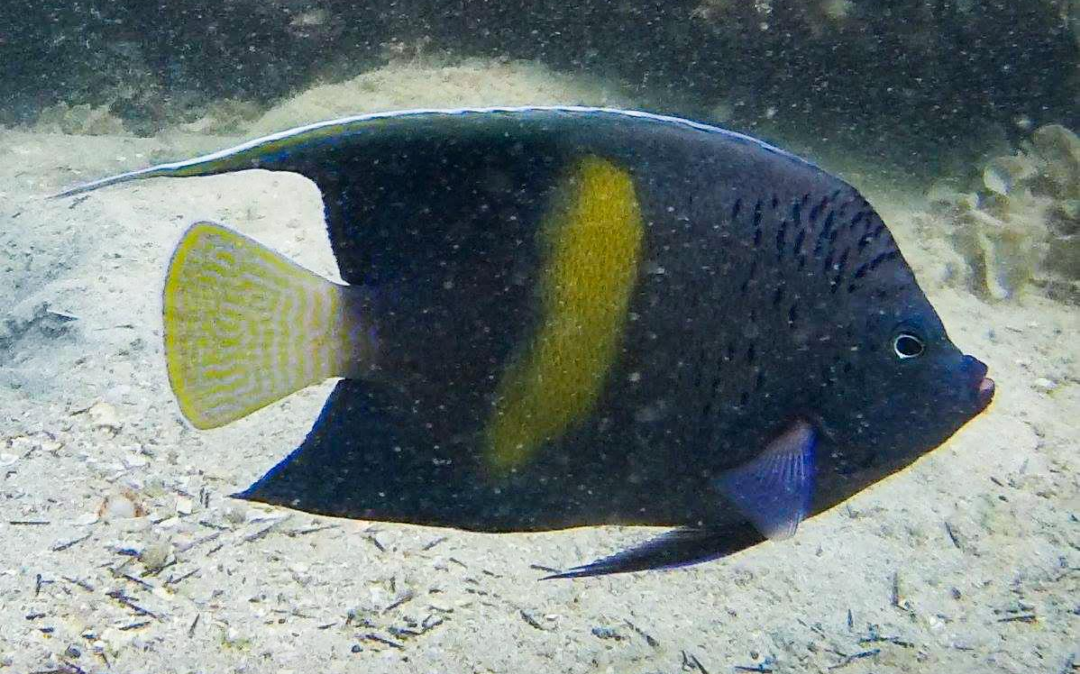
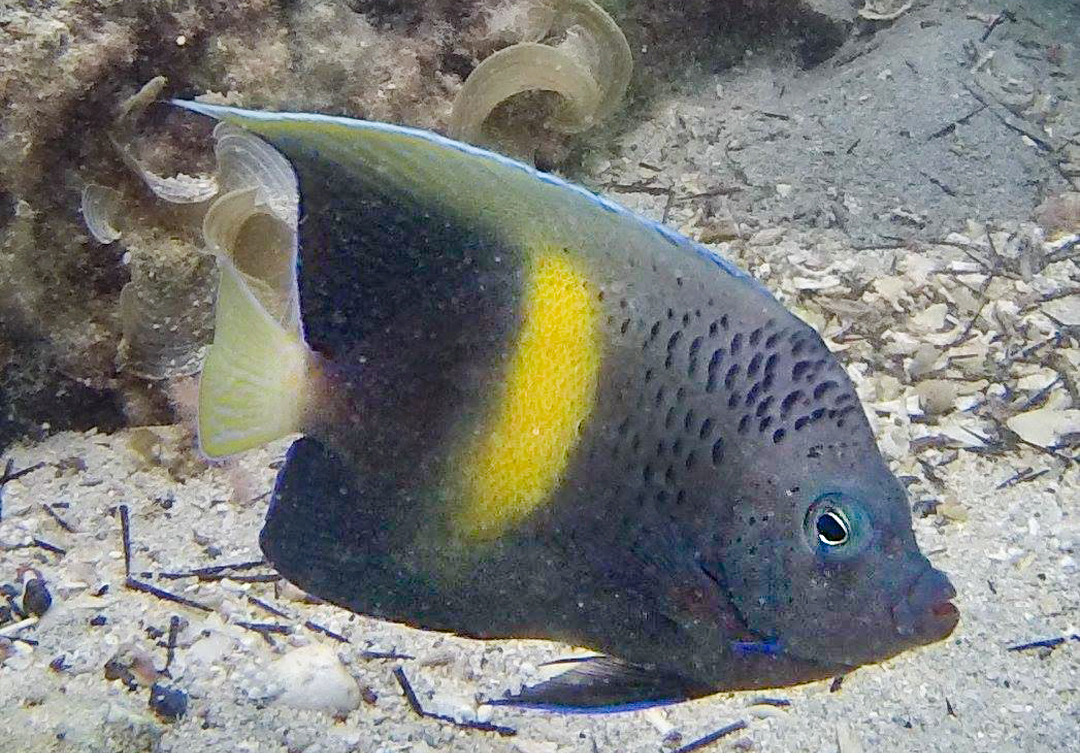
Juveniles have a blue body with pale-blue and white stripes. As they mature, yellow markings appear on the dorsal and caudal fins. Fully mature adults have an overall dark blue body with a blackish face, a yellow caudal fin, and a broad crescent-shaped yellow band vertically across the flanks. It attains a maximum total length of 40 cm.
The species is found in the western Indian Ocean, including the Red Sea, Gulf of Aden, eastern Africa as far south as Zanzibar, and the Persian Gulf. It has been recorded off Florida and Malta, likely from aquarium releases, and several specimens have been observed in Mediterranean waters of Israel and Lebanon. It inhabits depths between 3 and 30 metres, preferring sheltered inshore reefs with rich coral growth and silty seabed patches. Its diet is dominated by sponges and tunicates. It is a solitary, shy fish, normally recorded near caves or crevices, and is a protogynous hermaphrodite—larger fish in a pair change sex to become male.
Reader's Guide
The Arabian angelfish is infrequently found in the aquarium trade, though it has been bred in captivity, with captive-bred specimens sometimes marketed as 'half-moon angelfish'. Its shy and solitary nature makes it difficult for divers to approach, and it is typically recorded near caves or crevices on reefs. The species' protogynous hermaphroditism—where larger fish change sex to male—is a notable biological trait. Its presence in the Mediterranean and off Florida is attributed to probable releases of aquarium specimens, indicating human-mediated dispersal. The species' description history involves a dispute: first formally described in 1775 by Fabricius but commonly attributed to Forsskål. Its Arabic name in Yemen, 'asfur', is preserved in its scientific name. The species plays a role in reef ecosystems as a sponge and tunicate feeder, and its striking adult coloration—dark blue with a yellow crescent band—makes it visually distinctive.
Did You Know?
- Juveniles have blue bodies with pale-blue and white stripes, while adults are dark blue with a yellow crescent band.
- Its specific name 'asfur' is the Arabic name for this species in Yemen.
Appearance and Taxonomic Identity
The orangeback angelfish is a small marine ray-finned fish within the family Pomacanthidae, reaching a maximum total length of just 8 centimetres. Its colouration is striking and clearly divided: the head, upper flanks, dorsal fin, and caudal fin all glow in golden yellow, while the lower flanks and anal fin are black, densely peppered with purple spots. A vivid blue ring encircles each eye, adding a final accent to an already bold palette. Locally in South Africa, this little fish is affectionately called the Jumping Bean or simply the Bean, while other common names include flameback angelfish and African pygmy angelfish. Taxonomically, the species was first formally described in 1922 by English ichthyologist John Roxborough Norman under the name Holacanthus acanthops, with Durban designated as the type locality. The specific epithet acanthops is a Greek compound—acanthus meaning spine and ops meaning eye—pointing to a small rearward-directed spine situated beneath the eye. In certain modern classifications, the species is further nested within the subgenus Xiphipops.
Geographic Range and Habitat Preferences
The orangeback angelfish is a resident of the western Indian Ocean, with a distribution that stretches from the East African mainland coast—beginning at Somalia and extending southward to East London in the Eastern Cape Province—across a chain of island groups including Madagascar, the Seychelles, the Comoros, the Chagos Islands, and the Mascarene Islands. Its range also reaches into the Arabian Sea region, with records from the Gulf of Aden, the waters off Yemen including Socotra, Oman, and the Maldives. A single Australian territory, the Cocos (Keeling) Islands, also falls within its known range. In terms of vertical habitat, this species occupies depths from just 1 metre down to 70 metres, though it is most often encountered near living coral or in zones of broken coral rubble, where it favours tucking itself among the debris for shelter. Dense algal growth is a key feature of its preferred environment, as the fish feeds primarily by grazing on algae and supplementing its diet with small invertebrates.
Social Structure and Reproductive Biology
Unlike many solitary reef fish, the orangeback angelfish is a notably social species, typically observed in groups of up to ten individuals. Its reproductive biology adds another layer of complexity: the species is a protogynous hermaphrodite, meaning every individual begins life as a female. Within a group, the most dominant female will transition into a male, assuming the reproductive role of the group's breeding male. Remarkably, this sex change is not permanent; if the individual subsequently loses its dominant position, it can revert back to female status. Spawning events occur at dusk. During the act, the male stimulates the female to release her eggs by biting her on the abdomen. He then fertilises the released eggs, which are not guarded or attached to any substrate. Instead, the fertilised eggs are simply released into the water column and left to drift on the current, a pelagic strategy shared by many reef-dwelling fish.
Aquarium Trade and Scientific Legacy
The orangeback angelfish has found a second life outside its natural reefs through the aquarium trade, where it is both common and popular among hobbyists. Its small size, bold colouration, and manageable group behaviour make it an appealing choice for reef aquariums, and the species has been successfully bred in captivity, reducing the need for wild-caught specimens. On the scientific front, the fish's formal description in 1922 by John Roxborough Norman, an English ichthyologist who lived from 1898 to 1944, established its place in the taxonomic record. Norman designated Durban, on the South African coast, as the type locality. The name he chose, Holacanthus acanthops, carries a morphological clue: the specific epithet combines the Greek words acanthus (spine) and ops (eye), a direct reference to the small rearward-pointing spine located beneath the eye. Over the decades, taxonomic revisions have occasionally repositioned the species, with some authorities placing it within the subgenus Xiphipops, reflecting ongoing refinements in how angelfish lineages are understood.
Gallery
Frequently Asked Questions
What is the Arabian angelfish?
The Arabian angelfish (Pomacanthus asfur) is a marine ray-finned fish in the family Pomacanthidae, native to the western Indian Ocean. It is best known among reef enthusiasts for its dramatic color shift between juvenile and adult life stages.
What makes the Arabian angelfish's biology stand out?
It is a protogynous hermaphrodite, meaning every individual begins life as a female and can later transition to a male. Coupled with its striking juvenile-to-adult color transformation, this makes it one of the most visually and biologically fascinating members of the angelfish family.
How large does an Arabian angelfish grow and where does it live?
Adults reach a maximum total length of about 40 cm (16 in). They inhabit depths ranging from roughly 3 to 30 metres (about 10 to 98 ft) in the western Indian Ocean.
What is the fin structure of the Arabian angelfish?
The dorsal fin carries 12 spines followed by 19–20 soft rays, while the anal fin has 3 spines and 19–20 soft rays. This symmetrical spiny-then-soft arrangement is typical of pomacanthids but gives the Arabian angelfish a distinctive silhouette.
What is the Arabian angelfish like in terms of temperament and social behavior?
It is described as a shy and solitary species, rarely seen in groups and often observed alone near reef structures. This reclusive nature makes it a prized but elusive sight for divers exploring western Indian Ocean reefs.
More in Marine Angelfish, Part 3 1-24
Spotted an error? Know more?
Reader corrections go straight into our review queue. Suggest an edit · How this site is sourced