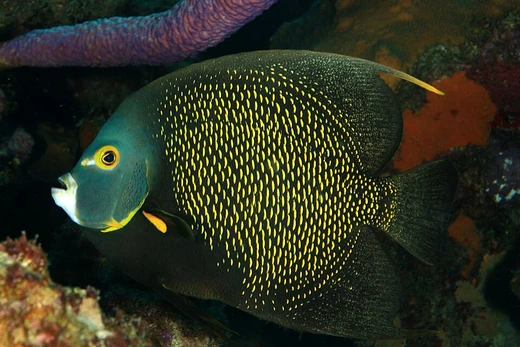
Holacanthus isabelita
A former species now considered a synonym of the blue angelfish.

Cliff from Arlington, Virginia, USA · CC BY 2.0
Holacanthus isabelita is a species of marine angelfish in the family Pomacanthidae, originally described as a separate species but now regarded as a synonym of Holacanthus bermudensis, the blue angelfish. Its holotype was designated as the neotype for Holacanthus bermudensis, making it notable in the taxonomic history of the species.
Quick Facts
- Genus
- Holacanthus
- Species
- bermudensis
Facts from the source article.
Lore & Background
Holacanthus isabelita was described by David Starr Jordan and Cloudsley Louis Ritter, with the type locality given as Key West, Florida. Its holotype later became the neotype for Holacanthus bermudensis, as set out in the Official List of Specific Names in Zoology (ICZN, Opinion 2003). This species was formerly considered distinct but is now regarded as a synonym of Holacanthus bermudensis.
Reader's Guide
Holacanthus isabelita holds significance primarily in taxonomic history, as its holotype was used to replace the syntypes of Holacanthus bermudensis. The species frequently hybridizes with the sympatric queen angelfish (Holacanthus ciliaris). Its description as a separate species reflects earlier taxonomic uncertainty that has since been resolved. The blue angelfish, under which H. isabelita is now subsumed, is a benthic, diurnal species found in the western Atlantic from North Carolina to Bermuda, the Bahamas, Florida, the Gulf of Mexico, Yucatan, Puerto Rico, and the Virgin Islands. It lives close to the seabed among sponges, coral, or rock at depths between 2 and 93 meters. Adults are typically encountered in pairs and are thought to be monogamous. The species is not commercially important but is common in the aquarium trade.
Did You Know?
- Its type locality is Key West, Florida.
- The holotype of H. isabelita was designated as the neotype for Holacanthus bermudensis.
Taxonomic Roots & Deep Lineage
The queen angelfish entered the scientific record in 1758 when Carl Linnaeus catalogued it under the name Chaetodon ciliaris in the tenth edition of his Systema Naturae, assigning it to the broad Western Atlantic and Caribbean region. French naturalist Bernard Germain de Lacépède later reassigned it to the genus Holacanthus in 1802, a name drawn from Ancient Greek words meaning "full" and "spine." The species epithet ciliaris, translating to "fringed," nods to the ciliate scales covering its body. Molecular evidence suggests the Holacanthus lineage first diverged between 10.2 and 7.6 million years ago, with the West African Guinean angelfish standing as the earliest branch, implying the group originally colonized the Atlantic from the Indian Ocean. The closure of the Isthmus of Panama roughly 3.5 to 3.1 million years ago isolated Pacific populations. The queen angelfish's closest living relative is the sympatric Bermuda blue angelfish, from which it separated approximately 1.5 million years ago. Remarkably, the two still interbreed, producing the fertile Townsend angelfish, a hybrid that can itself mate with either parent species.
Body Plan & Unusual Color Morphs
The adult queen angelfish presents a broad, laterally compressed oval body capped by a triangular caudal fin, with a short, blunt snout and a small mouth lined with bristle-like teeth. Its dorsal fin carries fourteen spines alongside nineteen to twenty-one soft rays, while the anal fin bears three spines and twenty to twenty-one soft rays, both trailing behind the body. The species reaches a maximum of 45 centimetres and 1,600 grams, with males tending to outsize females. Coloration is striking: blue-green scales tipped in yellow, vividly yellow tail, pectoral, and pelvic fins, orange-yellow tips on the dorsal and anal fins, and blue patches at the pectoral bases. The forehead bears the species' signature "crown"—a cobalt-blue ocellus ringed in electric blue and sprinkled with electric-blue dots, the single feature that separates it from the Bermuda blue angelfish. Juveniles appear entirely different, dark blue with bright vertical stripes and a yellow pectoral zone. Off Brazil's Saint Peter and Saint Paul Archipelago, seven additional color morphs have been documented, ranging from a dominant gold-orange form to all-white individuals. A cobalt-blue morph with white and yellow-orange patches was recorded off Dry Tortugas, Florida, in 2009.
Harem Life & Reproductive Rhythm
The social world of the queen angelfish revolves around a single dominant male who holds a large territory and maintains a harem of two to four females. The species is presumed to be protogynous, meaning individuals likely begin life as females; if the territorial male vanishes, the largest female in the group may undergo a sex change to assume his role. During the midday foraging period, each female ranges out independently to different spots, while the male shuttles between them, rushing toward her, circling, and feeding in her presence. Spawning takes place year-round but is timed around the full moon. Courtship involves the male displaying his flank to the female and flicking his pectoral fins. The resulting eggs are transparent and buoyant, drifting in the water column until they hatch. Juveniles emerge in a dark-blue, vertically striped form that bears little resemblance to the adults, and they spend their early months serving as cleaner fish, picking ectoparasites from the gills and bodies of larger reef residents before gradually developing transitional patterns on the road to adult coloration.
Sponge Specialists & Reef Ecology
Queen angelfish are benthic residents of coral reefs throughout the tropical and subtropical Western Atlantic, ranging from Florida and the Gulf of Mexico through the Caribbean down to Brazil, and extending eastward to Bermuda and the remote Saint Peter and Saint Paul Archipelago. They occupy depths from the shallow shore zone to roughly 70 metres, favouring soft-coral habitats and moving either singly or in pairs. Their diet is dominated by sponges: off St. Thomas and Salvador, Bahia, sponges constitute about 90 percent of adult intake, while at the Saint Peter and Saint Paul Archipelago they consume over thirty prey species, with sponges at 68 percent, algae at 25 percent, and bryozoans at 5 percent. Crucially, they are selective feeders—the proportion of any prey in their diet does not track its local abundance. At the archipelago they specifically target rarer sponge species such as Geodia neptuni, Erylus latens, Clathria calla, and Asteropus niger. Beyond sponges, their menu includes tunicates, jellyfish, corals, plankton, and algae. The species is a staple of the aquarium trade and has been a particularly common export from Brazil, yet the 2010 IUCN assessment rated wild populations as stable, listing them as least concern.
Gallery
Frequently Asked Questions
What is Holacanthus isabelita?
It is a name once applied to a marine angelfish in the Pomacanthidae family, based on a specimen collected off Key West, Florida. Modern taxonomy treats it as a synonym of the blue angelfish (Holacanthus bermudensis) rather than a distinct species.
Who originally described Holacanthus isabelita?
The name was coined by ichthyologists David Starr Jordan and Cloudsley Louis Ritter, who used a Key West, Florida specimen as the type for what they considered a new species.
Why isn't Holacanthus isabelita recognized as its own species anymore?
Taxonomists concluded it was simply another name for Holacanthus bermudensis, the blue angelfish. Its holotype was subsequently designated as the neotype for H. bermudensis, anchoring the blue angelfish's identity in the taxonomic record.
What does the blue angelfish eat in the wild?
Sponges make up the bulk of its diet, and it supplements that with tunicates, coral polyps, and algae on occasion.
How large can the blue angelfish grow and what depths does it occupy?
Adults can reach roughly 45 cm (18 in) in total length. They have been recorded at depths from about 2 m down to 93 m (6.6–305 ft), so they span a surprisingly wide vertical range in the water column.
More in Marine Angelfish, Part 3 1-24
Spotted an error? Know more?
Reader corrections go straight into our review queue. Suggest an edit · How this site is sourced