Holacanthus passer
A large eastern Pacific angelfish with striking color changes and ecological importance.

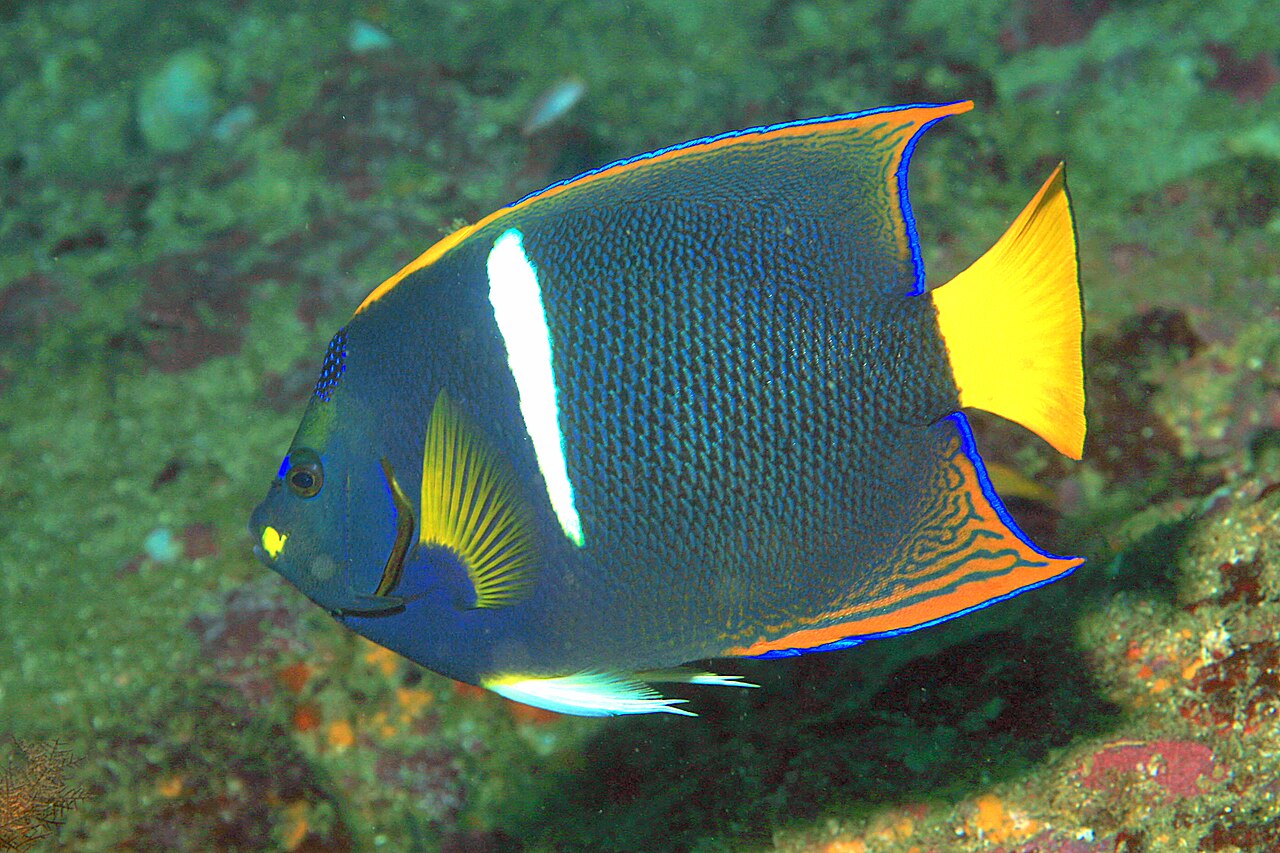
keesgroenendijk · CC BY-SA 4.0
The king angelfish, also called the passer angelfish, is a large, reef-dwelling marine angelfish belonging to the family Pomacanthidae. It lives in the eastern Pacific Ocean, from Peru north to the Gulf of California and out to the Galapagos, typically at depths between 4 and 30 meters. It does not migrate.
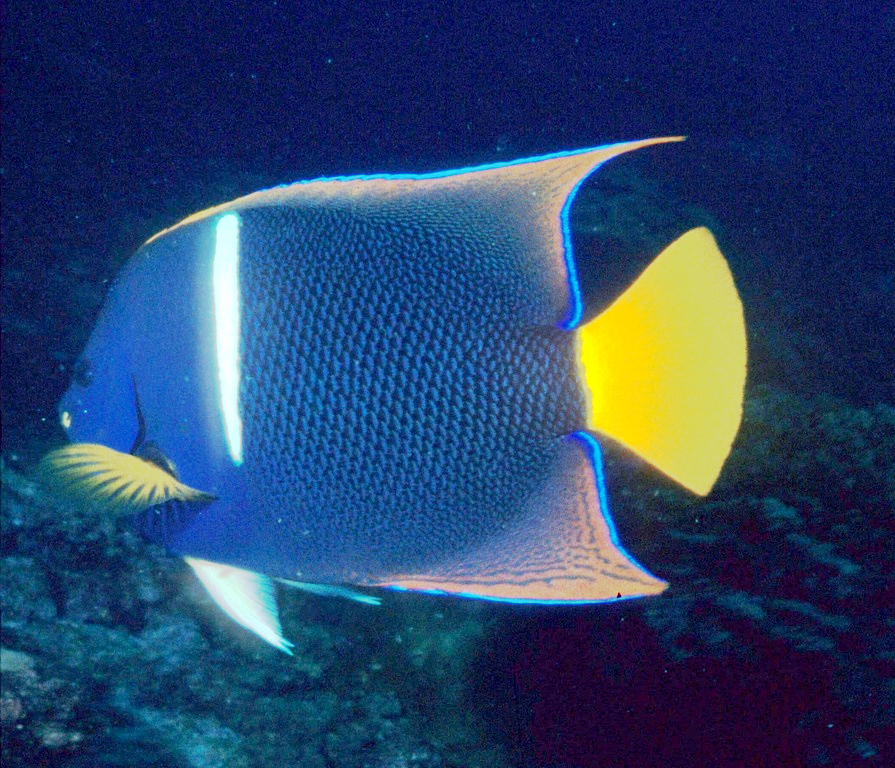
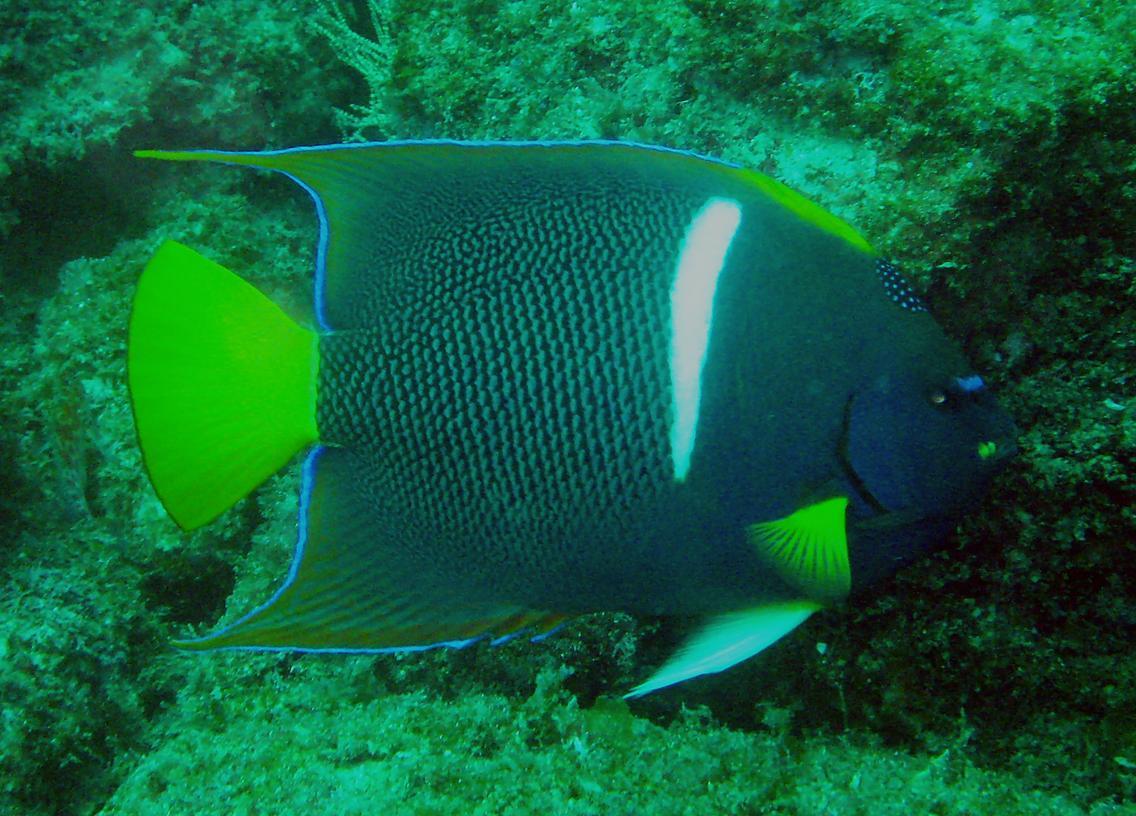
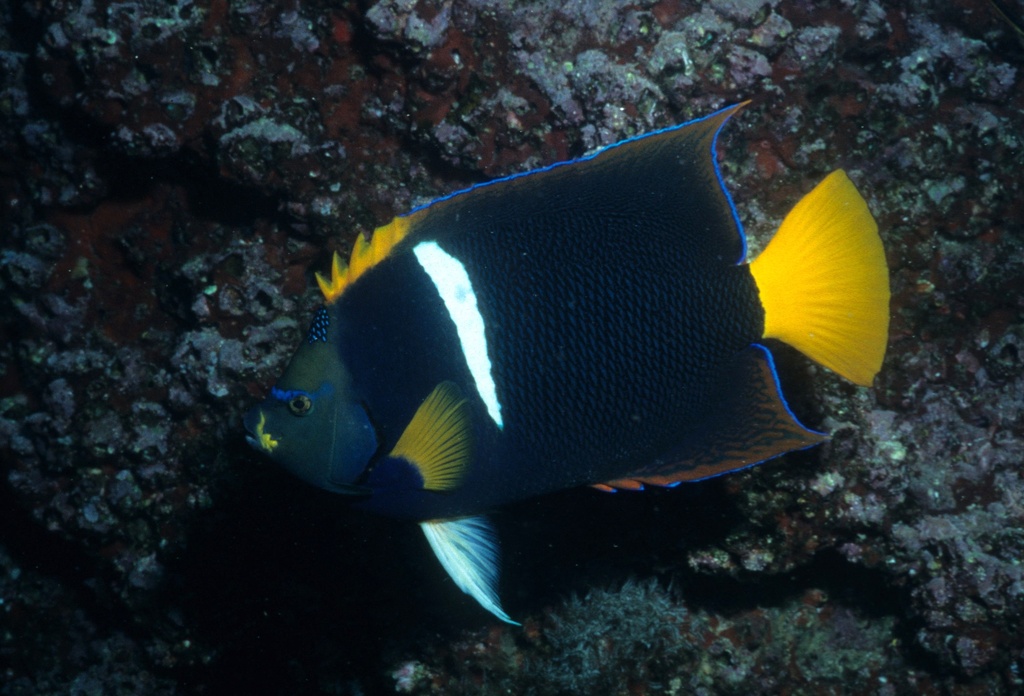
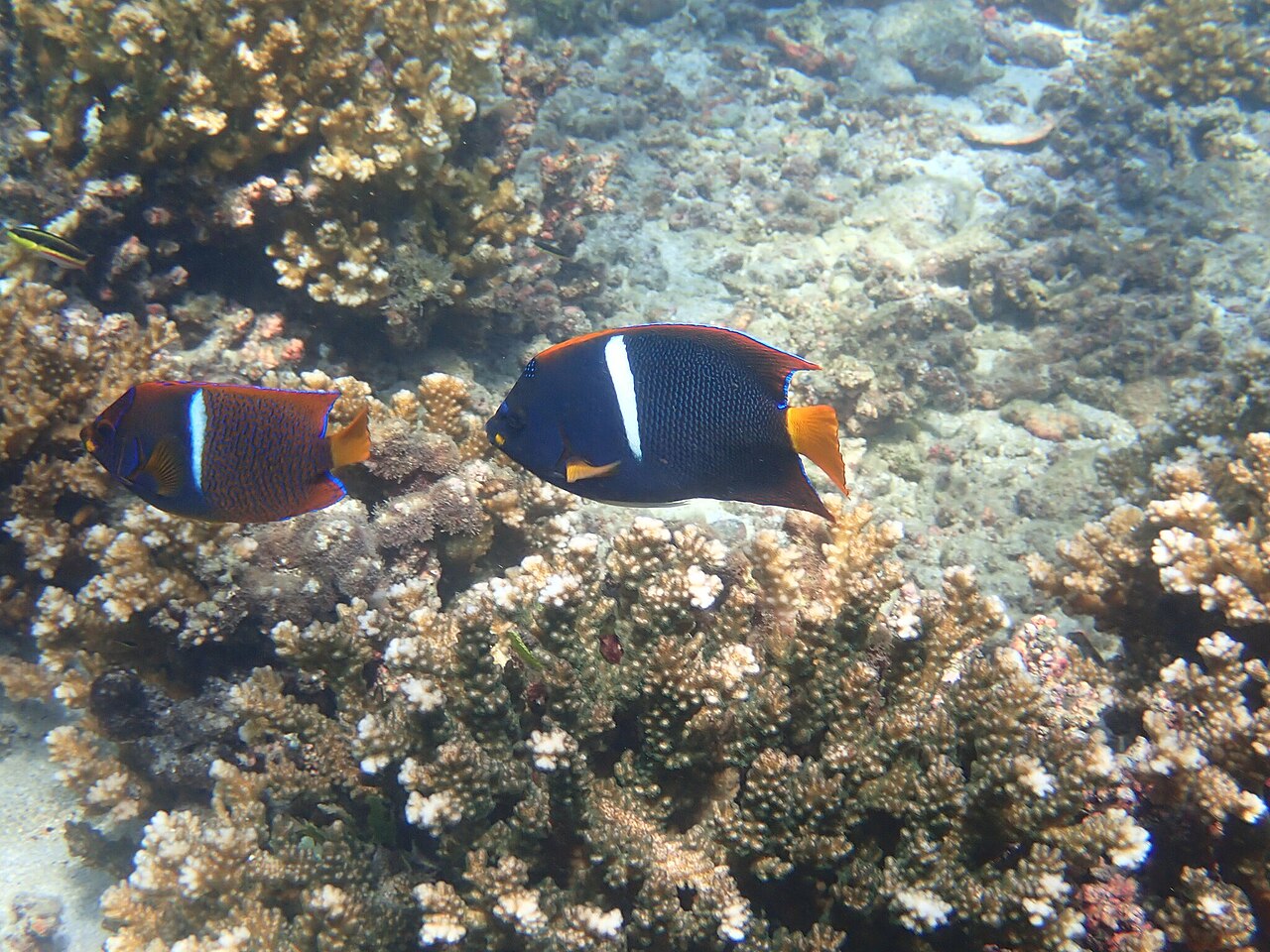
Adults usually reach about 35 centimeters in length. Their dorsal and pectoral fins each have 18 to 20 rays, and their anal fin has 17 to 19. A strong spike under the lower cheek serves as defense. Coloration changes dramatically with age. Juveniles are mostly orange-yellow, with rounded dorsal and anal fins edged in iridescent blue, blue stripes toward the rear, and an orange mask around the eye. Mature fish have brown or blue bodies (depending on the light), light yellow pectoral and pelvic fins, a yellow patch on the mouth, blue-rimmed dorsal and anal fins, and a yellow tail. Adults have pointed anal and caudal rays and lack the blue body stripes of juveniles, instead having a white stripe across the front of the body. Females have yellow pelvic fins, while males have white pelvic fins. Males can be up to 50% longer and 300% heavier than females.
This species belongs to a group of Tropical Eastern Pacific *Holacanthus* that split from two close relatives, *H. limbaughi* (from Clipperton Atoll) and *H. clarionensis* (mainly from the Revillagigedo Archipelago), about 3 to 3.5 million years ago through peripatric speciation. Those two species are entirely blue and lack the yellow tail and white lateral stripe of *H. passer*. The closure of the Isthmus of Panama drove the divergence between the genera *Pomacanthus* and *Holacanthus*. Biogeographical models suggest the Tropical Eastern Pacific kingfish existed before the isthmus closed, possibly originating from an Indian Ocean invasion after the Tethys Sea closed. A probable hybrid between *H. clarionensis* and *H. passer* has been observed near Cabo San Lucas, with a bright orange-red tail, pale yellow pelvic fins, orange pectoral fins, and blue-edged, pointed dorsal and anal fins like those of *H. passer*. Such hybridization is thought to occur when mates of the same species are scarce.
The king angelfish is listed as Least Concern on the IUCN Red List.
Quick Facts
- Taxon
- Holacanthus passer
Facts from the source article.
Lore & Background
The king angelfish is a non-migratory tropical fish inhabiting reefs in the eastern Pacific Ocean from Peru north to the Gulf of California, including offshore islands such as the Galapagos, at depths of 4–30 metres. Adults are generally about 35 cm in length, with 18–20 rays in the dorsal and pectoral fins and 17–19 in the anal fin. They possess a strong spike under the lower cheek for defense. Juveniles are primarily orange-yellow with blue-rimmed fins and blue striping, while adults have brown or blue bodies, light yellow pectoral and pelvic fins, a yellow patch on the mouth, blue-rimmed dorsal and anal fins, and a yellow caudal tail. Adults lack the blue striping and instead have a white lateral stripe anterior to the head. Sexual dimorphism is evident: females have yellow pelvic fins, males white pelvic fins, and males are up to 50% longer and 300% heavier.
Biogeographically, H. passer is part of a Tropical Eastern Pacific clade of Holacanthus that diverged approximately 3–3.5 million years ago through peripatric speciation, alongside H. limbaughi and H. clarionensis. The closure of the Isthmus of Panama caused divergence between Pomacanthus and Holacanthus, and models suggest the clade may have originated from an Indian Ocean invasion after the Tethys Sea closure. A probable hybrid between H. clarionensis and H. passer has been observed in Cabo San Lucas, with features including a bright orange-red caudal fin, pale yellow pelvic fins, and orange pectoral fins. This hybridization is hypothesized to occur when conspecific mates are scarce.
King angelfish are diurnal and feed on sponges, sessile invertebrates, zooplankton, and benthic microalgae. They are vital spongivores in the Mexican Pacific, consuming up to 23 of 24 sponge species surveyed, with a preference for the order Hadromerida. They also engage in coprophagy and form mutualistic cleaning relationships with species such as Chromis atrilobata. Their digestive tract includes a hindgut chamber with a diverse microbiome for digesting algae, and they host the opalinid flagellate Protoopalina pomacantha in the rectum.
Reader's Guide
The king angelfish is considered an ecosystem engineer because its grazing in benthic communities creates habitat for other species. It primarily inhabits the middle and bottom of the water column of rocky tropical reefs, often in crevices of large rocks, and juveniles occasionally occur in tide pools. In the Gulf of California, it is a dominant species due to its great relative abundance and occurrence, occupying reefs with large boulders, small boulders, rhodoliths, black corals, and walls, with a preference for sea walls and small boulders covered in algae.
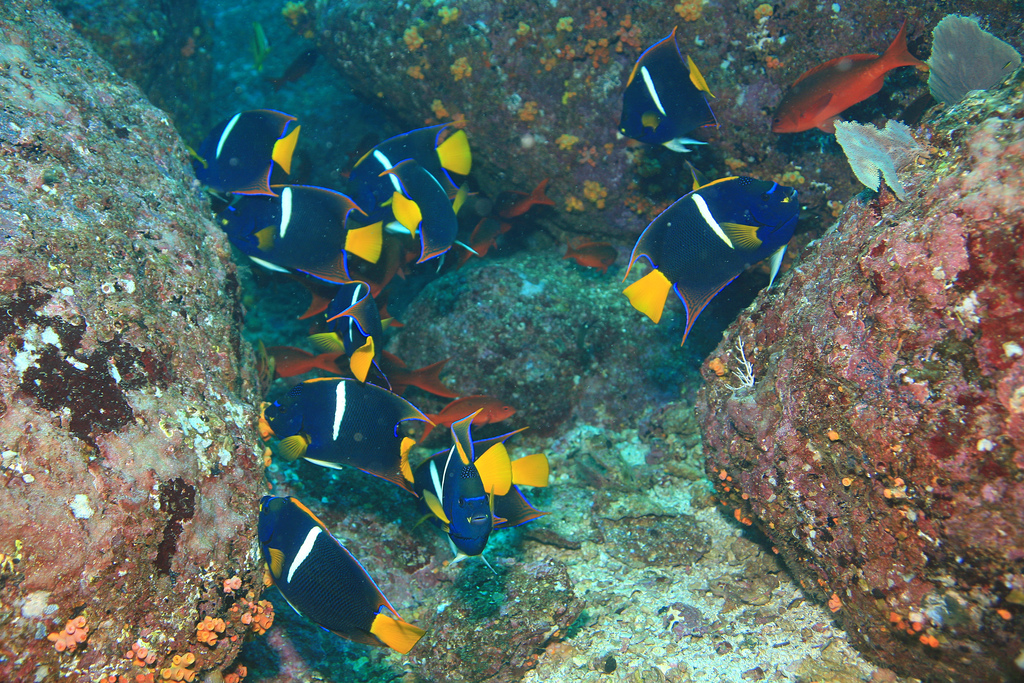
Reproductively, king angelfish are monogamous within pairs and spawn daily around sunset as broadcast spawners. A pair can produce upwards of ten million fertilized eggs per spawning cycle, averaging 25,000–75,000 daily. Eggs drift for about 20 hours before hatching, and fry live off their yolk sac until absorbing it, then feed on small zooplankton. Courtship involves males defending territories at sunset, with females arriving and the male performing a fluttering display. Larger males have higher reproductive success and may have multiple females in their territory.
Conservation-wise, the species is listed as least concern by the IUCN, but Mexico granted it special protection in 1996 due to overfishing, leading to the closure of two fisheries in the Gulf of California in the early 2000s. The species seemed to recover after the ban, though population density data for Latin America is lacking. In aquariums, king angelfish are somewhat popular but require large tanks (at least 125 gallons), live sponges and tunicates, and stable water quality; they have not bred in captivity.
Did You Know?
- Adult king angelfish have a strong spike under their lower cheek for defense.
- King angelfish host the opalinid flagellate Protoopalina pomacantha in their rectum.
A Dramatic Metamorphosis of Color and Form
The king angelfish undergoes one of the most visually striking transformations among reef fish as it matures. Young specimens present as vivid orange-yellow bodies, with matching pectoral and pelvic fins, rounded dorsal and anal fins edged in shimmering blue, blue striping running along the rear of the body, and an orange mask framing the eye. By the time they reach sexual maturity at roughly thirty-five centimetres, the picture has been almost entirely rewritten. The body shifts to a deep brown or blue hue that changes with ambient light, the pectoral and pelvic fins fade to pale yellow, a yellow patch appears on the mouth, and the caudal fin turns bright yellow. The rounded juvenile fins give way to pointed anal and caudal rays, the blue body striping vanishes, and a single white stripe emerges just ahead of the head. A defensive spike sits beneath the lower cheek throughout life. Sexual dimorphism adds another layer: females retain yellow pelvic fins while males display white ones, and males grow up to fifty percent longer and three hundred percent heavier than their female counterparts.
Ancient Lineages and Island Isolation
The king angelfish belongs to a small clade of Tropical Eastern Pacific Holacanthus species that split from one another roughly three to three and a half million years ago through peripatric speciation. Its two close relatives, H. limbaughi on Clipperton Atoll and H. clarionensis in the Revillagigedo Archipelago, are entirely blue and lack the yellow tail and white lateral stripe that distinguish H. passer. Deeper in the family tree, the closure of the Isthmus of Panama is credited with separating the genera Pomacanthus and Holacanthus. Biogeographical modelling suggests the Tropical Eastern Pacific kingfish lineage was already present before that isthmus closed, implying the clade may trace its roots to an Indian Ocean invasion following the earlier closure of the Tethys Sea. In a remarkable field observation at Cabo San Lucas, researchers documented a probable hybrid between H. clarionensis and H. passer, displaying a bright orange-red tail, pale yellow pelvic fins, orange pectoral fins, and the pointed blue-rimmed dorsal and anal margins characteristic of H. passer. Such interspecific pairing is thought to arise when suitable same-species mates are scarce.
Ecosystem Engineer and Spongivore
Within the rocky reefs of the eastern Pacific, the king angelfish plays a disproportionately important ecological role. It is classified as an ecosystem engineer because its constant grazing over benthic communities reshapes the substrate and opens space for other organisms to settle. In the Mexican Pacific, it is a critical spongivore, having been observed consuming up to twenty-three of twenty-four sponge species surveyed, with a marked preference for members of the order Hadromerida. Its foraging strategy is size- and sex-dependent: females and smaller individuals tend to graze on algae in benthic zones, while larger males spend more time in the mid-water column filtering zooplankton. The species also forms mutualistic cleaner-fish relationships with Chromis atrilobata, gaining access to organic matter including the host's fecal matter. Its digestive system, though structurally simple, relies on a highly vascularized hindgut chamber hosting a diverse microbiome and the opalinid flagellate Protoopalina pomacantha to break down algal material. In the Gulf of California, where it is considered a dominant species, the king angelfish occupies sea walls, large and small boulders, rhodoliths, and black coral formations, favouring sea walls for their strong plankton-laden currents and small algae-covered boulders for grazing.
Overfishing, Protection, and an Uncertain Recovery
Despite its IUCN Red List classification of least concern, the king angelfish has faced serious human pressure. Recognising the threat of overfishing, Mexico's Conservation Regulation granted the species special protection status in 1996, imposing harvest limits that ultimately forced the closure of two fisheries in the Gulf of California in the early 2000s. Following the fishing ban, population indicators suggested the species was recovering. However, a significant knowledge gap remains: no population density data exist for its presence across Latin America, making it difficult to assess the true extent of its recovery or any ongoing vulnerability. The fish is strictly non-migratory, ranging along the eastern Pacific coast from Peru northward to the Gulf of California, including offshore islands as far west as the Galapagos, typically at depths between four and thirty metres. Its sedentary nature means that local overexploitation can have outsized effects on a given reef community, and the absence of broad-scale monitoring data leaves conservationists without the tools to confirm whether the post-ban recovery is sustained across its full range.
Gallery
Frequently Asked Questions
Who is Holacanthus passer?
Holacanthus passer, commonly called the king angelfish or passer angelfish, is a large reef-dwelling species in the family Pomacanthidae. It is one of the most visually striking angelfish found in the eastern Pacific.
What does Holacanthus passer look like?
Juveniles are predominantly orange-yellow with rounded dark markings, while adults shift to a dramatically different color scheme. Males and females can be told apart by their pelvic fins—white in males, yellow in females.
Where does Holacanthus passer live?
This species ranges along the eastern Pacific coast from Peru northward to the Gulf of California and out to the Galápagos Islands. It stays on reefs at depths of roughly 4 to 30 meters and does not undertake long-distance migrations.
How big does Holacanthus passer get?
Adults typically reach around 35 centimeters in length, though males can grow up to 50 percent longer and roughly 300 percent heavier than females. Its fin structure includes 18 to 20 dorsal rays, 17 to 19 anal rays, and 18 to 20 pectoral rays.
How does Holacanthus passer defend itself?
Beneath the lower cheek the fish bears a strong defensive spike that deters would-be predators. Combined with its large body size and busy reef habitat, this gives it a notable advantage over smaller reef fish.
More in Marine Angelfish, Part 3 1-24
Spotted an error? Know more?
Reader corrections go straight into our review queue. Suggest an edit · How this site is sourced