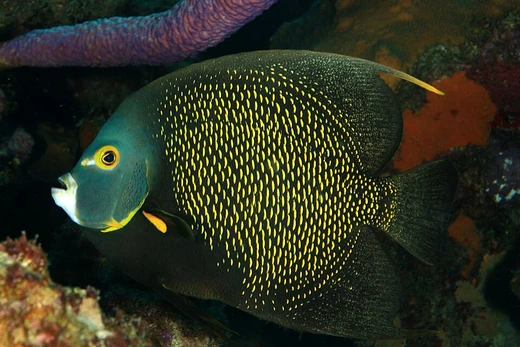
Queen angelfish
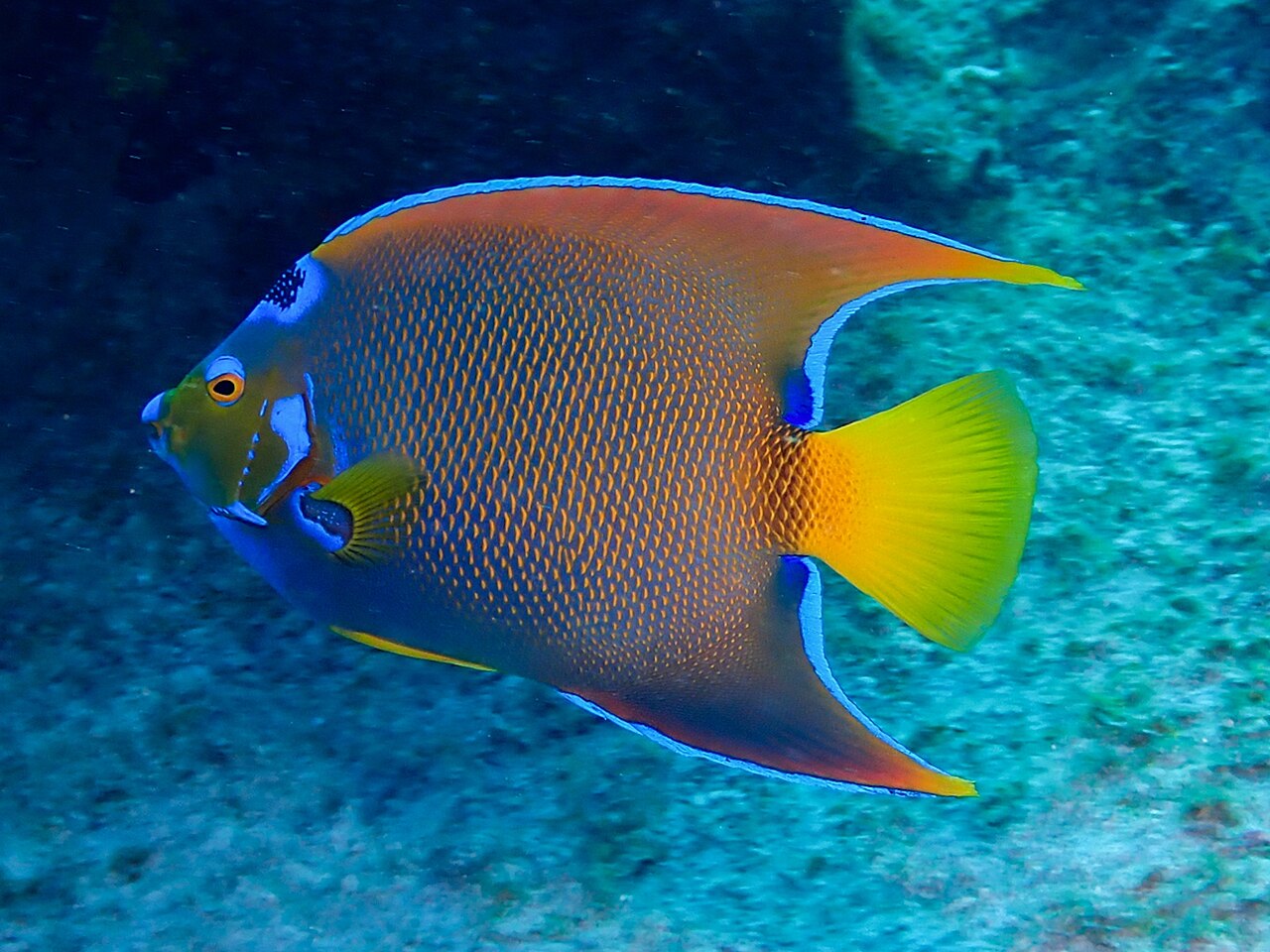
A coral reef angelfish with a blue-and-yellow crown.

Pedro Lastra · CC BY-SA 2.0
The queen angelfish (Holacanthus ciliaris) goes by several common names, including blue angelfish, golden angelfish, and yellow angelfish. This marine species lives in warm, shallow waters along the ocean floor in the western Atlantic, specifically among coral reefs. Its body is marked by blue and yellow coloring, and it has a distinctive spot, often called a "crown," on its forehead. That crown is the key feature that sets it apart from the similar-looking Bermuda blue angelfish (Holacanthus bermudensis), which shares its range and can mate with it to produce hybrids.
Adult queen angelfish are picky eaters, with sponges making up most of their diet. They live in social groups called harems, where one male oversees up to four females. Each group claims a territory, and the females forage separately while the male keeps watch. Breeding happens around the time of a full moon. The eggs are transparent and drift in the water until they hatch. Young queen angelfish look different from adults and act as cleaner fish, removing parasites from other fish.
This species is a popular choice for home aquariums, and Brazil has been a major source of exported individuals. In 2010, the International Union for Conservation of Nature listed the queen angelfish as least concern, since its wild population appeared stable.
Quick Facts
- Taxon
- Holacanthus ciliaris
Facts from the source article.
Lore & Background
The queen angelfish was first described as Chaetodon ciliaris in 1758 by Carl Linnaeus in the 10th edition of his Systema Naturae, with the type locality given as the 'Western Atlantic/Caribbean'. In 1802 it was moved by French naturalist Bernard Germain de Lacépède to the genus Holacanthus, the name of which is derived from Ancient Greek ὅλος (hólos), meaning 'full', and ἄκανθα (ákantha), meaning 'spine'. Its specific name ciliaris means 'fringed', a reference to its squamis ciliatis ('ciliate scales'). Marine angelfish of the genus Holacanthus likely emerged between 10.2 and 7.6 million years ago. The closest relative and sister species of the queen angelfish is the sympatric and similar Bermuda blue angelfish (H. bermudensis), from which it split around 1.5 mya. They are known to interbreed, producing a hybrid known as the Townsend angelfish which has features similar to both parent species; the Townsend angelfish is fertile and can breed both with each other and with the two parent species.
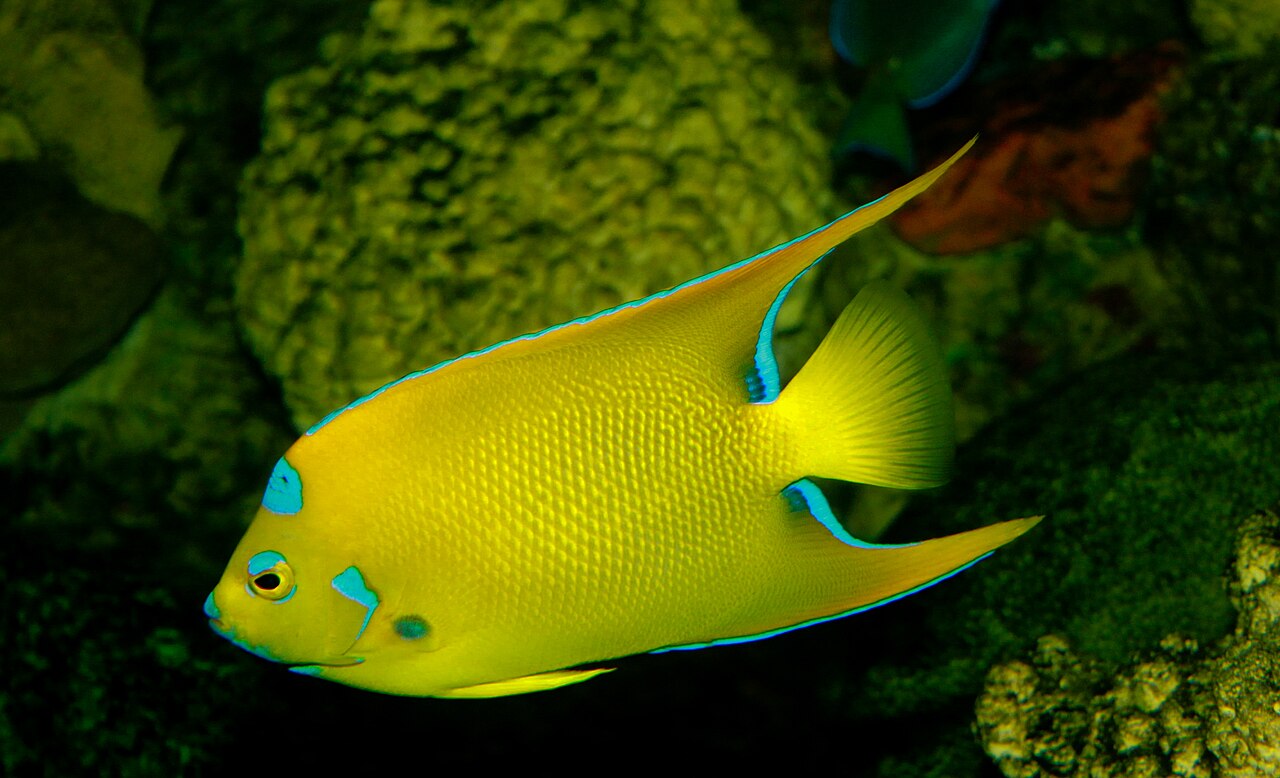
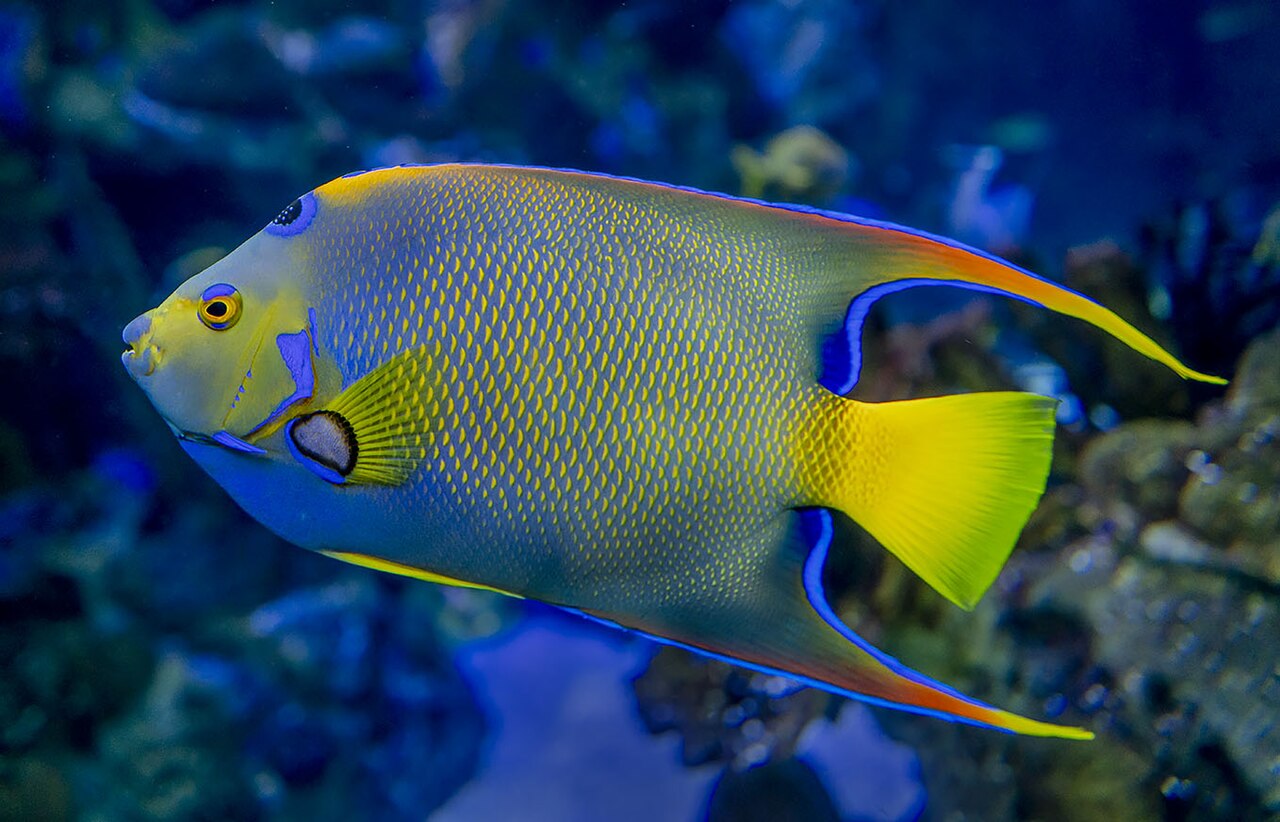
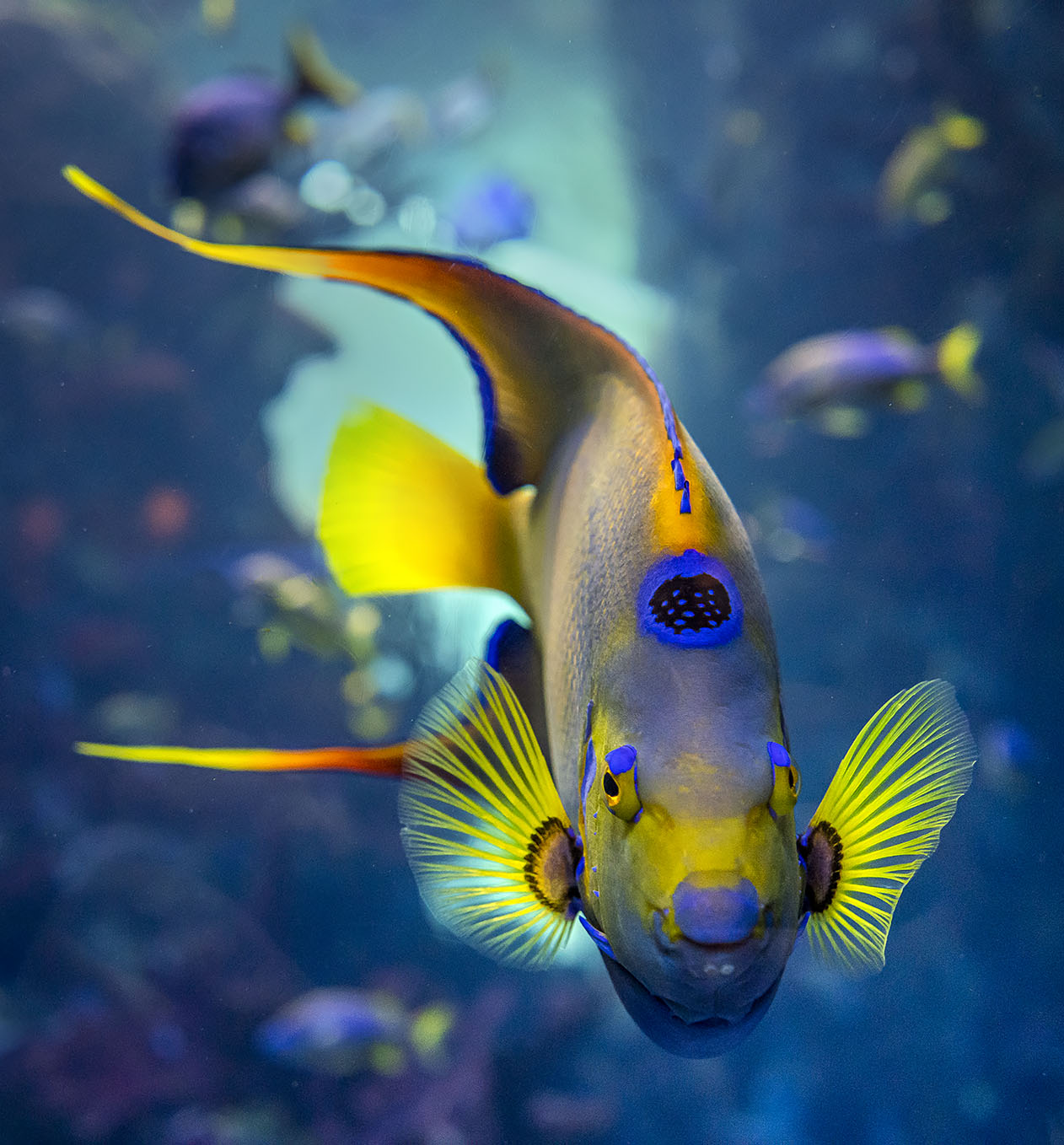
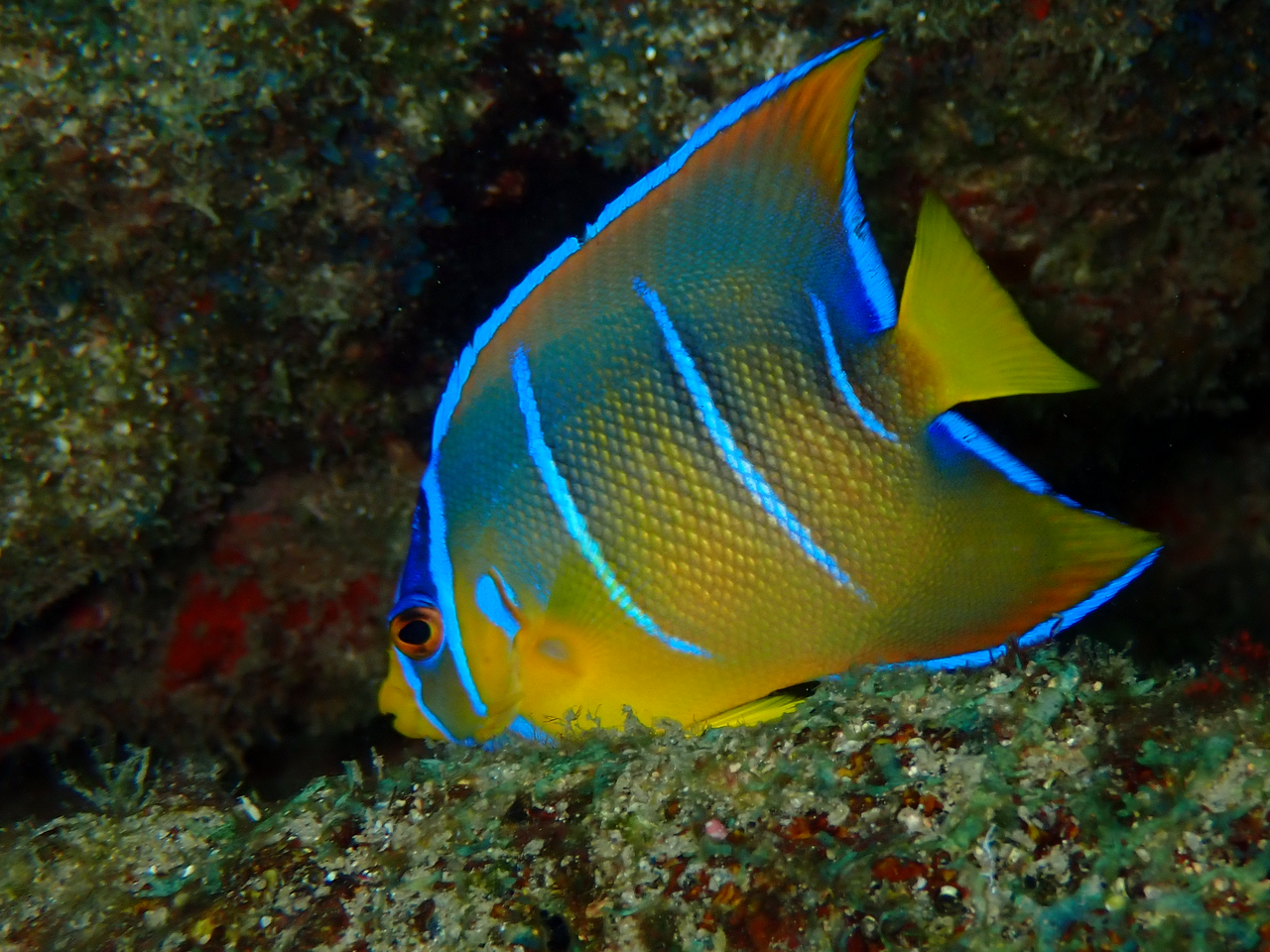
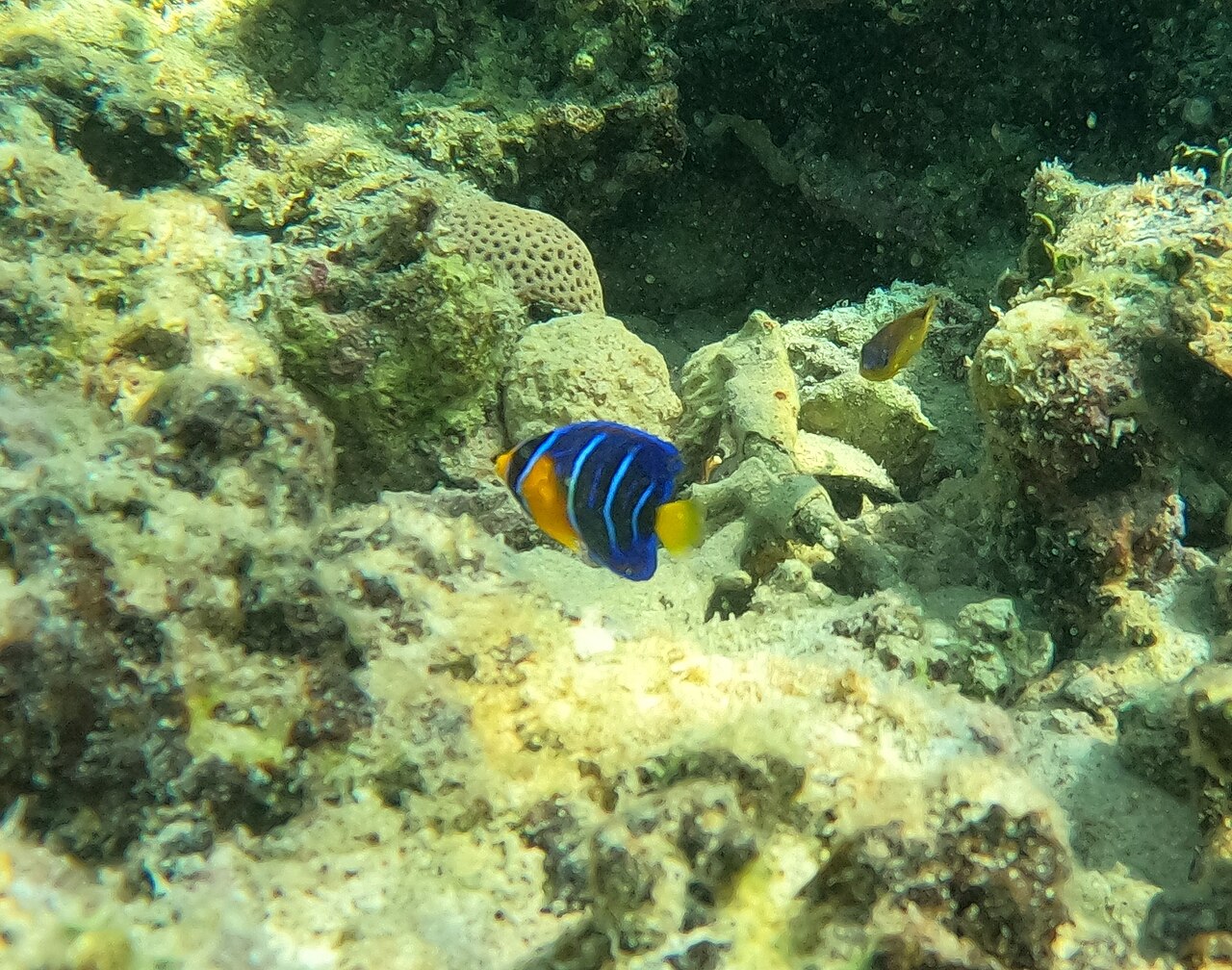
The queen angelfish has a broad, flattened, oval-shaped body with triangular tail fin, a reduced, dulled snout and a small mouth containing bristle-like teeth. The dorsal and anal fins both dangle behind the body. The species is covered in yellow-tipped blue-green scales, with a bright yellow tail, pectoral and pelvic fins. On the forehead is an eye-like spot or 'crown' that is cobalt blue with an electric blue outer ring and dotted with electric blue spots. Juveniles are dark blue with bright blue vertical stripes and a yellow pectoral area, and they act as cleaner fish. Seven other color morphs have been recorded off the coast of the Saint Peter and Saint Paul Archipelago, Brazil, the most common being a mostly gold or bright orange morph. There are records of at least two wild queen angelfish at St. Peter and St. Paul with a 'pughead' skeletal deformity.
Reader's Guide
The queen angelfish is popular in the aquarium trade and has been a particularly common exported species from Brazil. In Brazil, it is the most common marine ornamental fish sold aboard; from 1995 to 2000, 43,730 queen angelfish were traded at Fortaleza in the northeast of the country, and in 1995, 75% of marine fish sold were both queen and French angelfish. As juveniles, angelfish can adapt to eating typical aquarium food and hence have a higher survival rate than individuals taken as adults, which require a more specialized diet. Queen angelfish are not normally eaten or commercially fished; they are captured mostly for the aquarium trade, where they are highly valued. In 2010, the queen angelfish was assessed as least concern by the International Union for Conservation of Nature, as the species is only significantly fished off Brazil and the wild population appeared to be secure. Queen angelfish have been caught in the eastern Adriatic Sea, off Croatia, in 2011, and the Mediterranean Sea, off Malta, in 2020; these are likely introductions from the aquarium industry and not natural colonizations. In 2015, an aquarium-introduced angelfish was found in the Red Sea at Eilat's Coral Beach, Israel, with a kidney infected by the bacterium Photobacterium damselae piscicida, which was not previously recorded in Red Sea fish, raising concerns that it could infect native fish.
Did You Know?
- Adult queen angelfish primarily eat sponges, and off St. Thomas Island and Salvador, Bahia, 90% of their diet is sponges.
- The species spawns near a full moon, and the female discharges between 25 and 75 thousand eggs a day.
- The queen angelfish and the Bermuda blue angelfish split from a common ancestor around 1.5 million years ago.
Taxonomy & Evolutionary Lineage
The queen angelfish was first formally named by Carl Linnaeus in 1758, when he placed it under the genus Chaetodon in the tenth edition of his Systema Naturae, citing the Western Atlantic and Caribbean as its type locality. In 1802, French naturalist Bernard Germain de Lacépède reclassified the species into the genus Holacanthus, a name drawn from the Greek words meaning "full" and "spine." The species epithet ciliaris, meaning "fringed," references the ciliate scales covering its body. Molecular evidence suggests the Holacanthus lineage originated between 10.2 and 7.6 million years ago, with the West African Guinean angelfish representing the earliest branch, implying the group colonized the Atlantic from the Indian Ocean. The closure of the Isthmus of Panama roughly 3.5 to 3.1 million years ago isolated Pacific populations. The queen angelfish split from its closest relative, the Bermuda blue angelfish, approximately 1.5 million years ago. Remarkably, the two can still interbreed, producing a fertile hybrid called the Townsend angelfish that carries traits of both parents and can itself mate with either species.
Physical Form & Color Diversity
Adult queen angelfish display a broad, laterally compressed oval body capped by a triangular caudal fin, with a short, blunt snout and a small mouth lined with bristle-like teeth. Their dorsal fin carries 14 spines and 19 to 21 soft rays, while the anal fin has 3 spines and 20 to 21 soft rays, both trailing behind the body. The species reaches up to 45 cm and 1,600 g, with males tending to outsize females. Their most striking feature is the cobalt-blue "crown" on the forehead, ringed in electric blue and dotted with additional blue spots—the key identifier separating them from the visually similar Bermuda blue angelfish. Beyond the standard blue-and-yellow palette, researchers have documented seven additional color morphs off the Saint Peter and Saint Paul Archipelago in Brazil, ranging from predominantly gold or bright orange to entirely white specimens. A rare cobalt-blue morph with white and yellow-orange patches was also recorded off Dry Tortugas, Florida, in 2009. Juveniles look entirely different: dark blue with bright vertical stripes and a yellow pectoral region, gradually transitioning into adult coloration. Two wild individuals at St. Peter and St. Paul have been noted with a "pughead" skeletal deformity, a squashed upper jaw and protruding lower jaw, a condition more typical of captive fish.
Social Dynamics & Breeding
The social organization of the queen angelfish centers on a territorial harem: a single male presides over two to four females within a defined home range. The species is believed to be protogynous, meaning individuals likely begin life as females, and the largest harem female can transform into a male if the dominant one vanishes. During the day, the females disperse to forage independently at separate locations, while the male actively tends each one—rushing toward her, circling, and feeding alongside her. Courtship involves the male displaying his flank to the female and flicking his pectoral fins. Spawning takes place year-round but is typically observed around the full moon. The transparent eggs are released into the water column, where they drift until hatching. Juveniles, which look nothing like adults, take on an entirely different ecological role: they function as cleaner fish, establishing stations where they remove ectoparasites from larger reef-dwelling species. This dual life strategy—cleaner in youth, sponge-specialist in adulthood—gives the species a remarkable range of ecological interactions across its lifespan.
Feeding Ecology & Conservation Status
Queen angelfish are selective feeders whose diet is dominated by sponges, though they also consume tunicates, jellyfish, corals, plankton, and algae. In studies off St. Thomas Island and Salvador, Bahia, sponges made up 90 percent of adult intake. At the Saint Peter and Saint Paul Archipelago, more than 30 prey species were identified in their diet, with sponges accounting for 68 percent, algae for 25 percent, and bryozoans for 5 percent. Notably, the proportion of each prey type in their diet does not track the relative abundance of that prey in the environment, and the archipelago population specifically targets less common sponge species such as Geodia neptuni, Erylus latens, Clathria calla, and Asteropus niger. The species inhabits tropical and subtropical western Atlantic waters from Florida through the Gulf of Mexico and Caribbean down to Brazil, extending east to Bermuda and the Saint Peter and Saint Paul Archipelago, living on coral reefs from the shore down to 70 meters. In 2010, the IUCN assessed the wild population as stable and classified the species as least concern. The queen angelfish remains a popular aquarium species and has been a particularly common export from Brazil.
Gallery
Frequently Asked Questions
What is the queen angelfish?
The queen angelfish (Holacanthus ciliaris) is a coral-reef marine fish first formally described by Carl Linnaeus in 1758 under the name Chaetodon ciliaris. It is also widely known as the blue angelfish, golden angelfish, or yellow angelfish depending on its color phase.
What does a queen angelfish look like?
Adults display a vivid blue-and-yellow body pattern with a distinctive spot on the forehead commonly called a 'crown.' The upper profile is tall and angular, supported by 14 dorsal spines and 19 to 21 soft dorsal rays.
Where does the queen angelfish live?
This species is native to warm, shallow waters of the western Atlantic, where it dwells along the ocean floor among living coral reefs. It is a reef-dweller rather than an open-water fish.
How is the queen angelfish different from the Bermuda blue angelfish?
The defining difference is the forehead 'crown' spot, which the queen angelfish possesses but the Bermuda blue angelfish (Holacanthus bermudensis) does not. The two species overlap in range and are even capable of interbreeding to produce hybrid offspring.
How large does a queen angelfish grow?
A fully mature individual can reach a total length of up to 45 cm (about 18 inches) and a weight of roughly 1,600 g (56 oz), making it one of the bigger marine angelfishes.
More in Marine Angelfish, Part 3 1-24
Spotted an error? Know more?
Reader corrections go straight into our review queue. Suggest an edit · How this site is sourced