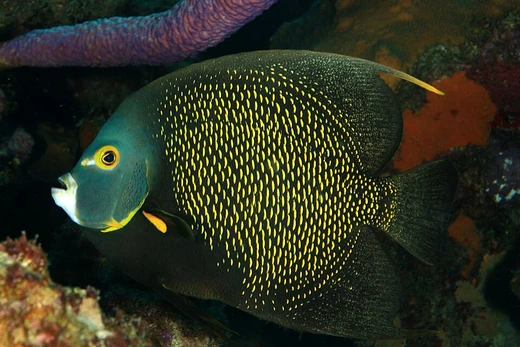
Clipperton angelfish
Endemic to Clipperton Island, scarce and highly valued in trade.

Pacific Southwest Region USFWS from Sacramento, US · Public domain
The Clipperton angelfish (Holacanthus limbaughi) is a species of marine ray-finned fish in the family Pomacanthidae, endemic to Clipperton Island, a French possession in the eastern Pacific Ocean. It is notable for its extremely restricted distribution and the very high prices it commands in the aquarium trade, where it is scarce.
Quick Facts
- Taxon
- Holacanthus limbaughi
Facts from the source article.
Lore & Background
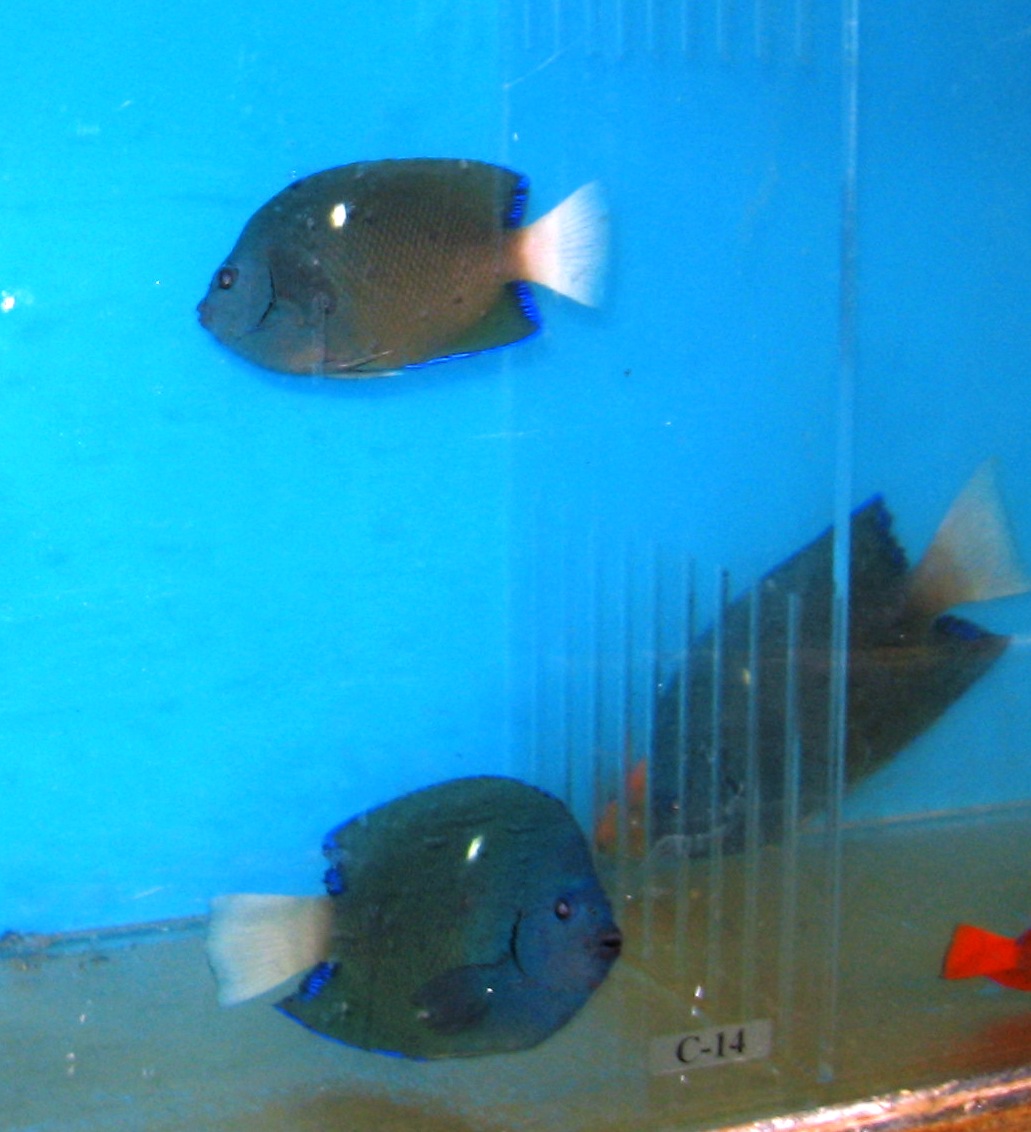
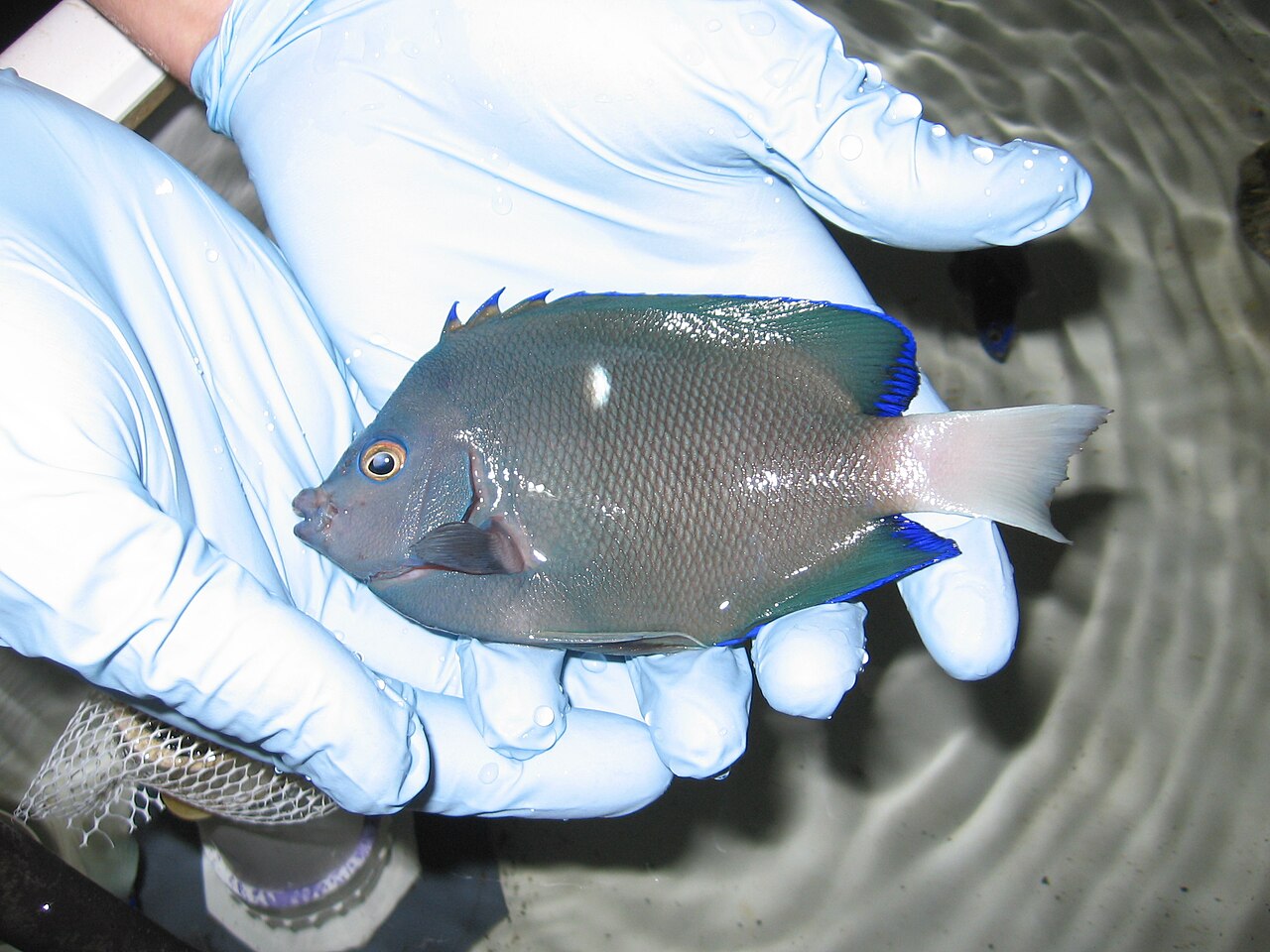
The Clipperton angelfish has a deep, laterally compressed body with a small mouth and bristle-like teeth. The preoperculum has a sizeable spine at its corner and a serrated rear margin, with four spines between the preoperculum and operculum. Juveniles are dark bluish-grey with vertical blue bars—two on the head and five on the flanks—which fade as they mature, along with a white spot on the upper side and white caudal and pectoral fins. Adults lack the barring and have vivid blue margins on the dorsal, anal, and pelvic fins.
This species was first formally described in 1963 by American ichthyologist Wayne J. Baldwin. The specific name honors American scuba diver, zoologist, and underwater photographer Conrad Limbaugh, who played a vital role in collecting the type specimen. Very little is known about its habitat preferences and biology.
Reader's Guide
The Clipperton angelfish is significant primarily because of its extreme endemism to Clipperton Island, a remote French possession 2,560 kilometres west of Costa Rica. Its restricted distribution makes it extremely scarce in the aquarium trade, and when it has appeared, it has commanded very high prices. In 2009, a California tropical fish dealer was caught attempting to bring 52 illegally collected Clipperton angelfish into the United States, falsely declaring them as king angelfish to federal wildlife authorities, intending to sell each fish for $10,000. This incident underscores the species' rarity and the high demand it generates. Despite its notoriety in trade, very little is known about its habitat preferences and biology, leaving much of its natural history undocumented. The species was formally described in 1963 by Wayne J. Baldwin, with its specific name honoring Conrad Limbaugh, who helped collect the type. Its remote distribution and the lack of biological data make it a subject of both conservation interest and commercial intrigue.
Did You Know?
- The Clipperton angelfish is endemic to Clipperton Island, a French possession 2,560 kilometres west of Costa Rica.
- It attains a maximum total length of 30 centimetres (12 in).
- In 2009, a dealer tried to smuggle 52 illegally collected Clipperton angelfish into the US, intending to sell them for $10,000 each.
Physical Form and Development
The Clipperton angelfish presents a strikingly deep, laterally compressed silhouette that sets it apart visually from many of its reef-dwelling relatives. Its small mouth is armed with bristle-like teeth, and the gill-cover region carries a notably large spine at the corner of the preoperculum, backed by a serrated rear edge and four additional spines positioned between the preoperculum and operculum. The species undergoes a visible transformation as it matures. Young fish display a dark bluish-grey body crossed by distinct vertical blue bars—two running down the head and five along the flanks—along with a pale spot on the upper side and clean white caudal and pectoral fins. As these juveniles grow into adults, the barring fades away entirely, replaced by vivid blue edging along the dorsal, anal, and pelvic fins. The dorsal fin itself bears fourteen spines and seventeen to eighteen soft rays, while the anal fin carries three spines with a matching count of soft rays. At full size, an individual can reach a total length of thirty centimetres, roughly twelve inches.
A Single Island in a Vast Ocean
The entire known population of Holacanthus limbaughi is confined to the waters surrounding Clipperton Island, a small French overseas territory sitting in the eastern Pacific. The island lies roughly 2,560 kilometres—about 1,590 miles—due west of Costa Rica, placing it in one of the most remote stretches of open ocean on the planet. This extreme geographic isolation is the defining feature of the species' ecology: there is no other location where this angelfish is known to occur. Within that narrow range, individuals have been recorded at depths spanning from six to one hundred metres, a range that suggests some flexibility in vertical habitat use. Beyond that depth window, however, scientific knowledge of the fish's specific habitat preferences, feeding behaviour, reproductive habits, and social structure remains remarkably thin. The combination of a single-island distribution and the practical difficulty of reaching such a distant location means that the Clipperton angelfish remains one of the least-studied marine angelfish species, with vast gaps in our understanding of its daily life and population dynamics.
Discovery and the Name Behind the Name
The Clipperton angelfish entered formal scientific record in 1963, when the American ichthyologist Wayne J. Baldwin produced the species' first official description. The specific epithet limbaughi was chosen to honour Conrad Limbaugh, an American scuba diver, zoologist, and underwater photographer who lived from 1925 to 1960. Limbaugh played what is described as a vital role in the collection of the type specimens—the reference individuals against which the species was formally defined. His involvement was particularly noteworthy given the extraordinary logistical challenge of reaching Clipperton Island, a remote island thousands of kilometres from any major port, and conducting underwater work there in the early 1960s. The fact that a diver and photographer, rather than a traditional academic collector, was instrumental in securing the material that allowed Baldwin to describe the species underscores how much early Pacific ichthyology depended on the skills of field workers who could actually get to the fish. Limbaugh's death in 1960, just three years before the description was published, adds a poignant layer to the naming.
A Fish Worth Ten Thousand Dollars
Because the Clipperton angelfish exists nowhere else on Earth, it is extraordinarily rare in the commercial aquarium market. On the handful of occasions it has surfaced in that trade, it has commanded prices that reflect its near-impossible availability. The most dramatic episode in the species' commercial history came in 2009, when a California-based tropical fish dealer was intercepted by federal wildlife authorities attempting to smuggle fifty-two illegally collected Clipperton angelfish into the United States. To conceal the true identity of the fish, the dealer had mislabelled them as king angelfish on the import documentation. The intended retail price for each individual was a staggering ten thousand dollars, a figure that speaks to the extreme scarcity of the species and the willingness of buyers to pay a premium for a fish no one else can easily obtain. The incident highlighted both the vulnerability of a single-island population to targeted collection and the lengths to which the exotic fish trade will go to move specimens across borders.
Gallery
Frequently Asked Questions
What is the Clipperton angelfish?
The Clipperton angelfish (Holacanthus limbaughi) is a ray-finned marine fish belonging to the angelfish family Pomacanthidae. It is one of the most geographically restricted angelfish species known, found nowhere else on Earth except the waters surrounding Clipperton Island.
Where does the Clipperton angelfish live?
This species is endemic to Clipperton Island, a small atoll administered by France in the eastern Pacific Ocean. It inhabits depths ranging from about 6 metres down to roughly 100 metres around that single island.
How large does the Clipperton angelfish grow?
Adults reach a maximum total length of about 30 centimetres (roughly 12 inches). Males and females share similar size ranges within that ceiling.
Why is the Clipperton angelfish so expensive in the aquarium trade?
Because it occurs at only one tiny island, wild populations are inherently limited and fragile, making live specimens extremely scarce. That rarity, combined with the difficulty of sourcing fish from a remote French territory, drives auction and retail prices well above those of other angelfish.
What do the dorsal fins of the Clipperton angelfish look like?
The dorsal fin carries 14 hard spines followed by 17 to 18 soft rays. This spine-and-ray arrangement is typical of the Pomacanthidae family but helps distinguish the species from look-alikes in scientific identification.
More in Marine Angelfish, Part 3 1-24
Spotted an error? Know more?
Reader corrections go straight into our review queue. Suggest an edit · How this site is sourced