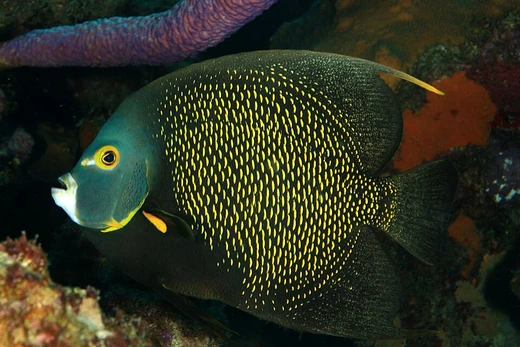
Guinean angelfish
A West African angelfish with distinct juvenile and adult coloration.

(c) Alberto Alcalá, some rights reserved (CC BY) · CC BY 4.0
The Guinean angelfish (Holacanthus africanus), also known as the West African angelfish, is a species of marine ray-finned fish in the family Pomacanthidae. It is found in the warmer sections of the eastern Atlantic Ocean off the coast of West Africa. This species is notable for its striking color changes between juvenile and adult stages and for its presence in the aquarium trade, where it commands high prices.
Quick Facts
- Taxon
- Holacanthus africanus
Facts from the source article.
Lore & Background
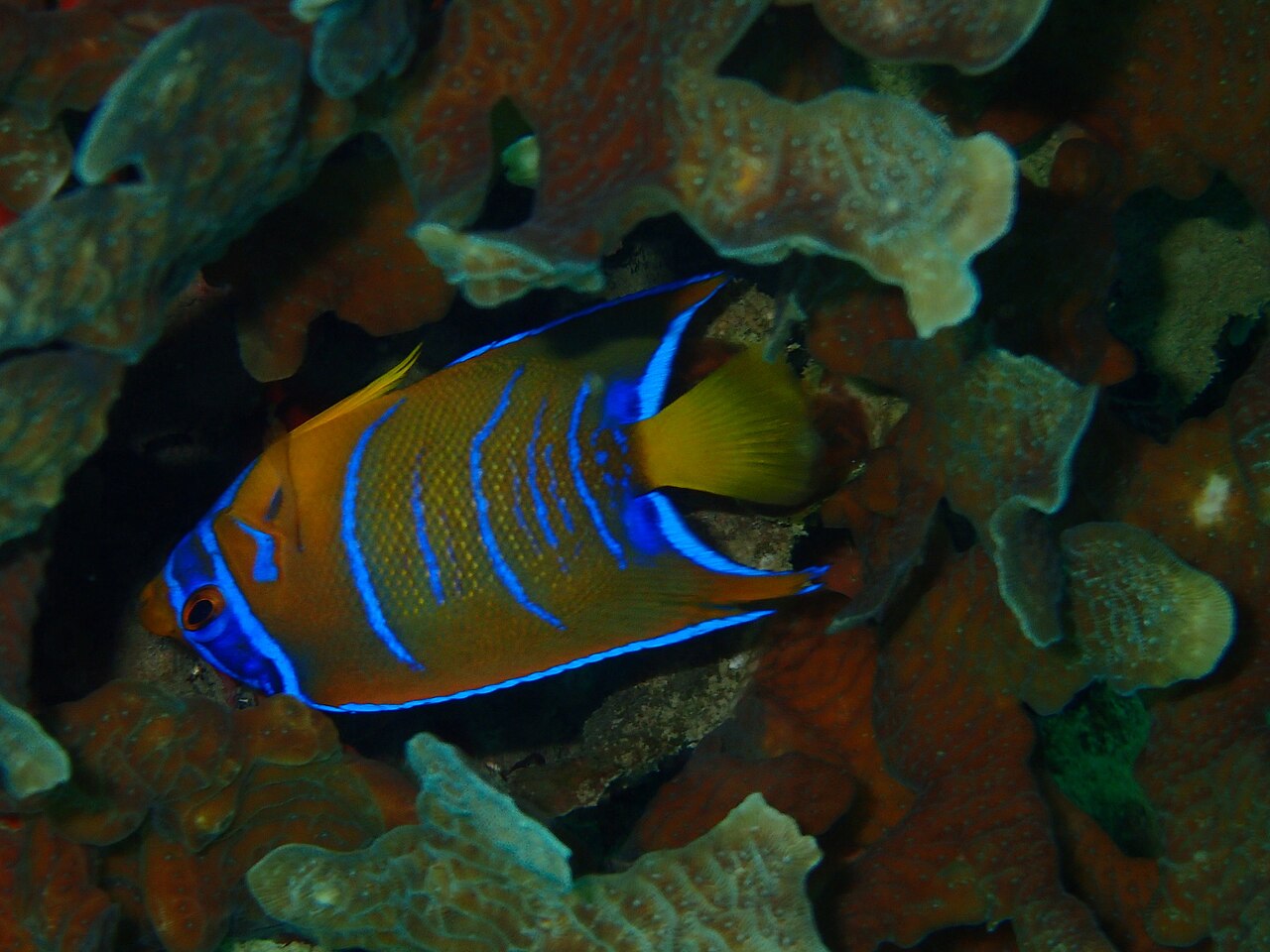
Holacanthus africanus was first formally described in 1951 by French ichthyologist Jean Cadenat, with the type locality given as Gorée in Senegal. The juvenile Guinean angelfish has a dark blue body with thin light blue vertical bars on either side of the eye, a yellow caudal fin, yellow lips, and a broad vertical white band in the middle of its flanks. As it matures, the blue changes to olive green, the white vertical bar widens and becomes more yellowish, and the caudal peduncle becomes almost black. Yellow areas may remain along the margins of the dorsal and anal fins, and a dark ocellus appears behind the operculum. This species attains a maximum total length of 45 centimeters (18 in). It is found in clear water over rocky reefs at depths between 1 and 40 meters. Its diet is non-specialized, feeding primarily on sponges, but also on tunicates, jellyfish, soft corals, algae, and plankton. Around the Cape Verde islands, it is often found in quite dense mixed species shoals, where the Guinean angelfish is dominant.
Reader's Guide
The Guinean angelfish is a notable species in the marine angelfish family Pomacanthidae, primarily due to its distinctive ontogenetic color changes and its restricted distribution in the eastern Atlantic from Senegal to the Congo River estuary, including the Cape Verde and São Tomé islands. Its first reported occurrence in the Mediterranean Sea, in Valletta harbour, Malta in 2017, marks a notable range expansion. The species appears in the aquarium trade only a few times annually and commands high prices, with availability increasing in the late 2010s. Its non-specialized diet and dominance in mixed-species shoals around Cape Verde highlight its ecological role. The species was formally described in 1951 by Jean Cadenat, adding to the systematic knowledge of the genus Holacanthus.
Taxonomy & Nomenclature
The bluering angelfish carries a taxonomic history stretching back nearly two and a half centuries. In 1795, the German physician and naturalist Marcus Elieser Bloch, who lived between 1723 and 1799, formally described the species under the name Chaetodon tricolor, designating the Indian Ocean as its type locality. Over time the fish was reclassified into the genus Pomacanthus, a group distinguished by its members being large marine angelfish within the family Pomacanthidae. Today it is most commonly known as Pomacanthus annularis, though hobbyists and field workers also call it the annularis angelfish or the blue king angelfish. The specific epithet annularis derives from the Latin word meaning ringed, a direct nod to the distinctive circular blue mark positioned above the gill cover on adult specimens. Taxonomic placement is not entirely settled: certain authorities assign the species to the subgenus Acanthochaetodon, reflecting ongoing debate about how to subdivide the broader Pomacanthus lineage. As a marine ray-finned fish, it occupies a well-defined ecological niche among the larger reef-dwelling angelfishes of the tropical seas.
Physical Appearance & Developmental Color Shift
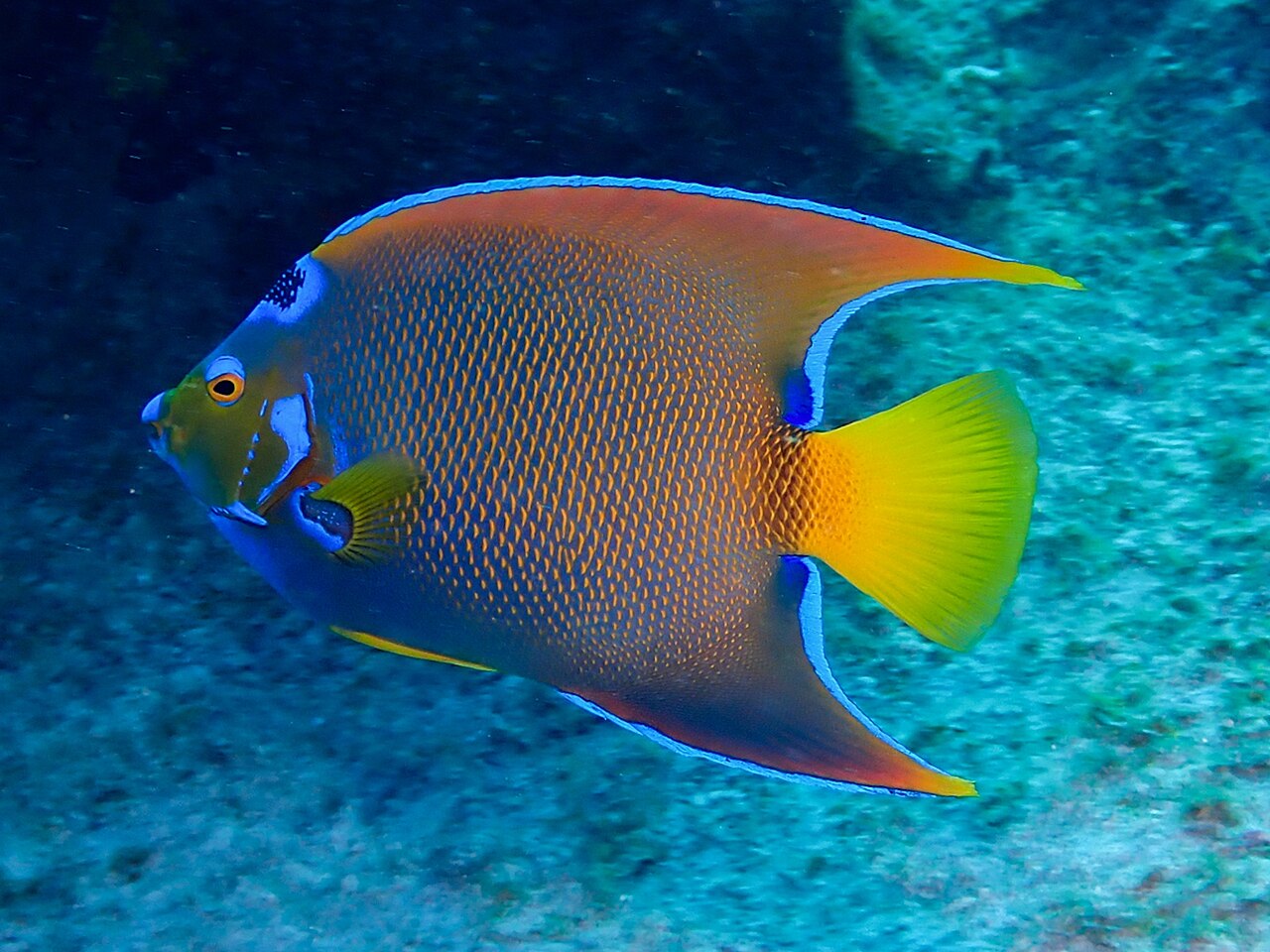
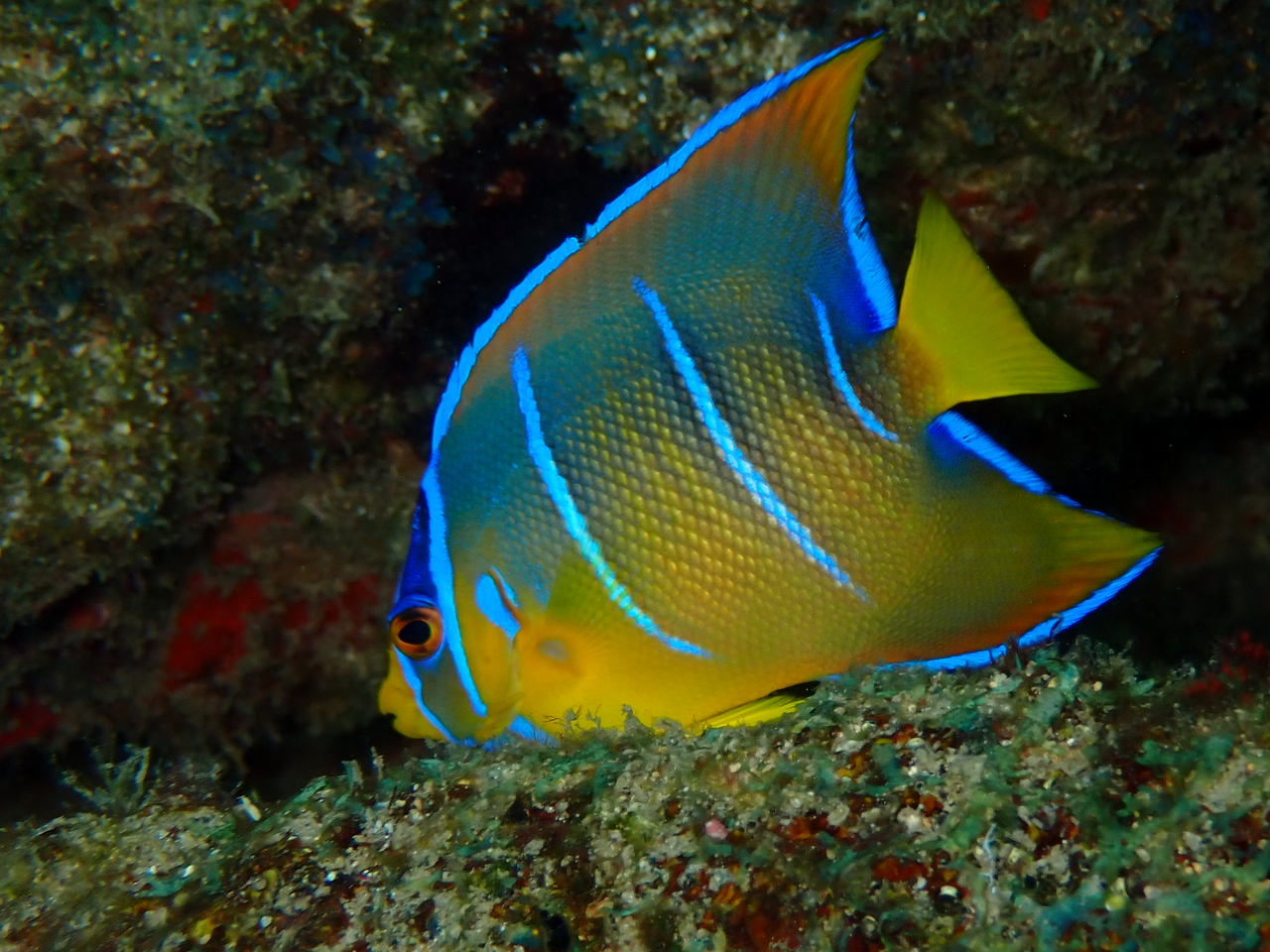
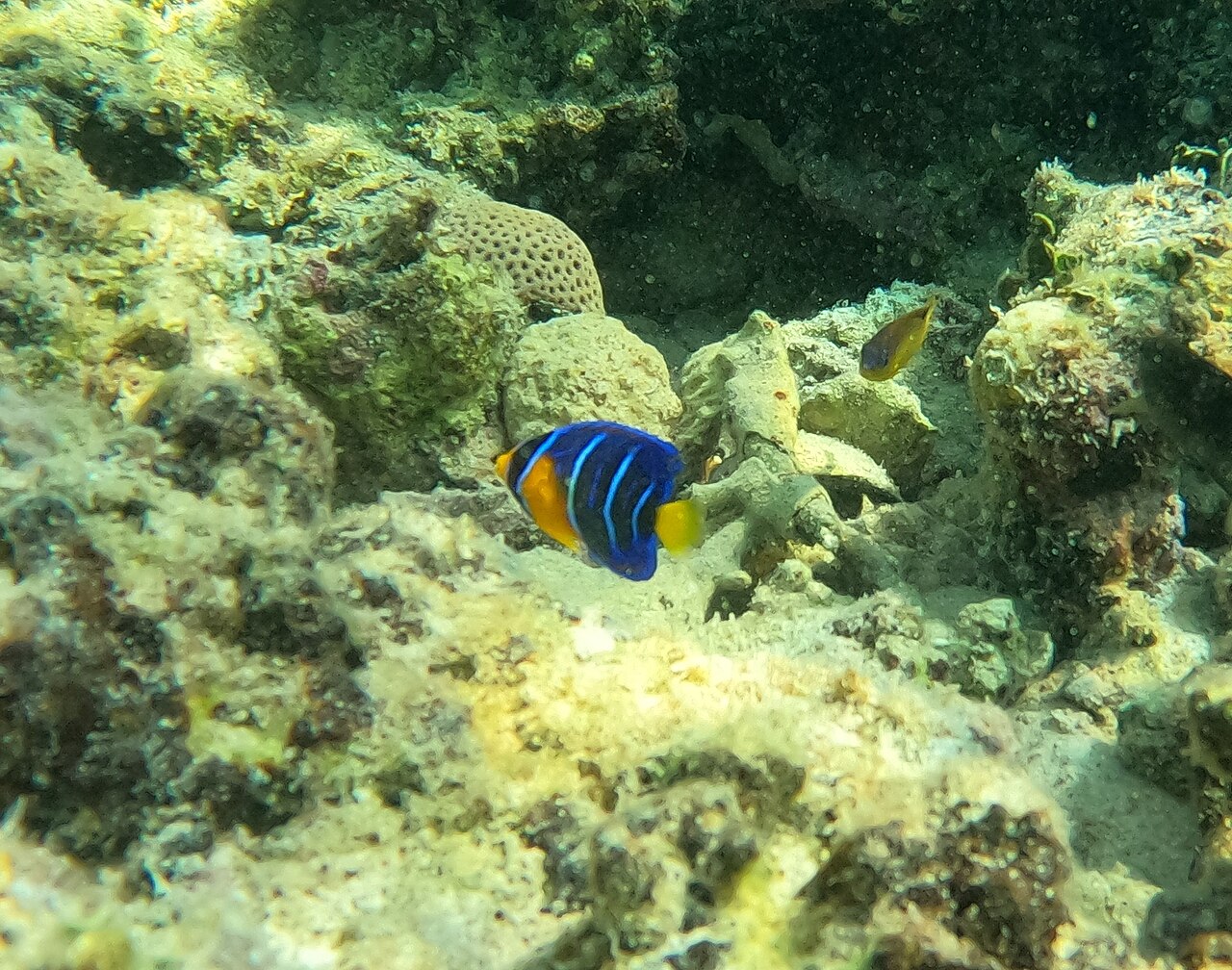
Adult bluering angelfish present a striking visual palette dominated by a warm yellow body overlaid with bold, arcing blue lines. A prominent circular blue mark sits just above the operculum, giving the species its ringed common name. The face bears two parallel blue stripes: one passes directly through the eye while the other runs immediately below it. The dorsal fin often terminates in an elongated, trailing tip, and the tail fin is white edged with a thin yellow border. Fin structure is precise: the dorsal fin carries thirteen spines alongside twenty to twenty-one soft rays, while the anal fin holds three spines and twenty soft rays. The species reaches a maximum total length of forty-five centimeters, roughly eighteen inches. In stark contrast, juveniles appear almost entirely bluish-black, decorated only with delicate, thin curved lines in white or pale blue. This dramatic transformation from dark juvenile to vividly yellow-and-blue adult is not merely cosmetic; it marks a fundamental biological shift in the fish's life, closely tied to its reproductive development.
Social Organization & Reproductive Biology
Bluering angelfish display a social structure typical of the genus Pomacanthus: a single male establishes and defends a territory while maintaining a small harem of females. Observers frequently encounter these fish in pairs, reinforcing the territorial, pair-bonded nature of their adult lives. Reproduction follows a courtship ritual during which the bonded male and female simultaneously release eggs and sperm into the water column. Perhaps the most remarkable aspect of their biology is sequential hermaphroditism. Every juvenile enters the world as a female, and as development proceeds the individual transitions into a male, accompanied by a complete overhaul of coloration from the bluish-black juvenile pattern to the bright yellow-and-blue adult scheme. Juveniles favor very shallow waters over rocky or dead-coral substrates where short filamentous algae grow. Adults shift their diet toward zooplankton, sponges, filamentous algae, and tunicates, reflecting the broader foraging range available to a larger, more mobile fish navigating reefs from a few meters to thirty meters deep.
Geographic Range & Habitat Preferences
The bluering angelfish ranges across the broad expanse of the Indo-West Pacific. Its distribution stretches from the coastal waters of East Africa, sweeps through the archipelagos of Indonesia and the seas around New Guinea, extends eastward to New Caledonia, and reaches north as far as the southern waters of Japan. Within this vast range the species is tied to coastal environments characterized by rocky coral reefs. It is not strictly limited to open reef faces; individuals may also be found sheltering in underwater caves or exploring the structures of shipwrecks. Depth-wise, the fish occupies a band from roughly three meters to thirty meters below the surface, encompassing both the sunlit upper reef and the dimmer mid-reef zones. Despite its wide geographic footprint and visually arresting appearance, the bluering angelfish is only infrequently encountered in the aquarium trade, suggesting that its specific habitat requirements, its harem-based social needs, or its relatively large adult size make it a less common choice for hobbyists compared to other, more readily available reef species.
Gallery
Frequently Asked Questions
What is the Guinean angelfish?
The Guinean angelfish (Holacanthus africanus), often called the West African angelfish, is a marine ray-finned fish in the family Pomacanthidae. It is best known for the dramatic color transformation it undergoes between its juvenile and adult life stages.
Where in the wild can you find the Guinean angelfish?
This species inhabits warm eastern-Atlantic waters stretching from Senegal to the Congo River estuary, with populations also recorded on Cape Verde and São Tomé islands. It typically lives at depths of 1 to 40 meters, though a single specimen was spotted in Valletta harbour, Malta, in 2017.
How big does the Guinean angelfish get?
Adults reach a maximum total length of roughly 45 centimeters (about 18 inches), placing them in the mid-size range among marine angelfish.
Why is the Guinean angelfish so expensive in the aquarium trade?
Its striking juvenile-and-adult color contrast makes it a highly coveted display fish for saltwater hobbyists. Because its natural range is limited to a relatively narrow stretch of the eastern Atlantic, wild-caught supply stays low, which pushes market prices upward.
Who first formally described the Guinean angelfish and when?
French ichthyologist Jean Cadenat gave the species its formal scientific description in 1951, using a specimen collected at the type locality of Gorée, Senegal.
More in Marine Angelfish, Part 3 1-24
Spotted an error? Know more?
Reader corrections go straight into our review queue. Suggest an edit · How this site is sourced