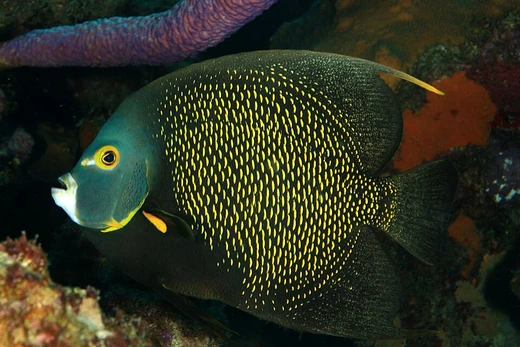
Pomacanthus sexstriatus
A marine angelfish with six vertical bands on adults.

The sixbar angelfish (Pomacanthus sexstriatus), also called the six-banded angelfish, is a marine ray-finned fish belonging to the family Pomacanthidae. It lives in the Indo-Pacific region.
Its scientific name, *sexstriatus*, means "six-banded," referring to the six vertical stripes seen on adult fish. Georges Cuvier, a French anatomist, first described the species in 1831 as *Holacanthus sexstriatus*, using a specimen from Java. Some experts place it in the subgenus *Euxiphipops*, a genus originally created by British ichthyologist Alec Fraser-Brunner in 1934 but later merged into *Pomacanthus*.
Juveniles and adults look very different. Young fish are blue-black with many straight white vertical bands near the head, which become more curved toward the tail. Adults have a brownish-yellow body and median fins covered in bright blue spots, plus six vertical bands: one whitish band just behind the head and five black bands along the flanks.
The dorsal fin has 13 to 14 spines and 18 to 23 soft rays; the anal fin has 3 spines and 18 to 19 soft rays. In the wild, this fish can grow up to about 46 cm (18 inches).
Its range stretches from Sri Lanka through the Malay Archipelago to the Solomon Islands, and from the Ryukyu Islands and Palau down to New Caledonia and Australia. In Australia, it appears from Shark Bay in Western Australia, along the northern coast, to the Capricorn and Bunker Group off Queensland, as well as around the Rowley Shoals, Scott Reef, and Ashmore Reef.
The species lives at depths of 1 to 60 meters (3.3 to 196.9 feet). Adults inhabit lagoons and outer reef slopes with rich coral growth, while juveniles prefer sheltered inner reefs. Adults are solitary or live in pairs. They are omnivores, eating macroalgae, sponges, and tunicates. When startled, they can produce loud grunting sounds.
The sixbar angelfish is sometimes caught for the aquarium trade, but only juveniles are suitable for home tanks because adults grow too large.
Quick Facts
- Taxon
- Pomacanthus sexstriatus
Facts from the source article.
Lore & Background
The sixbar angelfish was first formally described as Holacanthus sexstriatus in 1831 by the French anatomist Georges Cuvier, with the type locality given as Java. Some authorities place this species in the subgenus Euxiphipops, which was once an independent genus erected in 1934 by the British ichthyologist Alec Fraser-Brunner, but was later synonymized with Pomacanthus. The specific name sexstriatus means 'six-banded', referencing the six vertical bands on the flanks of adults.
Juvenile and adult sixbar angelfish are quite different in appearance. Juveniles have an overall blue-black color broken by many vertical white bands, with anterior bands straight and posterior bands increasingly arced toward the tail. Adults have an overall color of brownish-yellow on the body and median fins, with vivid blue spots, and six vertical bands along the flanks—the first whitish behind the head and the rest black.
The species is found from Sri Lanka through the Malay Archipelago to the Solomon Islands, and from the Ryukyu Islands and Palau to New Caledonia and Australia. In Australia, its range extends from Shark Bay in Western Australia along the northern coast to the Capricorn and Bunker Group off Queensland, and also around the Rowley Shoals, Scott Reef, and Ashmore Reef. Adults inhabit lagoons and outer reef slopes with rich coral growth at depths between 1–60 m, while juveniles prefer sheltered inner reefs. Adults live in pairs or solitarily, are omnivorous (feeding on macroalgae, sponges, and tunicates), and can make loud grunting sounds when alarmed.
Reader's Guide
The sixbar angelfish is occasionally collected for the aquarium trade, but only juveniles are suitable for home aquaria because adults are too large, reaching up to about 46 cm in the wild. This size limitation is a key consideration for hobbyists. The species is notable for its striking ontogenetic color change, with juveniles displaying blue-black and white bands that transform into the brownish-yellow body with vivid blue spots and six vertical bands in adults. Its distribution across the Indo-Pacific, from Sri Lanka to the Solomon Islands and from the Ryukyu Islands to Australia, makes it a widespread but regionally specific member of the Pomacanthidae family. The taxonomic history includes a placement in the subgenus Euxiphipops, reflecting ongoing scientific discussion about its classification. The species' ability to produce loud grunting sounds when alarmed is an unusual behavioral trait among angelfish. Its omnivorous diet of macroalgae, sponges, and tunicates places it as an important grazer on coral reefs. The sixbar angelfish remains a subject of interest for marine biologists and aquarists alike, though its large adult size limits its presence in home aquariums.
Did You Know?
- Juveniles have blue-black color with vertical white bands, while adults are brownish-yellow with vivid blue spots.
- When alarmed, the sixbar angelfish can make loud, grunting sounds.
- It was first described as Holacanthus sexstriatus by Georges Cuvier in 1831 with type locality Java.
More in Marine Angelfish, Part 3 1-24
Spotted an error? Know more?
Reader corrections go straight into our review queue. Suggest an edit · How this site is sourced