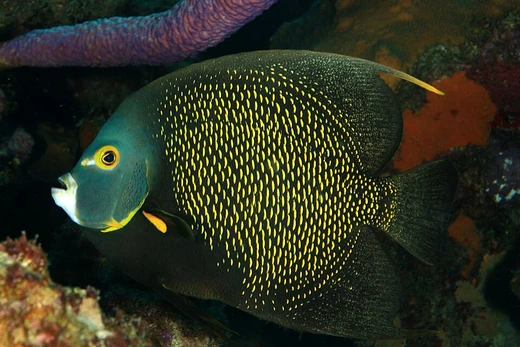
Pomacanthus paru
A slow-growing Caribbean reef fish with juvenile cleaning behavior.

Pomacanthus paru, commonly known as the French angelfish, is a slow-growing coral reef fish from the Caribbean. It belongs to the family Pomacanthidae, which includes other marine angelfish, and its closest relative is the grey angelfish (P. arcuatus). The species is notable for its deep, vertically compressed body, black or dark gray coloration with bright yellow scale tips, and its role as a cleaner fish in juvenile stages.
Quick Facts
- Taxon
- Pomacanthus paru
Facts from the source article.
Lore & Background
The French angelfish was first formally described as Chaetodon paru by German physician and naturalist Marcus Elieser Bloch (1723–1799), with type localities given as Brazil and Jamaica. Its specific name, paru, is the Portuguese name for the species. The species is placed by some authorities in the subgenus Pomacanthus. It has a deep but vertically compressed body, a short snout, and a small mouth with bristle-like teeth. An obvious spine is present at the corner of the preoperculum, but no spines on the operculum or under the eye. Adults have black or dark gray bodies with bright yellow scale tips, a white mouth, yellow orbit, and a wide orange-yellow band on the pectoral fins. Juveniles are almost entirely black with five vertical yellow bands. The species is found in the western Atlantic from Florida to Brazil and the Caribbean, and in the eastern Atlantic around Ascension Island and St. Paul's Rocks, at depths from about 4.5 m to the mesophotic zone (30–150 m). Adults primarily feed on sponges (about 70% of diet), while juveniles act as cleaner fish, consuming ectoparasites on larger fish and sea turtles at cleaning stations. French angelfish form monogamous pairs, are highly territorial, and are active during daylight, returning to a hiding spot each night. They can produce a knocking sound when alarmed. Reproduction occurs around sunset, with pairs swimming upward in a wide curve; the species is a protogynous hermaphrodite. Although sympatric with grey angelfish, natural hybrids have not been observed, though artificial hybrids were produced in a laboratory in 1976.
Reader's Guide
The French angelfish is significant in both ecological and human contexts. Ecologically, it is a common inhabitant of rocky and coral reefs in the Caribbean and western Atlantic, where adults primarily consume sponges, and juveniles provide cleaning services to a variety of fish and sea turtles. Its monogamous pairing and territorial behavior distinguish it from its closest relative, the grey angelfish. The species is listed as least concern by the IUCN, but faces threats from the marine ornamental trade—being the fifth most exported fish in Brazil—and from bycatch. Its slow growth, late sexual maturity, and longevity (up to 27 years) make it vulnerable to overexploitation. For humans, it is common in the aquarium trade, has been bred in captivity, and is harvested for food, though it has been reported as a source of ciguatera poisoning. The species' ability to produce a knocking sound when alarmed and its protogynous hermaphroditism add to its biological interest. The lack of natural hybridization with the sympatric grey angelfish, despite laboratory success, highlights behavioral incompatibilities between the two species.
Did You Know?
- The French angelfish can produce a knocking sound when alarmed.
- Juveniles act as cleaner fish, feeding on ectoparasites of larger fish and sea turtles.
- The oldest recorded French angelfish in a 2016 study was 27 years old.
- The species is a protogynous hermaphrodite; a female can change sex to male if no male is present.
More in Marine Angelfish, Part 3 1-24
Spotted an error? Know more?
Reader corrections go straight into our review queue. Suggest an edit · How this site is sourced