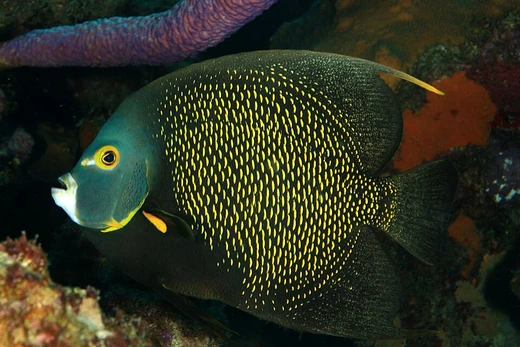
Pomacanthus navarchus
A small, colorful Indo-Pacific angelfish with a defensive gill spine.

The blue-girdled angelfish, also called the majestic angelfish (Pomacanthus navarchus), is a marine species found in the Indo-Pacific. It sometimes appears in the aquarium trade and is among the smallest of the larger angelfish types. This fish reaches a maximum length of 28 centimeters (11 inches), though it is usually much smaller, and can live up to 21 years. Younger individuals stay closer to shallow waters, while older fish can be found as deep as 120 feet (37 meters). Its diet consists mainly of sponges and tunicates. Juveniles are mostly blue with white stripes, but as they mature, they develop yellow coloring on the flanks, dorsal fin, and tail.
The body is laterally flattened. Adults display three main color sections: the area in front of the eyes and the front of the body is lemon yellow; the central section is funnel-shaped and deep blue; and the rear section is reticulated with bright yellow and blue. These sections are separated by pale blue bands edged with black. The mouth and lips are blue, as are the rays of the pectoral and anal fins, while the dorsal and caudal fins are yellow with pale blue edges. A long spine on the gill cover is used for defense. Juvenile fish are dark blue with slightly curved white lateral stripes. The transition from juvenile to adult coloring happens quite abruptly, with little intermediate coloration.
This species is native to the tropical Indo-Pacific, ranging from Indonesia and the Philippines to northern and eastern Australia, the Great Barrier Reef, Micronesia, and Hawaii. It lives at depths down to about 40 meters (130 feet) on outer reef slopes, channels, and lagoons in coral-rich habitats.
Pomacanthus navarchus is territorial and usually found alone, though occasionally in pairs or small groups. It inhabits the demersal zone, feeding on sponges, algae, tunicates, zooplankton, and small invertebrates. It is a protogynous hermaphrodite, beginning adult life as a female and later becoming a male.
Quick Facts
- Taxon
- Pomacanthus navarchus
Facts from the source article.
Lore & Background
The body of Pomacanthus navarchus is laterally flattened. Adult fish have three main colored sections: the anterior section in front of the eyes and the front part of the body is lemon yellow; the central section is funnel-shaped and deep blue; and the posterior section is reticulated in bright yellow and blue. These sections are separated by pale blue bands edged with black. The mouth and lips are blue, as are the rays of the pectoral and anal fins, while the dorsal and caudal fins are yellow, edged with pale blue. There is a long spine on the gill cover used in defence. Juvenile fish are dark blue with slightly curved, white lateral stripes. The change from juvenile to adult coloring takes place quite abruptly, with little intermediate coloring.
Pomacanthus navarchus is native to the tropical Indo-Pacific region, ranging from Indonesia and the Philippines to northern and eastern Australia, the Great Barrier Reef, Micronesia, and Hawaii. It can be found at depths down to about 40 m (130 ft) on outer reef slopes, channels and lagoons in coral-rich habitats. Younger fish stay closer to the shallows, but more mature fish can be found up to 120 feet (37 m) deep.
The species is territorial and is generally found alone, but occasionally in pairs or small groups. It inhabits the demersal zone, feeding mainly on sponges and tunicates, as well as algae, zooplankton and small invertebrates. It is a protogynous hermaphrodite, starting adult life as a female and later becoming a male.
Reader's Guide
Pomacanthus navarchus is notable as one of the smallest of the larger angelfish species, reaching a maximum length of 28 centimetres but usually much smaller. It can live up to 21 years. Its striking adult coloration—lemon yellow, deep blue, and reticulated yellow and blue sections separated by pale blue bands edged with black—makes it a visually distinctive reef fish. The long spine on the gill cover serves as a defence mechanism. The species is protogynous, beginning adult life as a female and later transitioning to male. Its diet consists primarily of sponges and tunicates, supplemented by algae, zooplankton, and small invertebrates. Found across a wide Indo-Pacific range from Indonesia to Hawaii, it inhabits coral-rich outer reef slopes, channels, and lagoons down to about 40 meters. Juveniles are dark blue with white stripes and stay in shallower waters, while adults venture deeper. The species occasionally enters the aquarium trade, though its territorial nature and specific dietary needs make it a challenging captive subject.
Did You Know?
- Pomacanthus navarchus is one of the smallest of the larger species of angelfish.
- It can live to be up to 21 years old.
- Juvenile fish are mostly blue with white stripes, and the change to adult coloring is abrupt.
More in Marine Angelfish, Part 3 1-24
Spotted an error? Know more?
Reader corrections go straight into our review queue. Suggest an edit · How this site is sourced