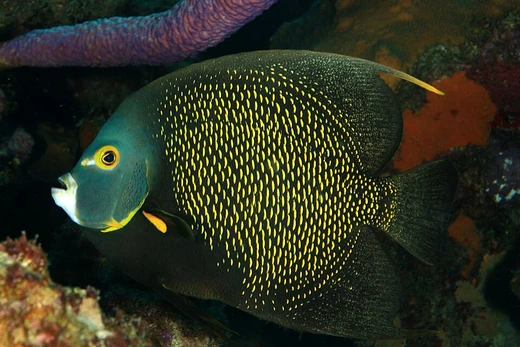
Pomacanthus maculosus
A solitary marine angelfish with a distinctive yellow bar.

The yellowbar angelfish, also called the half-moon, yellow-marked, yellowband, or yellow-blotched angelfish, is a marine ray-finned fish in the family Pomacanthidae. Its scientific name is *Pomacanthus maculosus*. This species lives in the western Indian Ocean and, since 2008, has been occasionally spotted in the eastern Mediterranean Sea.
Adults have a deep, compressed body and a small mouth lined with bristle-like teeth. A noticeable spine sits at the angle of the preoperculum. The soft-rayed parts of the dorsal and anal fins extend into filaments that reach past the caudal fin. The body is brownish blue, with each scale edged in blue, giving an overall blue impression. A ragged yellow bar runs near the middle of the flanks, and dark blue, vertically elongated spots appear toward the head. The caudal fin is pale yellow with wavy blue lines. Juveniles are mostly black, marked with many curved, vertical blue lines and three broader white lines; only the rear third of the tail is yellow. The dorsal fin has 12–13 spines and 21 soft rays, while the anal fin has 3 spines and 19–20 soft rays. Maximum total length is 50 cm (20 in).
This angelfish occurs in the Red Sea, Persian Gulf, and Gulf of Oman. It has been recorded on rare occasions in the eastern Mediterranean since 2008, and also off Florida and Brazil, likely from deliberate aquarium releases.
It lives at depths of 4 to 50 meters (13–164 ft), typically alone in sheltered areas with a mix of coral and silt. Its diet consists mainly of sponges and tunicates, but it will eat other invertebrates when available. Females reach sexual maturity at about 5.5 years old and 21.6 cm (8.5 in) total length. Maximum lifespan is thought to be 36 years. Divers describe the species as curious and not shy. It is a protogynous hermaphrodite: older females can change sex to become males if males are scarce. The larvae are planktonic.
The species was first formally described in 1775 as *Chaetodon maculosus* by the Finnish-born Swede Peter Forsskål (1732–1763), with the type locality given as Al-Luhayya, Yemen. Some authorities place it in the subgenus *Arusetta*. The specific name *maculosus* means "spotted," referring either to the blue spots on the scales or the large yellow blotch.
Quick Facts
- Taxon
- Pomacanthus maculosus
Facts from the source article.
Lore & Background
Pomacanthus maculosus has a deep and compressed body with a small mouth equipped with small bristle-like teeth. It has an obvious spine at the angle of the preoperculum. Adults have filaments extending back from the soft-rayed parts of the dorsal and anal fins, reaching past the caudal fin. The background colour of adults is brownish blue, with each scale having a blue margin creating the impression that it is predominantly blue. There is an uneven, yellow bar close to the centre of the flanks with dark blue, vertically elongated spots towards the head. The caudal fin has wavy, blue lines on a pale yellow background. Juveniles are mainly black marked with many arced, vertical blue lines and three broader white lines; only the rear third of the caudal fin is yellow.
This species is found in the Red Sea, Persian Gulf and Gulf of Oman. It has been recorded on distinct but uncommon occasions since 2008 in the eastern Mediterranean Sea. It has also been recorded off Florida and Brazil, regarded as an instance of deliberate releases from an aquarium. It is a solitary species that lives in sheltered areas, often where there is a mixture of coral and silt. Its diet is dominated by sponges and tunicates, although other invertebrates will be eaten opportunistically. Females attain sexual maturity at around 5.5 years of age and a total length of 21.6 cm. The maximum longevity is thought to be 36 years. Divers have noted that this is a curious species and is not shy. They are protogynous hermaphrodites, and older females can change sex to become males when there is a shortage of males. The larvae are planktonic.
Reader's Guide
Pomacanthus maculosus is occasionally collected for the aquarium trade. In some parts of the Persian Gulf it has been recorded in fish markets. The species was first formally described in 1775 as Chaetodon maculosus by Peter Forsskål, with the type locality given as Al-Luhayya, Yemen. Some authorities place this species in the subgenus Arusetta. The specific name maculosus means 'spotted' and is a reference to either the blue spots on the scales or the large yellow blotch. Its presence in the eastern Mediterranean since 2008, and records off Florida and Brazil attributed to aquarium releases, highlight its adaptability and the impact of human activity on marine species distribution. The species' protogynous hermaphroditism and long lifespan of up to 36 years contribute to its biological interest. Its curious and non-shy nature, noted by divers, makes it a notable subject for observation in its natural habitat.
Did You Know?
- Pomacanthus maculosus attains a maximum total length of 50 cm (20 in).
- It has been recorded in the eastern Mediterranean Sea on distinct but uncommon occasions since 2008.
More in Marine Angelfish, Part 3 1-24
Spotted an error? Know more?
Reader corrections go straight into our review queue. Suggest an edit · How this site is sourced