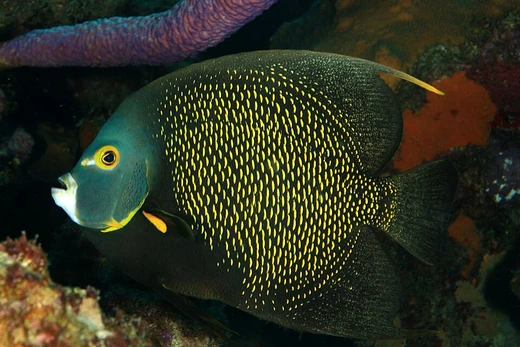
Pomacanthus asfur
A shy, solitary angelfish of the western Indian Ocean.

Pomacanthus asfur, commonly known as the Arabian angelfish, is a species of marine ray-finned fish in the family Pomacanthidae. It is notable for its striking color transformation from juvenile to adult and for being a protogynous hermaphrodite.
Quick Facts
- Taxon
- Pomacanthus asfur
Facts from the source article.
Lore & Background
Pomacanthus asfur was first formally described in 1775 by Danish zoologist Johan Christian Fabricius, though it has commonly been attributed to Peter Forsskål. The type locality is Al-Luhayya, Yemen, and the specific name 'asfur' is the species' Arabic name in Yemen. Some authorities place it in the subgenus Arusetta, of which it is the type species.
Juveniles have a blue body with pale-blue and white stripes. As they mature, yellow markings appear on the dorsal and caudal fins. Fully mature adults have an overall dark blue body with a blackish face, a yellow caudal fin, and a broad crescent-shaped yellow band vertically across the flanks. It is a protogynous hermaphrodite, with larger fish in a pair changing sex to become male.
Its diet is dominated by sponges and tunicates. It is a solitary and shy fish, normally recorded near caves or crevices in the reef, and divers find it difficult to approach. It is common on sheltered inshore reefs with rich coral growth and patches of silty seabed.
Reader's Guide
Pomacanthus asfur is infrequently found in the aquarium trade, though it has been bred in captivity and captive-bred specimens are sometimes marketed as 'half-moon angelfish'. Its principal distribution is the western Indian Ocean, including the Red Sea, Gulf of Aden, eastern Africa as far south as Zanzibar, and the Persian Gulf. It has been recorded, as a probable release of aquarium specimens, off the eastern coast of Florida and from Malta, and several specimens have been observed in the Mediterranean waters of Israel and Lebanon. The species attains a maximum total length of 40 cm and is found at depths between 3 and 30 metres. Its shy, solitary nature and striking adult coloration make it a notable species among marine angelfish, though its wild populations are not heavily exploited.
Did You Know?
- Adults have a broad crescent-shaped yellow band running vertically across the flanks.
- It is a protogynous hermaphrodite, with larger fish changing sex to become male.
Frequently Asked Questions
Who is Pomacanthus asfur?
Pomacanthus asfur, widely called the Arabian angelfish, is a marine ray-finned species belonging to the family Pomacanthidae. It is a shy, solitary fish native to the western Indian Ocean and is best recognized by its dramatic shift in coloration as it matures from a juvenile into an adult.
What are Pomacanthus asfur's powers/role?
Its most celebrated biological trait is a protogynous hermaphroditic life cycle: every individual begins life as a female and can later transition to a male role within the reef community. Coupled with its bold juvenile-to-adult color transformation, this makes it one of the most visually and reproductively dynamic members of the angelfish family.
Why is Pomacanthus asfur important?
As a mid-level reef predator it helps regulate populations of smaller invertebrates and fish, keeping the western Indian Ocean reef community in balance. Its striking two-stage coloration and sex-change biology also make it a key study subject for marine biologists researching developmental genetics and reef ecology.
How big does Pomacanthus asfur get and what does its body look like?
Adults reach roughly 40 cm (16 in) total length and carry 12 dorsal spines backed by 19–20 soft dorsal rays, 3 anal spines with 19–20 anal soft rays, and 17 or 18 pectoral-fin rays. This fin architecture gives the species its characteristic tall, laterally compressed silhouette that fans instantly recognize in the water column.
More in Marine Angelfish, Part 3 1-24
Spotted an error? Know more?
Reader corrections go straight into our review queue. Suggest an edit · How this site is sourced