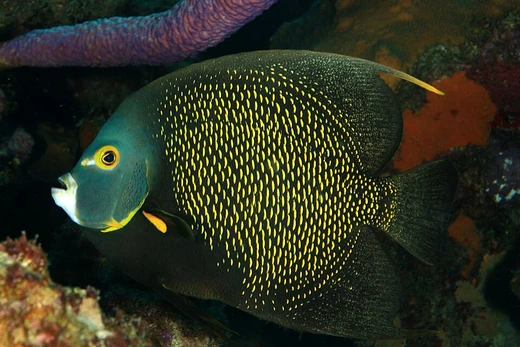
Old woman angelfish
A drab adult angelfish from the western Indian Ocean.

The old woman angelfish (Pomacanthus rhomboides) is a marine angelfish from the family Pomacanthidae, found in the western Indian Ocean. Adults are likely the least colorful members of their genus, with a bronze-brown front two-thirds of the body and a pale bluish-gray rear third. Juveniles resemble other young angelfish in the genus and are more vivid, mainly black with thin blue and white lines. The dorsal fin has 11 to 13 spines and 22 to 25 soft rays, while the anal fin has 3 spines and 21 to 23 soft rays. This species can reach a total length of 46 centimeters (18 inches).
Its range extends from Maputo Bay in Mozambique south along South Africa’s coast to Knysna in the Western Cape. It lives along shorelines and on rocky reefs at depths between 5 and 30 meters (16 to 98 feet). Juveniles inhabit shallow tidal pools, while adults form small groups near the coast, feeding on algae and benthic invertebrates, and occasionally swimming near the surface to eat plankton.
First formally described in 1908 as *Holacanthus rhomboides* by Scottish ichthyologist John Dow Fisher Gilchrist and South African colleague William Wardlaw Thompson, with the type locality given as KwaZulu-Natal. Some authorities place it in the subgenus *Acanthochaetodon*. Its specific name *rhomboides* means “rhombus-like,” likely referring to its deep, almost quadrangular body.
Because its range does not overlap with the main areas of Africa’s coast where fish are collected for the aquarium trade, the old woman angelfish is extremely rare in that trade.
Quick Facts
- Taxon
- Pomacanthus rhomboides
Facts from the source article.
Lore & Background
The old woman angelfish was first formally described in 1908 as Holacanthus rhomboides by the Scots ichthyologist John Dow Fisher Gilchrist and his South African colleague William Wardlaw Thompson, with the type locality given as KwaZulu-Natal. The species is placed by some authorities in the subgenus Acanthochaetodon. Its specific name rhomboides means 'rhombus-like', possibly a reference to its deep, almost quadrangular body.
Adults are bronze brown on the anterior two thirds of their bodies with the posterior third being pale bluish grey. Juveniles resemble those of other species in the genus and are more colourful, mainly black with thin, wavy blue and white lines. The species attains a maximum total length of 46 centimetres.
It is found from Maputo Bay in Mozambique southwards along the coast of South Africa as far as Knysna in the Western Cape. It inhabits shorelines and rocky reefs at depths between 5 and 30 m, with juveniles found in shallow tidal pools. Adults live in small groups close to the coast, feeding on algae and benthic invertebrates, and occasionally swim near the surface to feed on plankton.
Reader's Guide
The old woman angelfish is notable primarily for its subdued adult coloration, described as possibly the least colourful of the genus Pomacanthus, contrasting with the more vivid juveniles. Its distribution is restricted to the western Indian Ocean, from Mozambique to South Africa, and it does not overlap with the main areas of Africa's coast where fish are collected for the aquarium trade. Consequently, it is extremely rare in that trade. The species was described in 1908 by Gilchrist and Thompson, and some authorities place it in the subgenus Acanthochaetodon. Its specific name, rhomboides, likely refers to its deep, almost quadrangular body shape. The fish lives in small groups near the coast, feeding on algae, benthic invertebrates, and occasionally plankton near the surface. Its limited range and rarity in the aquarium trade make it an uncommon species in both scientific collections and the hobby.
Did You Know?
- Adults are bronze brown on the anterior two thirds and pale bluish grey on the posterior third.
- It is found from Maputo Bay in Mozambique to Knysna in South Africa.
More in Marine Angelfish, Part 3 1-24
Spotted an error? Know more?
Reader corrections go straight into our review queue. Suggest an edit · How this site is sourced