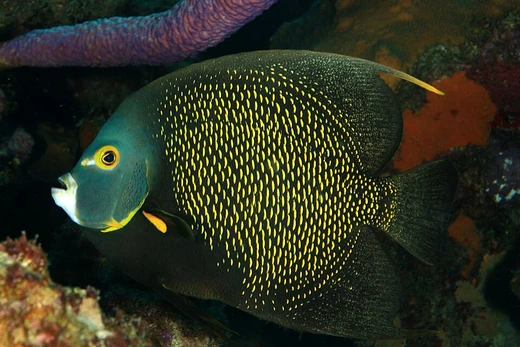
Halfcircle angelfish
A marine angelfish with distinct juvenile and adult color patterns.

The halfcircle angelfish (Pomacanthus semicirculatus) is a species of ray-finned fish in the family Pomacanthidae, found in the Indo-West Pacific Ocean. It is also known as the semicircled angelfish, Koran angelfish, blue angelfish, zebra angelfish, or half-circled angelfish, and occasionally makes its way into the aquarium trade.
Quick Facts
- Taxon
- Pomacanthus semicirculatus
Facts from the source article.
Lore & Background
Pomacanthus semicirculatus was first formally described as Holacanthus semicirculatus in 1831 by French anatomist Georges Cuvier, with type localities including Timor, Bourou, Waigeo, Indonesia, and Port Praslin, New Ireland Island, Bismarck Archipelago in Papua New Guinea. The specific name semicirculatus means 'semicircular,' referring to the semicircular slender blue and white lines on the rear of the body in juveniles, which are lost in adults. Some authorities place this species in the subgenus Arusetta.
Adults are brownish green with scales edged in blue, creating a blue speckling over the body and tail. All fins except the plain yellow pectoral fins have blue margins, and the dorsal and anal fins have long, filamentous growths. Juveniles are blue-black with narrow white stripes that are fairly straight at the head end but become increasingly curved toward the tail base. Juveniles gradually adopt adult coloration when they reach 8 to 16 centimeters in length.
The species is found in the Indo-Pacific region, from the eastern coast of Africa (southern Red Sea coast of Sudan to South Africa) east across the Indian and Pacific Oceans to Fiji, Tonga, and Samoa, and as far north as southern Japan and south to Australia. Within Australian waters, it ranges from the Houtman Abrolhos of Western Australia around the coast to Sydney, with juveniles extending farther south to Merimbula. It also occurs at Christmas Island, the Cocos (Keeling) Islands, and Lord Howe Island. It has been seen sporadically off the east coast of Florida since 1999 and at Oahu, Hawaii since 2005.
Reader's Guide
The halfcircle angelfish is notable for its striking ontogenetic color change, with juveniles displaying semicircular white stripes that give the species its common name. This species is frequently encountered in the aquarium trade, though its collection is limited by its natural distribution in the Indo-West Pacific. In the wild, it inhabits sheltered coral reefs at depths between 1 and 40 meters, where it feeds on algae, tunicates, and sponges. Juveniles are very timid and difficult to approach, preferring shallow sheltered areas, while adults favor coastal reefs with rich coral growth that provides hiding places. Adults are typically encountered in pairs or as solitary individuals and have been recorded from wrecks. The species' sporadic appearances off Florida since 1999 and in Hawaii since 2005 suggest possible introductions or range expansions, though the article does not specify the cause. Its maximum total length of 40 centimeters makes it a moderately sized angelfish for the aquarium trade, and its distinctive juvenile patterning remains a key identifying feature until the fish reaches 8 to 16 centimeters in length.
Did You Know?
- The specific name semicirculatus means 'semicircular,' referring to the semicircular blue and white lines on juvenile fish.
- Adults have long, filamentous growths from the dorsal and anal fins.
More in Marine Angelfish, Part 3 1-24
Spotted an error? Know more?
Reader corrections go straight into our review queue. Suggest an edit · How this site is sourced