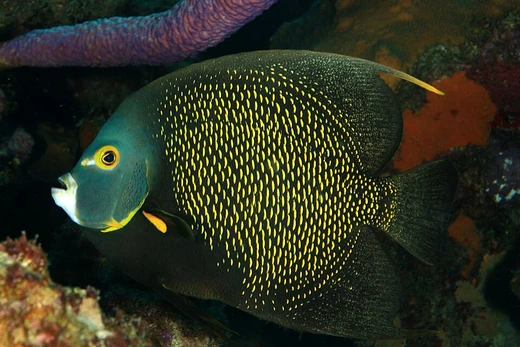
Goldtail angelfish
A marine angelfish of the western Indian Ocean.

The goldtail angelfish (Pomacanthus chrysurus), also called the earspot angelfish, is a marine ray-finned fish in the Pomacanthidae family. It lives in the western Indian Ocean. Unlike most other marine angelfish in its genus, the young and adults look quite similar. Juveniles have a blackish-brown body with many white vertical bars, a paler, more orange face marked with uneven blue lines, and a yellow tail fin. When they reach about 4 cm long, a white bar appears on the tail base. Both young and adults have a black spot on the upper front part of the body. Adults differ by having a darker face and no white bar on the tail base. The dorsal fin has 13–14 spines and 17–19 soft rays; the anal fin has 3 spines and 18–19 soft rays. They can grow up to 33 cm long. This fish is found from the Gulf of Aden south along East Africa to KwaZulu-Natal, including Madagascar, the Comoro Islands, and the Seychelles. It lives at depths of 1 to 30 meters on shallow coral or rocky reefs. Adults mainly eat sponges, tunicates, crustaceans, and zooplankton, while juveniles, found in shallower water, consume lots of algae. Otherwise, little is known about its biology. First described in 1831 by Georges Cuvier as Holocanthus flavissimus, the type locality may be an error for Madagascar. Some experts place it in the subgenus Acanthochaetodon. Its species name chrysurus means “gold tail,” referring to the yellow tail fin. It is rarely collected for the aquarium trade, and most available specimens come from Kenya.
Quick Facts
- Taxon
- Pomacanthus chrysurus
Facts from the source article.
Lore & Background
The goldtail angelfish was first formally described as Holocanthus flavissimus in 1831 by the French anatomist Georges Cuvier, with the type locality given as Dorey Harbor, New Guinea, which could be an error for Madagascar. Some authorities place this species in the subgenus Acanthochaetodon. The specific name chrysurus is a compound of chrysis meaning 'gold' and urus meaning 'tail', a reference to the yellow caudal fin. Juveniles have blackish-brown bodies marked with many white vertical bars, a paler orangey face with uneven blue lines, and a yellow caudal fin. A white bar appears on the caudal peduncle when the fish reaches around 4 cm (1.6 in) in length. Both juveniles and adults have a black spot on the upper anterior portion of the body. Adults are similar to juveniles but have a dark face and lack the white bar on the caudal peduncle. The goldtail angelfish is found from the Gulf of Aden south along the coast of Eastern Africa as far as KwaZulu Natal, including Madagascar, the Comoro Islands, and the Seychelles. It inhabits shallow reefs with rich coral growth or rocky reefs at depths between 1 and 30 metres.
Reader's Guide
The goldtail angelfish is infrequently collected for the aquarium trade and does not often make it to market; most commercially available specimens originate from Kenya. Its biology is otherwise little known. Adults feed primarily on sponges, tunicates, crustaceans, and zooplankton, while juveniles, found in much shallower water, consume large quantities of algae. The species attains a maximum total length of 33 cm (13 in). The dorsal fin has 13–14 spines and 17–19 soft rays, while the anal fin has 3 spines and 18–19 soft rays. The goldtail angelfish is distinguished by the black spot on the upper anterior portion of the body present in both juveniles and adults, and by the yellow caudal fin that gives it its common name. Its limited availability in the aquarium trade and the uncertainty surrounding its type locality add to its interest among marine fish enthusiasts.
More in Marine Angelfish, Part 3 1-24
Spotted an error? Know more?
Reader corrections go straight into our review queue. Suggest an edit · How this site is sourced