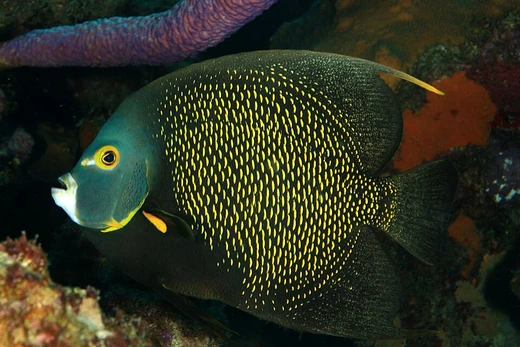
French angelfish
A slow-growing Caribbean reef fish with distinctive juvenile cleaning behavior.

The French angelfish (Pomacanthus paru) is a slow-growing coral reef fish from the Caribbean, belonging to the family Pomacanthidae. Its closest relative is the grey angelfish (P. arcuatus). It is notable for its deep, vertically compressed body, black or dark gray coloration with bright yellow scale tips, and a long yellow filamentous extension on the dorsal fin. Juveniles are almost completely black with five vertical yellow bands and act as cleaner fish, feeding on ectoparasites of larger fishes and sea turtles.
Quick Facts
- Taxon
- Pomacanthus paru
Facts from the source article.
Lore & Background
The French angelfish was first formally described as Chaetodon paru by the German physician and naturalist Marcus Elieser Bloch (1723–1799), with type locality given as Brazil and Jamaica. The specific name paru is the Portuguese name for this species. It is placed by some authorities in the subgenus Pomacanthus. The species is found in the western Atlantic from Florida to the Gulf of Mexico and down to Brazil and the Caribbean, including the Antilles and Roatan, and in the eastern Atlantic around Ascension Island and St. Paul's Rocks. It inhabits depths above about 4.5 m (15 ft) and has been reported in the mesophotic zone between 30 m and 150 m (100–500 ft).
Adults primarily feed on sponges (about 70% of diet), using comb-like teeth to grind sponge pieces. Juveniles feed on ectoparasites of larger fishes and establish cleaning stations, where they also clean green sea turtles' heads, carapace, and plastron. As juveniles grow, they become more generalist in sponge consumption, with larger juveniles eating more sponges than smaller ones. French angelfish are monogamous and form pairs that are highly territorial, defending their territory from neighbors. They are active during daylight and return to a designated hiding spot each night, and can produce a knocking sound when alarmed.
Reader's Guide
The French angelfish is common in the aquarium trade, with collection and export to the United States and European markets being common in Brazil. It has been bred in captivity. It is also harvested for food, with its flesh considered highly palatable, though it has been reported as a source of ciguatera poisoning. According to the IUCN, it is currently listed as least concern, but the article notes it may move to near threatened or vulnerable due to the marine ornamental trade—in Brazil it is the fifth most exported fish in the trade—and bycatch. The longevity of large-bodied pomacanthids, their slow growth, late sexual maturity, and heavy exploitation put them at risk because they cannot quickly replenish their population. The species is sympatric with the closely related grey angelfish, but no natural hybrids have been observed; however, a laboratory hybrid was produced in 1976 by artificially mixing gametes, and the resulting juveniles were not clearly distinguishable from juvenile grey angelfish.
Did You Know?
- Juvenile French angelfish act as cleaner fish, feeding on ectoparasites of larger fish and cleaning green sea turtles at cleaning stations.
- The oldest French angelfish in a 2016 otolith study was 27 years old.
- French angelfish are monogamous, unlike their closest relative the grey angelfish which mates in polygamous groups.
- A laboratory hybrid between French and grey angelfish was produced in 1976, but no natural hybrids have been observed.
More in Marine Angelfish, Part 3 1-24
Spotted an error? Know more?
Reader corrections go straight into our review queue. Suggest an edit · How this site is sourced