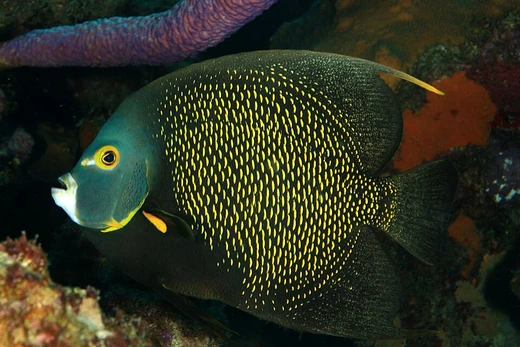
Emperor angelfish
A reef-associated fish with brilliant blue and yellow stripes.

The emperor angelfish (Pomacanthus imperator) is a species of marine angelfish native to the Indian and Pacific Oceans, from the Red Sea to Hawaii and the Austral Islands. It is a reef-associated fish noted for its unique, brilliant pattern of coloration, making it a favorite of photographers, artists, and aquarists.
Quick Facts
- Taxon
- Pomacanthus imperator
Facts from the source article.
Lore & Background
The emperor angelfish was first formally described in 1787 as Chaetodon imperator by the German physician and naturalist Marcus Elieser Bloch, with the type locality given as Japan. Some authorities place this species in the subgenus Acanthochaetodon. The specific name imperator means 'emperor' and reflects the Dutch name Keyser van Iapan meaning 'Emperor of Japan' coined by the publisher Louis Renard around 1719, possibly reflecting its majestic appearance.
Juveniles have a dark blue body marked with concentric curving lines of pale blue and white, while adults are striped with blue and yellow horizontal stripes, a light blue face with a dark blue mask over the eyes, and a yellow caudal fin. Adult individuals of the Pacific Ocean population sport a filament trailing from the rear of the dorsal fin, absent in the Indian Ocean population. The species attains a maximum total length of 40 cm.
It is found at depths between 1 and 100 metres, with adults in areas of rich coral growth on clear lagoon, channel, or seaward reefs, often under ledges and within caves. Its diet comprises sponges and other encrusting organisms, as well as tunicates. They form pairs, and juveniles and adults may act as cleaner fish, cleaning ectoparasites off larger fishes. When frightened, these fish can produce a knocking sound.
Reader's Guide
The emperor angelfish is notable for its wide Indo-Pacific distribution, occurring from the Red Sea and East African coast to the Tuamotu Islands, Line Islands, southern Japan, the Great Barrier Reef, New Caledonia, and the Austral Islands. Vagrants have been recorded from Hawaii, and it has been recorded at several sites off the coast of Florida and off Puerto Rico. Since 2009, it has been observed as a Lessepsian migrant to the eastern Mediterranean basin, where it now occurs in low numbers in several localities.
The species is generally associated with stable populations and faces no major threats of extinction. It is common in the aquarium trade, and its unique, brilliant pattern of coloration makes it a favorite of photographers, artists, and aquarists. The article notes that the species shows a marked difference between juveniles and adults, and that Pacific and Indian Ocean populations differ in the presence of a dorsal fin filament. Its ability to act as a cleaner fish and produce a knocking sound when frightened adds to its biological interest.
Did You Know?
- The emperor angelfish was first described in 1787 as Chaetodon imperator by Marcus Elieser Bloch.
- Juveniles have concentric curving lines of pale blue and white on a dark blue body, while adults have horizontal blue and yellow stripes.
- Pacific Ocean adults have a filament trailing from the rear of the dorsal fin, which is absent in Indian Ocean adults.
- Since 2009, it has been recorded as a Lessepsian migrant in the eastern Mediterranean basin.
More in Marine Angelfish, Part 3 1-24
Spotted an error? Know more?
Reader corrections go straight into our review queue. Suggest an edit · How this site is sourced