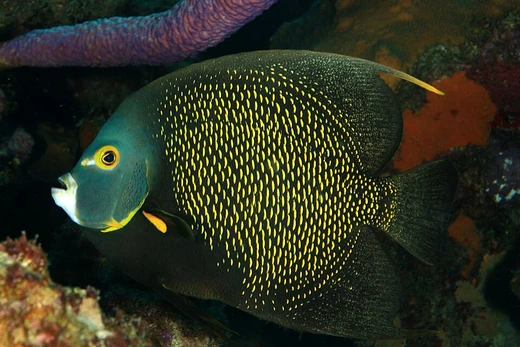
Bluering angelfish
A marine angelfish with blue rings and yellow body.

The bluering angelfish (Pomacanthus annularis), also called the annularis or blue king angelfish, is a type of marine ray-finned fish in the family Pomacanthidae. It belongs to the genus Pomacanthus, which includes large marine angelfish.
This species lives in the Indo-West Pacific, from East Africa through Indonesia and New Guinea to New Caledonia, and north to southern Japan. It inhabits coastal rocky coral reefs, and can also be found in caves or on shipwrecks, at depths between 3 and 30 meters.
Adults are mainly yellow, with curved blue lines across the body and a blue ring-shaped mark above the gill cover. The dorsal fin often has an elongated tip, and the tail fin is white with a yellow edge. Two blue stripes cross the face: one through the eye and another just below it. Juveniles are bluish-black with thin white or blue curved lines. The dorsal fin has 13 spines and 20–21 soft rays; the anal fin has 3 spines and 20 soft rays. Maximum total length is 45 cm.
Bluering angelfish are often seen in pairs. Like other Pomacanthus species, they live in harems: a male defends a territory and controls several females. After a courtship ritual, males and females release eggs and sperm. All juveniles start as females (sequential hermaphrodites), becoming males as they develop, with a complete color change from juvenile to adult. Juveniles prefer very shallow water with rock or dead coral and short filamentous algae. Adults eat zooplankton, sponges, filamentous algae, and tunicates.
The species was first formally described in 1795 as Chaetodon tricolor by German naturalist Marcus Elieser Bloch, with the type locality given as the Indian Ocean. Some authorities place it in the subgenus Acanthochaetodon. The specific name annularis means "ringed," referring to the ring on the body above the gill cover.
Bluering angelfish are rarely found in the aquarium trade.
Quick Facts
- Taxon
- Pomacanthus annularis
Facts from the source article.
Lore & Background
The bluering angelfish was first formally described in 1795 as Chaetodon tricolor by the German physician and naturalist Marcus Elieser Bloch, with the type locality given as the Indian Ocean. The specific name annularis means 'ringed', referring to the ring on the body above the gill cover. Some authorities place this species in the subgenus Acanthochaetodon.
Adults are mainly yellow with obvious arcing blue lines and a blue circle-shaped mark above the operculum. They frequently have an elongated tip to the dorsal fin, a white caudal fin with a yellow margin, and a pair of blue stripes across the face—one through the eye and one beneath it. Juveniles have a bluish-black overall color with thin white to blue curved lines on the body. The species attains a maximum total length of 45 cm.
Bluering angelfish inhabit coastal rocky coral reefs and may also be encountered in caves or on wrecks, at depths of 3–30 m. They are found in the Indo-West Pacific oceans from East Africa, throughout Indonesia and New Guinea to New Caledonia, north to southern Japan. Juveniles prefer very shallow waters with rock or dead coral substrates and short filamentous algae.
Reader's Guide
The bluering angelfish is a member of the genus Pomacanthus, which consists of large marine angelfish. Its biology includes a haremic social structure, where a male defends a territory and controls several females. After a courtship ritual, males and females release eggs and sperm. All juveniles begin life as females (sequential hermaphrodites), becoming males during development, with a complete color change from juvenile to adult stage. Adults mainly feed on zooplankton, sponges, filamentous algae, and tunicates. The species is infrequently found in the aquarium trade. Its distribution spans the Indo-West Pacific from East Africa to New Caledonia and southern Japan. The specific name annularis, meaning 'ringed', highlights the distinctive blue ring above the gill cover that characterizes the adult.
Did You Know?
- Its specific name annularis means 'ringed', referring to the blue ring above the gill cover.
- All juveniles are female at the beginning of life, becoming males during development.
More in Marine Angelfish, Part 3 1-24
Spotted an error? Know more?
Reader corrections go straight into our review queue. Suggest an edit · How this site is sourced