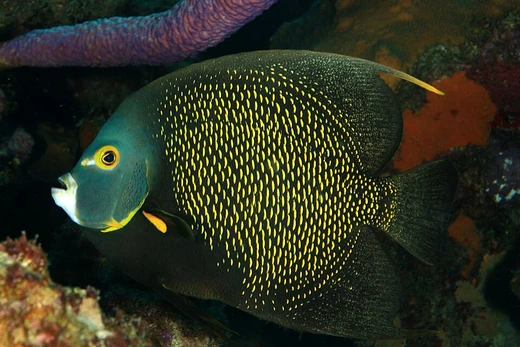
Blueface angelfish
A marine angelfish with a yellow mask and blue-lined face.

The blueface angelfish, also called the yellowface angelfish, is a marine ray-finned fish from the family Pomacanthidae. It lives in the shallow waters of the Indo-Pacific and is known for its vivid facial coloring.
First described in 1853 by Dutch ichthyologist Pieter Bleeker as *Holocanthus xanthometopon*, its scientific name means "yellow forehead," referring to the yellow mask across its eyes. Some experts place it in the subgenus *Euxiphipops*.
This fish inhabits coral reefs in the eastern tropical Indo-Pacific, including the Maldives, Malaysia, Indonesia, Japan, Taiwan, the Philippines, northern Australia, and Micronesia. It has occasionally been seen off Florida. It prefers lagoons, outer reef slopes, and channels down to about 25 meters deep, often near rocks and caves. Juveniles frequently hide inside caves.
Adults grow up to 38 centimeters long and have a laterally compressed body. The mouth sits just above the snout tip. The large, rounded fins are yellow, edged with blue. The dorsal fin, located just in front of the tail, has a black eyespot at its base and 13–14 spines and 16–18 soft rays. The anal fin has 3 spines and 16–18 soft rays. Pale blue scales edged with yellow create a reticulated pattern. The face is yellow with dense blue lines on the lower half and a plain yellow mask around the eyes. Juveniles look different: they have six vertical white bars separated by pale blue lines, and a tail fin barred in two shades of blue. They change color gradually after reaching 7 to 12 centimeters. It can be confused with the queen angelfish or blue angelfish, but those have completely blue faces and lack the tail eyespot.
The fish usually lives alone or in pairs, feeding on tunicates, sponges, other encrusting organisms, and algae. It lays eggs, scattering them on the seabed. The IUCN lists it as least concern because it is common across its wide range and faces no major threats.
It is uncommon in the aquarium trade; specimens typically come from dealers in the Philippines and Singapore.
Quick Facts
- Taxon
- Pomacanthus xanthometopon
Facts from the source article.
Lore & Background
Pomacanthus xanthometopon was first formally described in 1853 as Holocanthus xanthometopon by Dutch ichthyologist and herpetologist Pieter Bleeker, with the type locality given as Telok betong, Sumatra in Indonesia. Some authorities place the species in the subgenus Euxiphipops. Its specific name xantometopon means 'yellow forehead', referencing the yellow 'mask' across its eyes.
The species grows to a maximum length of 38 cm and is laterally compressed. Its face is yellow with a dense network of brilliant blue lines on the bottom half and a plain yellow mask around the eyes. The scales are pale blue edged with yellow, giving a reticulated pattern. Juveniles are quite differently colored, with six vertical white bars separated by pale blue lines and a caudal fin barred in two shades of blue; they change color gradually after reaching a length of 7 to 12 cm. The dorsal fin has a distinctive black eyespot at the base. This species can be confused with the queen angelfish or the blue angelfish, but both of those have a completely blue face and lack the caudal eyespot.
Reader's Guide
The blueface angelfish is found on coral reefs in the eastern part of the tropical Indo-Pacific, including the Maldive Islands, Malaysia, Indonesia, Japan, Taiwan, the Philippines, northern Australia, and Micronesia, and has occasionally been observed off the coast of Florida. It favors lagoons, outer reef slopes, and channels at depths down to about 25 meters, often among rocks and near caves; juveniles frequently live inside caves. It usually lives singly or in pairs and feeds on tunicates, sponges, other encrusting organisms, and algae. It is an egg-laying species that scatters its eggs on the seabed. The IUCN Red List considers the yellowface angelfish of least concern because it is common over most of its wide range and has no major threats. The species is uncommon in the aquarium trade; specimens that enter that trade are usually traded through dealers in the Philippines and Singapore.
Did You Know?
- It can be confused with the queen angelfish and blue angelfish, but those species have a completely blue face and lack the caudal eyespot.
- It has occasionally been observed off the coast of Florida, far from its main Indo-Pacific range.
Frequently Asked Questions
What is the blueface angelfish?
It is a marine ray-finned fish in the family Pomacanthidae, instantly recognizable by the bright yellow band across its eyes and the fine blue lines tracing the rest of its face. The species is also widely known under the alternate common name yellowface angelfish.
Where can you find the blueface angelfish in the wild?
This angelfish ranges across shallow coral reefs in the eastern tropical Indo-Pacific, with documented populations in the Maldives, Indonesia, the Philippines, Japan, Taiwan, and Malaysia. It generally occupies waters no deeper than about 25 metres (82 ft).
How large does a blueface angelfish grow?
Adults top out at roughly 38 centimetres (15 inches) in total length. Their fin structure includes 13 to 14 dorsal spines paired with 16 to 18 soft dorsal rays, plus 3 anal spines and 16 to 18 anal soft rays.
What does the blueface angelfish's scientific name actually mean?
Dutch ichthyologist Pieter Bleeker coined the binomial Holocanthus xanthometopon back in 1853, and the specific epithet breaks down to "yellow forehead," a direct reference to the yellow mask over the eyes. A number of modern taxonomists further sort the species into the subgenus Euxiphipops.
Why is the blueface angelfish's face so distinctive?
The fish earns its common name from the vivid yellow mask that wraps across both eyes, set off by contrasting blue lines on the surrounding facial skin. That bold two-tone pattern makes it easy to pick out even in a crowded reef community.
More in Marine Angelfish, Part 3 1-24
Spotted an error? Know more?
Reader corrections go straight into our review queue. Suggest an edit · How this site is sourced