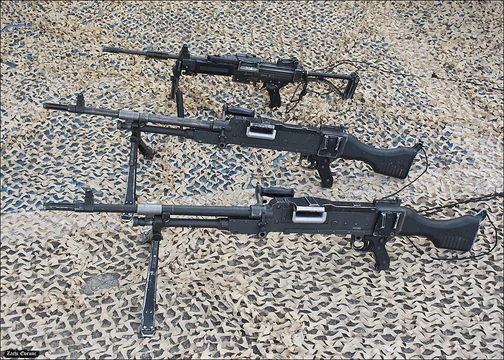
IWI Negev
Israeli light machine gun adopted in 1997, with 7.62mm variant from 2012.

The IWI Negev is a 5.56×45mm NATO light machine gun developed by Israel Weapon Industries (IWI), formerly Israel Military Industries Ltd. (IMI). It entered service with the Israel Defense Forces in 1997, replacing the Galil ARM, and is named after the Negev Desert in southern Israel. A 7.62×51mm NATO variant, the Negev NG-7, was introduced in 2012.
Quick Facts
- Service
- 1997–present
- Wars
- Second Intifada / 2006 Lebanon War / Gaza War (2008–2009) / War in Afghanistan (2001–2021) / Operation Protective Edge / Russo-Ukrainian War / Gaza war / 2025 Cambodia–Thailand conflict
- Designer
- Israel Military Industries
- Length
- 1,020 mm (stock extended) (Negev and Negev NG-5) · 1,100 mm (stock extended) (Negev NG-7)
- Action
- Gas-operated, rotating bolt
- Origin
- Israel
- Is Ranged
- yes
- Design Date
- 1985–1990
- Manufacturer
- Israel Weapon Industries / made under license by PLR Systems, India / Z111 Factory (licensed components and derived copies)
- Production Date
- 1995–present
- Weight
- 7.65 kg (Negev NG-5) / 7.6 kg (Negev NG-7) · 7.4 kg (STrL-7,62VN)
- Part Length
- 460 mm (Negev NG-5) / 508 mm (Negev NG-7)
Facts from the source article.
Lore & Background
Development of the Negev began in 1985 by Israel Military Industries to replace the Galil ARM. After extensive testing by the IDF Ordnance Corps, it entered service in 1997. The design uses a long-stroke gas piston system with a three-position gas regulator, and the barrel is quick-change, chrome-lined, and cold hammer forged. The iron sights consist of a front post and rear aperture with elevation adjustment from 300 to 1,000 m, and tritium vials are embedded for night operation. The sight rail is mounted to the frame, not the feed top cover, to maintain zero when optics are attached. The classic Negev had a welded adapter for optics, while the NG-5 and NG-7 have a standard Picatinny rail. The stock was originally a metal-tube folding design from the Galil; the NG-5 introduced an adjustable folding stock that allows full operation when folded. The bipod folds under the handguard, and the Negev SF 'Commando' variants include a 45-degree forward grip. The feed system copies the Czechoslovak Vz. 52 and PK, using a lever driven by the bolt carrier to push the belt during rearward movement.
Reader's Guide
The Negev's significance lies in its role as the standard light machine gun of the Israel Defense Forces, replacing the Galil ARM after a development period starting in 1985. Its design emphasizes reliability in adverse conditions, with a quick-change barrel and a gas system that accommodates different feed types. The introduction of the NG-7 in 2012 expanded its utility to the 7.62×51mm NATO cartridge, and subsequent variants like the Negev 7 ULMG (2023) offered lighter alternatives. The weapon's feed system, adapted from earlier designs, allows use of both belts and box magazines. The Negev has also been produced under license or adapted by other nations: Vietnam revealed the STrL-7,62VN in late 2024, chambered in 7.62×39mm, and India developed the Prahar derivative. The Indian Army selected the MEPRO X6 telescopic sight for its Negev NG-7s, with a technology transfer agreement for local production. The Negev's continued evolution and international adoption underscore its adaptability and the sustained demand for a reliable, modular light machine gun.
Did You Know?
- The Negev NG-7 was introduced in 2012, with NG standing for Next Generation.
- The Negev can feed from a 150-round fabric container or a 35-round Galil box magazine.
- A Vietnamese variant, the STrL-7,62VN, is chambered in 7.62×39mm and compatible with AK magazines and RPD belts.
More in Machine Guns 1-24
Spotted an error? Know more?
Reader corrections go straight into our review queue. Suggest an edit · How this site is sourced