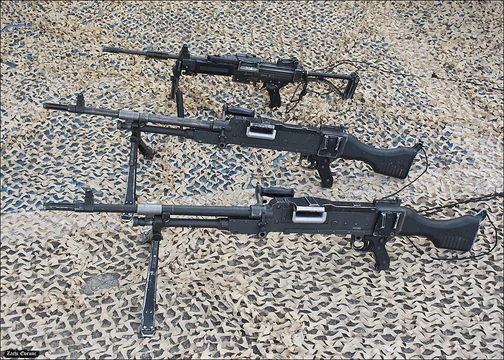
Saturation fire
Intense firepower to overwhelm and suppress enemy positions.

Fabjan · CC BY-SA 3.0
Saturation fire is a saturation attack using an intense level of artillery bombardment or rapid direct fire from automatic weapons such as machine guns, autocannons or rotary guns. It is designed to overwhelm a target area with lethal firepower for the purpose of suppression, area denial or mass destruction of the enemy.
- Type
- Saturation attack
- Methods
- Artillery bombardment, rapid direct fire from automatic weapons (machine guns, autocannons, rotary guns)
- Purpose
- Suppression, area denial, mass destruction of the enemy
Lore & Background
Saturation fire can be delivered through indirect artillery bombardment or direct fire from automatic weapons. In the Battle of the Bulge, German troops used Werfer rocket batteries to conduct saturation fire on Allied positions, particularly prior to an attack. During the Vietnam War, the US military used saturation fire against Vietnamese forces; in one example in 1972, US Air Force did saturation fire around a bunker where seven US advisers alongside a number of South Vietnamese ARVN soldiers were surrounded by NVA forces. AC-130 gunships incorporated side-firing 20 mm Gatling-style rotary cannons which allowed them to provide area-saturation fire as the aircraft circled over a target. Another use in the Vietnam War was with 'guntrucks' in convoys—2-ton cargo vehicles with two M-60 machine gunners that would provide a rapid, retaliatory saturation fire within the critical first 3 minutes of an enemy attack such as an ambush.
Reader's Guide
The use of automatic weapons for saturation fire has been criticized by a major US gun maker. The president of ArmaLite stated that using an automatic rifle such as his company's AR-15 for saturation fire can waste ammunition, a situation particularly problematic when soldiers have to carry their own ammunition. He argued that carefully aimed semi-automatic fire can be more effective than sweeping enemy positions with random full-automatic fire. US soldier Paul Howe supports this view, stating that 'volume [of full-automatic fire] in the wrong place is useless'. An author argues that the widespread use of automatic rifles such as the M16 by the US Army in Vietnam, Cambodia and Laos, along with the concept of saturation fire and general abandonment of the principles of individual marksmanship and weapon performance, led to military failures; he argues that there must be a balance between accuracy and firepower in the general application.
Did You Know?
- Saturation fire can be delivered by artillery, machine guns, autocannons, or rotary guns.
- During the Vietnam War, AC-130 gunships used side-firing 20 mm Gatling-style rotary cannons for area-saturation fire.
- German troops used Werfer rocket batteries for saturation fire in the Battle of the Bulge.
- The president of ArmaLite criticized saturation fire with automatic rifles as wasteful of ammunition.
Core Concept and Strategic Purpose
Saturation fire represents one of the most intense forms of military firepower application. Rather than targeting individual positions with precision, this tactic floods an entire area with lethal rounds—whether through artillery shells, rocket salvos, or the rapid stream of bullets from automatic weapons like machine guns, autocannons, and rotary cannons. The strategic intent behind this overwhelming volume is threefold: to suppress enemy combatants so they cannot return fire or maneuver, to deny them use of a particular area entirely, or to achieve outright mass destruction of hostile forces. The defining characteristic is intensity; the volume of fire is deliberately pushed to a level that makes resistance or movement within the target zone virtually impossible. This approach contrasts sharply with precision strikes, prioritizing sheer density of rounds over surgical accuracy.
Artillery and Aerial Bombardment in Historical Conflicts
Saturation fire through indirect fire has deep roots in major conflicts. In the Battle of the Bulge, German forces employed Werfer rocket batteries to saturate Allied positions with devastating volume, typically timed just before ground assaults to break enemy cohesion and morale. Benjamin Colby has also linked the concept to the 1945 fire-bombing of Dresden, arguing the U.S. campaign constituted a form of saturation bombardment. During the Vietnam War, American forces repeatedly turned to this approach against Vietnamese opponents. A particularly dramatic instance occurred in 1972, when U.S. Air Force assets delivered saturation fire around a bunker where seven American advisers and several South Vietnamese ARVN soldiers had been pinned down for days under relentless NVA assault. The bombardment was intended to relieve the besieged garrison by overwhelming the surrounding enemy positions with an unrelenting curtain of ordnance.
Small Arms, Gunships, and Convoy Defense
At the ground level, saturation fire takes on a different character through high-rate-of-fire automatic weapons. German military doctrine has long emphasized that laying down a dense curtain of small-arms fire keeps the enemy's heads down while friendly troops close the distance to their objective. In Vietnam, the AC-130 gunship embodied this principle at scale, mounting side-firing 20 mm Gatling-style rotary cannons that could sweep a target area with continuous area-saturation fire as the aircraft circled overhead. Convoy operations offered another application: so-called guntrucks—2½-ton cargo vehicles crewed by two M-60 machine gunners—were tasked with delivering rapid retaliatory saturation fire within the critical first three minutes of an ambush, overwhelming attackers before they could reorganize. These examples show how saturation fire scales from squad-level weapons to heavy platforms, always centered on overwhelming volume.
Criticism and the Accuracy-versus-Firepower Debate
Not all military thinkers embrace saturation fire as an optimal tactic. The president of ArmaLite, a major U.S. firearms manufacturer, publicly criticized the practice of using automatic rifles like the AR-15 for saturation fire, warning that it squanders ammunition—a severe liability when infantrymen must carry their own supply. He contended that carefully placed semi-automatic rounds could prove more effective than indiscriminate full-auto sweeps across enemy positions. U.S. soldier Paul Howe echoed this sentiment, observing that volume of fire directed at the wrong location is simply useless. A military author went further, arguing that the widespread adoption of automatic rifles such as the M16 across Vietnam, Cambodia, and Laos, combined with an embrace of saturation fire and a general abandonment of individual marksmanship principles, contributed to operational failures. He insisted that effective combat requires a balance between accuracy and firepower rather than an unqualified preference for one over the other.
Gallery



Frequently Asked Questions
What exactly is Saturation Fire?
Saturation Fire is a type of saturation attack that blankets a target zone with an overwhelming volume of lethal firepower. It relies on either heavy artillery bombardment or rapid direct fire from automatic weapons to flood the area with rounds.
Which weapons deliver Saturation Fire?
The tactic can be executed through artillery bombardment or by rapid direct fire from machine guns, autocannons, and rotary guns. The common thread is the extremely high rate of fire needed to saturate the zone.
What is the primary purpose of Saturation Fire?
Its goals are threefold: suppressing enemy positions so they cannot return effective fire, denying the enemy use of a particular area, and inflicting mass destruction on hostile forces. In practice, all three objectives often overlap in a single engagement.
How does Saturation Fire differ from a standard volley or burst?
A standard volley or burst fires a limited number of rounds, whereas Saturation Fire sustains an intense, continuous volume of fire until the target area is fully overwhelmed. The emphasis is on quantity and duration of lethality rather than a single precise shot.
Why is Saturation Fire considered a key doctrine in modern infantry and armored warfare?
Because it is specifically engineered to break enemy morale and capability by making any position untenable under the sheer weight of incoming rounds. It forces defenders into suppression, clears areas for advancing troops, and can eliminate large concentrations of enemy personnel or equipment in a short window.
More in Machine Guns 1-24
Spotted an error? Know more?
Reader corrections go straight into our review queue. Suggest an edit · How this site is sourced