Synchronization gear
A device allowing forward-firing guns to shoot through a spinning propeller arc.

Unknown author · Public domain
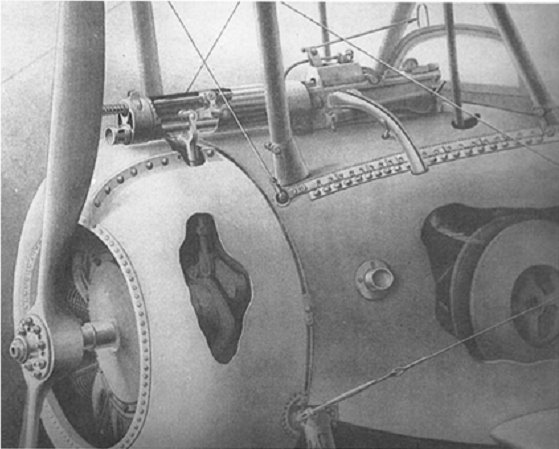
A synchronization gear, also called a gun synchronizer or interrupter gear, allowed a single-engine tractor aircraft to fire its forward-facing guns through the spinning propeller arc without hitting the blades. This meant the pilot aimed the whole aircraft at the target rather than moving the gun separately. All known gears worked by actively triggering each shot, like a semi-automatic weapon.
Practical problems came from the imprecise nature of automatic gunfire, the high and varying speed of propeller blades, and the extreme speed at which any synchronizing mechanism had to operate. Design work began in France and Germany in 1913–1914, following ideas from August Euler, who first suggested mounting a fixed forward-firing gun in 1910. The first operational—though far from reliable—gear appeared on the Fokker Eindecker fighters, which entered German squadron service in mid-1915. The Eindecker’s success led to many synchronization devices, culminating in the reasonably reliable hydraulic Romanian Constantinesco gear of 1917. By the end of World War I, German engineers were perfecting an electric gear using an electro-mechanical solenoid to trigger the gun, instead of a mechanical or hydraulic link.
From 1918 to the mid-1930s, standard fighter armament remained two synchronized rifle-caliber machine guns firing through the propeller arc. In the late 1930s, fighters were increasingly tasked with destroying large all-metal bombers, for which this armament was inadequate. Fitting more than two guns in the limited space of a single-engine fuselage was impractical, so guns were mounted in the wings instead, firing outside the propeller arc and requiring no synchronization. Synchronization became unnecessary on all aircraft with the arrival of jet propulsion, which eliminated propellers.
The mechanism can be described as "interrupting" the gun’s fire or as "synchronizing" or "timing" it to the propeller’s revolutions. These terms are somewhat misleading. "Interrupter" implies the gear pauses fire when a blade passes the muzzle. But even slow World War I propellers turned two or three times for each shot a machine gun could fire. A two-bladed propeller could obstruct the gun up to six times per firing cycle, a four-bladed one twelve times—over forty interruptions per second while firing only about seven rounds per second.
- First operational service
- Fokker Eindecker fighters, mid-1915
- Notable later gear
- Romanian Constantinesco gear, 1917
- Typical armament period
- 1918 to mid-1930s: two synchronized rifle-calibre machine guns
Lore & Background
Design and experimentation with gun synchronization had been underway in France and Germany in 1913–1914, following the ideas of August Euler, who seems to have been the first to suggest mounting a fixed armament firing in the direction of flight in 1910. The first practical—if far from reliable—gear to enter operational service was that fitted to the Fokker Eindecker fighters, which entered squadron service with the German Air Service in mid-1915. The success of the Eindecker led to numerous gun synchronization devices, culminating in the reasonably reliable hydraulic Romanian Constantinesco gear of 1917. By the end of the First World War, German engineers were well on the way to perfecting a gear using an electrical rather than a mechanical or hydraulic link between the engine and the gun, with the gun triggered by an electro-mechanical solenoid.
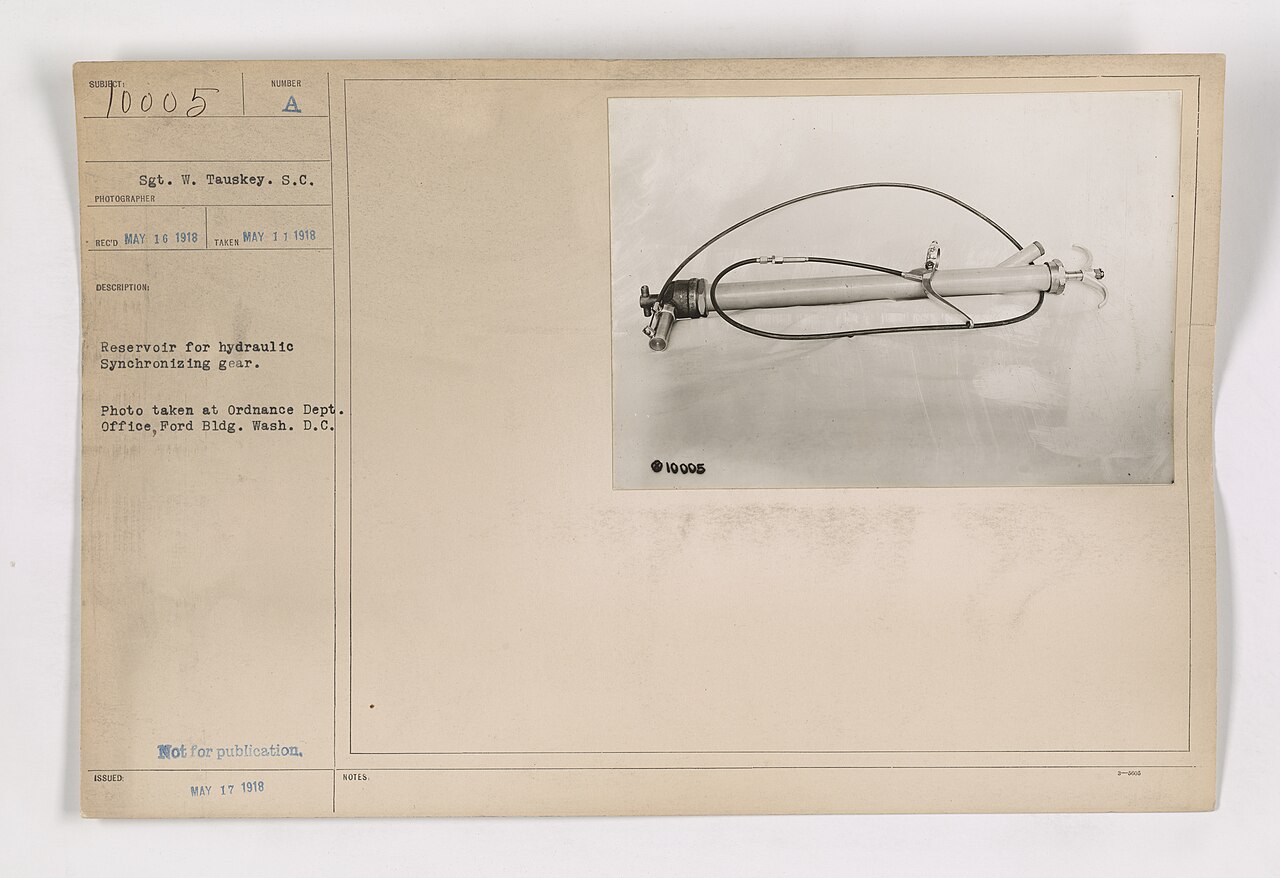
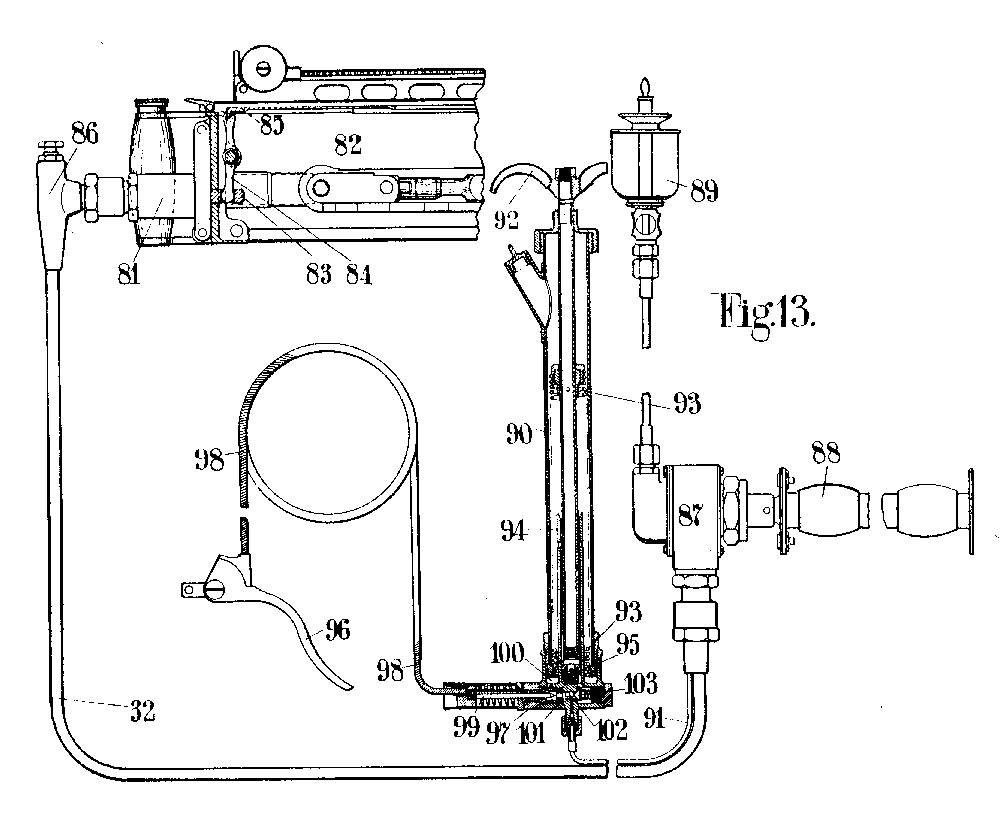
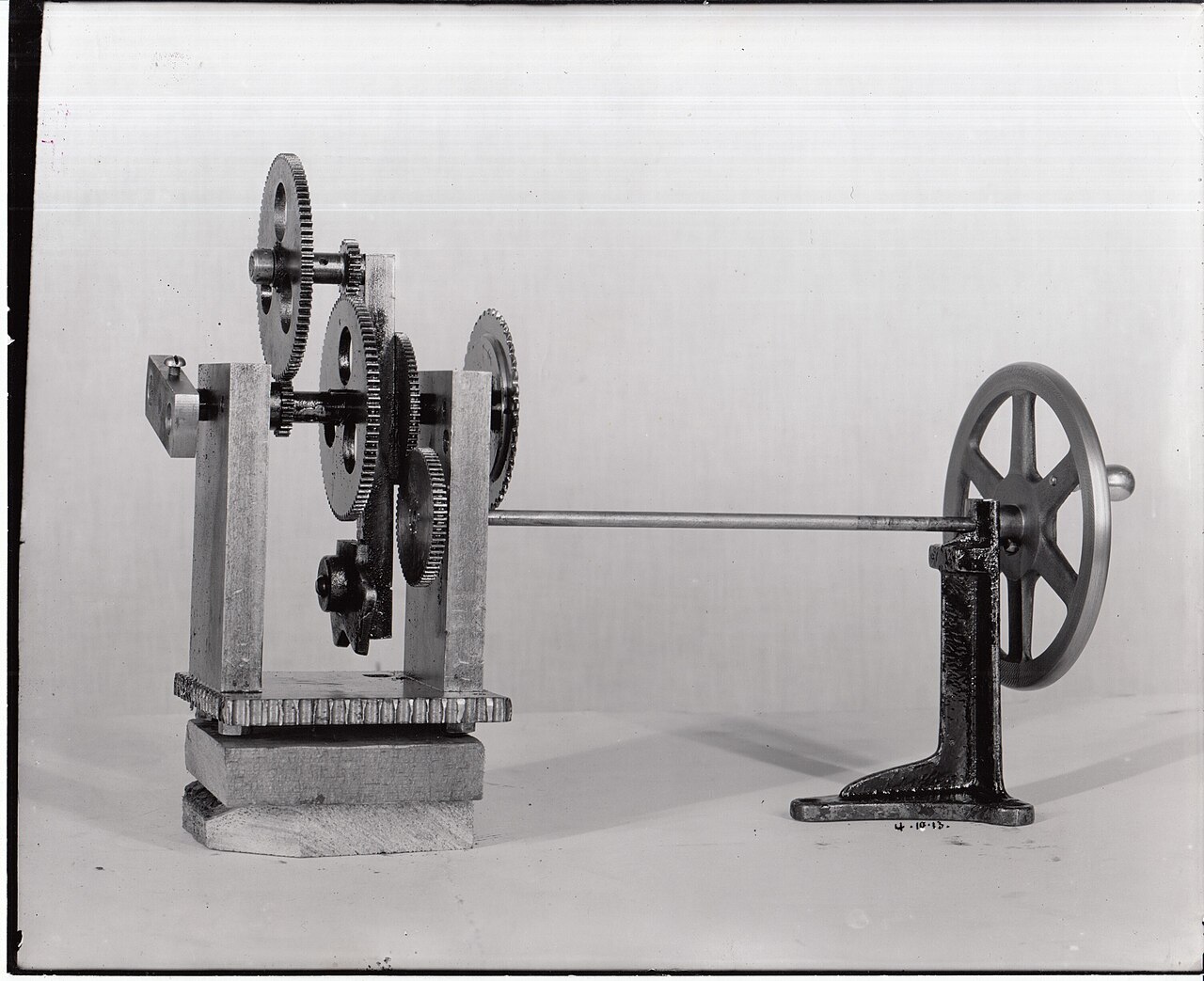
A typical synchronizing gear had three basic components. First, a method of determining the position of the propeller at a given instant was required, typically a cam driven from the propeller shaft or drive train. Second, a gun that would reliably fire or hold its fire exactly when required was needed; several widely used automatic weapons were triggered from an open bolt and were thus not suitable without extensive modification. In practice it was found necessary for the gun to be fired in semi-automatic mode, with firing impulses transmitted as the propeller revolved. The delay between the end of the firing cycle and the arrival of the next firing impulse slowed the rate of fire compared to a free-firing machine gun, but provided the gear functioned correctly, the gun could fire fairly rapidly between the whirling propeller blades without striking them.
Reader's Guide
From 1918 to the mid-1930s the standard armament for a fighter aircraft remained two synchronized rifle-calibre machine guns, firing forward through the arc of the propeller. In the late 1930s, however, the main role of the fighter was increasingly seen as the destruction of large, all-metal bombers, for which this armament was inadequate. Since it was impractical to fit more than two guns in the limited space available in the front of a single-engine aircraft's fuselage, guns began to be mounted in the wings instead, firing outside the arc of the propeller so not requiring synchronising. Synchronizing became unnecessary on all aircraft with the introduction of propellerless jet propulsion. The terms 'interrupter' and 'synchronizer' are more or less misleading; the term 'interrupter' implies the gear pauses fire when a blade passes, but a two-bladed propeller could obstruct the gun up to six times every firing cycle, making such interruption too problematic to be seriously attempted. True synchronization, with a machine gun's rate of fire exactly proportional to propeller speed, would require an impractical level of complexity, as a machine gun normally fires at a fixed rate while propeller rotation varies widely.
Did You Know?
- The first practical synchronization gear entered service on Fokker Eindecker fighters in mid-1915.
- The Romanian Constantinesco gear of 1917 was a reasonably reliable hydraulic system.
- By the end of World War I, German engineers were developing an electrical gear using an electro-mechanical solenoid.
- Synchronized guns fired in semi-automatic mode, with each shot triggered by an impulse from the propeller.
From Euler's Sketch to the Fokker Dominance
The concept of mounting a fixed weapon that fired along the aircraft's line of flight first surfaced in 1910, when August Euler proposed the idea. For several years it remained largely theoretical until, between 1913 and 1914, engineers in both France and Germany began serious design work and experimentation. The breakthrough that changed aerial combat came in mid-1915, when the Fokker Eindecker fighters entered squadron service with the German Air Service, carrying what was the first practical—though far from dependable—synchronization mechanism. The tactical shock of the Eindecker prompted a wave of competing designs across the warring nations. By 1917, the Romanian Constantinesco gear, which used a hydraulic link between engine and gun, had achieved a level of reliability that set a new benchmark. Even as the First World War drew to a close, German engineers were already pushing toward the next generation: replacing mechanical and hydraulic connections with an electrical link in which an electro-mechanical solenoid would trigger the gun, a direction that pointed toward the future of the technology.
Why 'Interrupter' Was a Misnomer
The popular label 'interrupter gear' suggests a simple mechanism: the gun fires freely, and the device merely pauses it each time a propeller blade sweeps past the muzzle. In reality, the mathematics made that approach impossible. Even the relatively slow propellers of First World War aircraft typically completed two or three full revolutions for every single shot a machine gun could produce. A two-bladed propeller could therefore block the firing arc up to six times within one cycle, and a four-bladed one twelve times. At those rates, the gun would be interrupted more than forty times per second while managing only about seven rounds per second—the gaps between interruptions were simply too brief to permit a round to cycle. True synchronization, in which the gun's rate of fire tracked the propeller's rotational speed exactly, demanded a complexity that was impractical: a machine gun fires at a fixed cyclic rate that cannot be varied on the fly, while propeller speed shifted constantly with throttle and maneuver. Every operational gear that ever worked therefore abandoned continuous fire and instead actively triggered each individual shot, functioning more like a semi-automatic weapon than the fully automatic gun it was built into.
The Cam, the Link, and the Margin of a Millimetre
At its core, a synchronizing gear relied on a small set of mechanical components working in concert. The most critical element was a method for determining the propeller's angular position at any given instant. In most designs, a cam driven from the propeller shaft—or from a part of the drive train rotating at the same speed—generated impulses matched to the propeller's revolutions. Some variants placed the cam inside the gun's trigger mechanism, and in hydraulic or electric systems the impulses could be timed to fire at every two or three revolutions, or even two or more times per single revolution. The timing of each impulse had to fall within a narrow 'safe' window when the blades were well clear of the muzzle, and that alignment needed periodic verification, particularly after a propeller swap or a major engine overhaul. The consequences of a tiny error were catastrophic: a cam wheel slipping even a millimetre or two, or a pushrod flexing under load, could send every bullet into the propeller—a worse outcome than firing with no synchronization at all. The other common failure was the opposite: the generator or linkages jamming or breaking, starving the gun of firing impulses and producing the familiar 'jam' that grounded so many fighters.
Two Guns, Then None: The Slow Retirement
From 1918 through the mid-1930s, the standard fighter armament across the world's air forces was a pair of rifle-calibre machine guns firing forward through the propeller arc, their shots carefully timed by a synchronization gear. For nearly two decades this configuration defined what a fighter could carry and how it could fight. The shift began in the late 1930s, when the primary mission of the fighter increasingly became the destruction of large, all-metal bombers—targets that rifle-calibre rounds simply could not penetrate effectively. Yet the limited space in the nose of a single-engine tractor aircraft made it impractical to install more than two guns in the forward position. The solution was to move the armament into the wings, where the guns fired outside the propeller's arc and no synchronization mechanism was required at all. The final and most complete retirement of the technology came with the advent of propellerless jet propulsion, which eliminated the spinning blades entirely and rendered the entire class of synchronization gear obsolete.
Gallery
Frequently Asked Questions
What is a synchronization gear?
It is a mechanical interrupter device that lets a forward-facing machine gun fire safely through the arc of a spinning aircraft propeller. By timing each round to the blade positions, the pilot could aim the entire aircraft at a target instead of having to adjust the gun independently.
How does a synchronization gear actually trigger a shot?
Every known design works by actively firing each individual round in sync with the propeller's rotation, much like a semi-automatic mechanism. The gear essentially gates the trigger cycle so a bullet is only released when a blade has cleared the barrel's line.
When and where did synchronization gears first see operational service?
The Fokker Eindecker fighters of mid-1915 marked the first combat use of a working interrupter gear. This gave early WWI fighters the ability to fire straight ahead, fundamentally changing aerial dogfighting tactics.
What made building a reliable synchronization gear so difficult?
Designers had to contend with the inherent inaccuracy of rapid automatic fire, the high and fluctuating speed of propeller blades, and the extreme timing precision the mechanism itself demanded. Any slight miscalculation in the gear's cycle risked a bullet striking a blade.
What was the standard armament for aircraft using synchronization gears?
From 1918 through the mid-1930s, the typical configuration was two synchronized rifle-calibre machine guns mounted in the engine cowling. A later notable example is the Romanian Constantinesco gear of 1917, which further refined the concept.
More in Machine Guns 1-24
Spotted an error? Know more?
Reader corrections go straight into our review queue. Suggest an edit · How this site is sourced