Bergmann MG 15nA machine gun
German light machine gun bridging rifle and heavy machine gun roles.

Dimitris Kamaras · CC BY 2.0
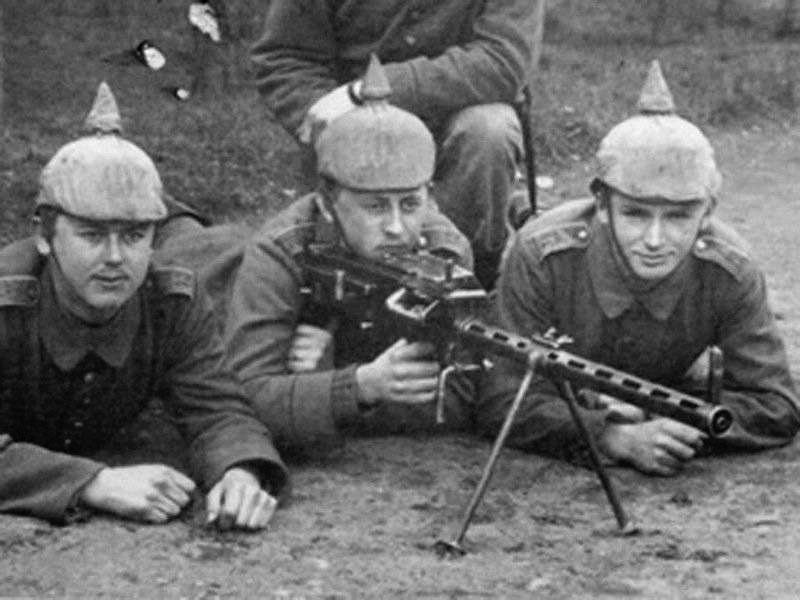
The Bergmann MG 15nA was a light machine gun fielded by Germany during the First World War, with production beginning in 1915. It fed from 100- or 200-round belts and was fitted with a bipod, enabling the gun to be placed on a flat surface for improved accuracy. This weapon bridged a capability gap in German forces between the standard rifle and the heavy machine gun.
The gun operated on a short recoil principle and used a locking system patented by Theodor Bergmann in 1901, where a cam moved a lock vertically—a mechanism similar to that of Browning machine guns. Bergmann had been developing machine guns since 1901, evolving through several water-cooled medium models, with early work partly done by Louis Schmeisser. By 1910, the current model fired from a closed bolt using cloth belts at about 600 rounds per minute. A 1915 version was modified to share a mount with the MG 08.
The weapon was then lightened for infantry and aircraft use. For aircraft, the bolt was lightened and the rate of fire increased from 500 to 800 rounds per minute. The ground version, adopted as the Bergmann MG 15, had a machined-down receiver, a buttstock, a pistol grip and trigger group instead of spade grips, a thin perforated barrel shroud replacing the heavy cooling jacket, and a bipod halfway along the barrel.
A major redesign came in early 1916, mirroring the development of the Maxim MG 08/15. The bolt was slowed to fix stoppage issues in ground use. The bipod was moved from the barrel shroud to a swivel-mount just forward of the pistol grip, using a bipod shared with the Maxim gun. A carry handle and new sights were added. This version was adopted as the Bergmann MG 15nA (neuer Art, 'new model'), while the earlier pattern was renamed MG 15aA (alter Art, 'old model'). The nA saw much more frequent use.
Battlefield use was significant but never matched the Maxim weapons. The MG 15nA filled a critical need: before its adoption, the only light machine guns in German service were the Madsen, used by machine gun sharpshooter battalions. After the 1916 Battle of the Somme, the German Army urgently needed a counter to the British Lewis gun, and limited Madsen supplies—mostly captured from various sources, including a shipment bound for Bulgaria—only heightened the demand. In November 1916, Germany ordered about 6,000 MG 15nA examples.
Quick Facts
- Origin
- German Empire
- Is Ranged
- yes
- Service
- 1916–1920s
- Wars
- World War I / German Revolution / Turkish War of Independence / Warlord era / Spanish Civil War / World War II (Limited)
- Designer
- Theodor Bergmann and Louis Schmeisser
- Design Date
- 1910
- Manufacturer
- Bergmann Waffenfabrik
- Production Date
- 1916–1919
- Number
- Approx. 5,000
- Weight
- 12.9 kg
- Length
- 1120 mm
- Part Length
- 726 mm
Facts from the source article.
Lore & Background
The Bergmann MG 15nA was developed from earlier Bergmann machine gun designs that began in 1901, using a lock system patented by Theodor Bergmann and the short recoil principle. The locking system, in which a cam moves a lock vertically, was not dissimilar to Browning machine gun designs. Early development was partly performed by Louis Schmeisser. By 1910 the then-current model used cloth belts, fired from a closed bolt, and could fire at around 600 rpm. A 1915 model was modified to share a mount with the MG 08.
The weapon was lightened for both infantry and aircraft use. For aircraft use, the bolt was lightened and the mechanism sped up from 500 to 800 rounds per minute. For ground use, it was adopted as the Bergmann MG 15. The receiver was machined down, a butt stock was fitted, and it received a pistol grip and trigger group instead of spade grips. The heavy cooling jacket was replaced with a thin perforated barrel shroud, and a bipod was fitted halfway along the barrel. The major development came early in 1916 when the Bergmann MG 15 was converted into a second variation to mirror the development of the Maxim MG 08/15. The bolt was slowed back down due to stoppage issues in the ground role. The bipod was removed from the barrel shroud and relocated to just forward of the pistol grip using a swivel-mount that accepted the bipod shared between the Bergmann and Maxim guns. A carry handle and new sights were also added. This variation was called the Bergmann MG 15nA, with nA standing for 'neuer Art' (new model); the old pattern was renamed MG 15aA for 'alter Art' (old model). The MG 15nA saw much more frequent use among Imperial German forces.
Reader's Guide
The Bergmann MG 15nA was an important weapon in that it filled a gap in the German armory between the rifle and the heavy machine gun. The only other light machine guns the Imperial German Army fielded before the Bergmann was adopted was the Madsen machine gun used by the battalions. In the 1916 Battle of the Somme, the German Army found they desperately needed a weapon to counter the British Army's Lewis light machine gun, and the limited quantities of Madsen guns only added to the need. Germany did not produce any Madsens in the First World War and relied almost entirely on captured weaponry. The German Army, reeling from the Somme, ordered some 6,000 MG 15nA examples in November 1916. These weapons were distributed to infantry battalions before enough troops could be trained on the new MG 08/15 in the winter and spring of 1917. The majority of MG 15nA weapons were actually delivered to the Eastern and Palestine fronts where the German Asia Corps made the most significant use of the gun. A major limitation was that its air-cooled barrel would overheat after 250 rounds of sustained fire; they were therefore grouped into sections allowing gunners to open fire alternately, or attributed to mobile detachments. The German 'Light Machine Gun Units' were formed specifically for the weapon. The MG 15nA was a generally reliable gun that served until manufacture of automatic weaponry ceased in 1919 under the Treaty of Versailles, but the dominance of the Maxim 08 during the war meant it never acquired much enthusiasm from military officials. It had faded into obscurity by the Second World War, though some were used by the Republicans during the Spanish Civil War. During the closing months of World War II, it was briefly put back into service by German Volkssturm units who lacked modern equipment.
Did You Know?
- The Bergmann MG 15nA used a lock system patented by Theodor Bergmann in 1901.
- Some 6,000 MG 15nA examples were ordered in November 1916 after the Battle of the Somme.
- The MG 15nA was briefly used by German Volkssturm units in the closing months of World War II.
Gallery
Frequently Asked Questions
What is the Bergmann MG 15nA?
It was a German light machine gun introduced in 1915 during the First World War, built to give infantry squads a portable automatic weapon. It fired 7.92×57mm Mauser cartridges at roughly 500 rounds per minute while set up on a bipod.
What role did the Bergmann MG 15nA fill in the German army?
The weapon closed the firepower gap between a standard bolt-action rifle and the heavier, crew-served machine guns of the era. By being light enough for a single soldier to carry and deploy with a bipod, it handed infantry sections their own dedicated automatic firepower.
How does the Bergmann MG 15nA's action work?
The gun runs on a short-recoil, locked-breech system in which a cam drives a locking piece vertically to unlock the bolt after each shot. That cam-and-lock arrangement was patented by Theodor Bergmann in 1901 and closely resembles the locking approach later used in Browning machine guns.
What are the key specs of the Bergmann MG 15nA?
It fed from 100- or 200-round ammunition belts, was air-cooled through a perforated barrel shroud, and was deliberately kept light for infantry handling. The built-in bipod let the gunner rest the weapon on flat ground for steadier, more accurate fire.
Why is the Bergmann MG 15nA considered important in machine-gun history?
It represented one of Germany's first practical attempts to field a true infantry-portable light machine gun rather than relying exclusively on heavy, water-cooled models. Its short-recoil, cam-locked action and belt-feed layout shaped how German forces approached squad-level automatic firepower in the years that followed.
More in Machine Guns 1-24
Spotted an error? Know more?
Reader corrections go straight into our review queue. Suggest an edit · How this site is sourced