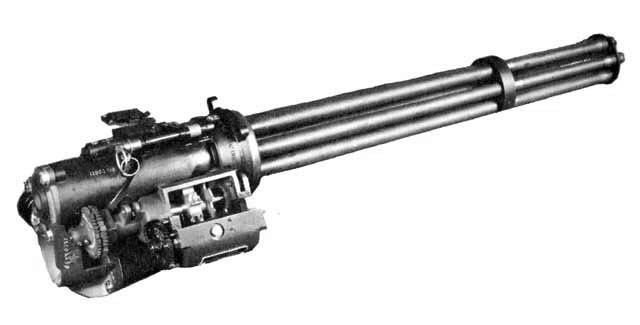
XM214 Microgun
A scaled-down rotary machine gun with extreme rate of fire.

The XM214 Microgun is an American prototype 5.56 mm rotary-barreled machine gun designed and built by General Electric. It was a scaled-down, lighter version of the M134 Minigun, firing M193 5.56×45mm ammunition, and was notable for its extremely high rate of fire and man-portable configuration.
Quick Facts
- Origin
- United States
- Is Ranged
- yes
- Designer
- General Electric
- Design Date
- 1966
- Manufacturer
- General Electric/General Dynamics
- Production Date
- 1970s - ?; In G.E. catalog until late 1990s
- Number
- Unknown; 10 Six-Paks delivered to WECOM/US Air Force
- Weight
- 10.2 kg gun body 38.6 kg complete with tripod, integral battery unit, feed chute and 1,000 rounds of ammunition in container
- Length
- 732 mm
- Part Length
- 533 mm
- Cartridge
- 5.56×45mm M193
- Caliber
- 5.56 mm
Facts from the source article.
Lore & Background
The XM214 was first developed for aircraft applications. General Electric later developed it into a man-portable weapon system called the GE Six-Pak, which weighed 85 pounds with 1,000 rounds and could be carried by a two-man team. The Six-Pak consisted of the XM214 gun, a power module, and an ammunition module with two 500-round disposable cassettes feeding through a flexible chute. The power module contained a 24-volt nickel-cadmium battery, a 0.8 hp motor, and solid-state electronic controls that allowed the rate of fire to be adjusted from 400 rpm up to 4,000 rpm. Later editions of Jane's Infantry Weapons claimed a theoretical cyclic rate of up to 6,000 rpm, while George Chinn contended the prototype could reach 10,000 rpm, and General Electric tested it successfully at 12,000 rpm. The system could be broken down into two portable loads of roughly 42 lb each via a quick-release fitting.
A Microgun Pod was also developed for external use on light aircraft and helicopters, with an ammunition capacity of 1,500 to 3,500 rounds and a loaded weight of 186 to 300 lb. It used a linkless helical drum feed and had a nominal rate of fire of 6,000 rpm, adjustable to 1,000 or 10,000 rpm. Power could come from a built-in battery pack or the aircraft.
The ability to fire the 5.56 mm round used by the M16 rifle was the major selling point. The US Army and US Air Force showed interest for use on aircraft, helicopters, and armored vehicles. General Electric pitched it to the US Navy for riverine craft and proposed many mounting arrangements. However, the 5.56 mm ammunition was also its downfall: accuracy suffered at high speeds and range was limited compared to the 7.62 mm Minigun. General Electric tried to refocus the Microgun as an infantry weapon, but the Army showed no interest.
Reader's Guide
The XM214 Microgun represents an ambitious attempt to scale down the proven M134 Minigun concept to a smaller caliber, offering a very high rate of fire in a package that could be carried by infantry or mounted on light aircraft. Its development highlighted the trade-offs inherent in using standard rifle ammunition for aerial suppression: while the 5.56 mm round was common and lightweight, it lacked the range and accuracy of the 7.62 mm round at the high speeds typical of aircraft engagements. The Six-Pak man-portable system, though heavy at 85 pounds loaded, demonstrated the possibility of a crew-served rotary weapon, but the Army's lack of interest in the infantry role ended that path. The Microgun Pod for aircraft saw some interest but ultimately did not enter widespread service. The XM214 remains a notable prototype that pushed the boundaries of rate of fire—tested up to 12,000 rpm—and influenced later designs such as the XM556 microgun, though it never achieved production or operational deployment.
Did You Know?
- The XM214 was a scaled-down version of the M134 Minigun, firing 5.56×45mm ammunition.
- General Electric tested the XM214 successfully at 12,000 rpm.
- The Microgun Pod could hold 1,500 to 3,500 rounds and had a nominal rate of fire of 6,000 rpm.
The Six-Pak System and Physical Design
The XM214 Microgun was conceived by General Electric as a compact, lighter alternative to the M134 Minigun, chambered for the M193 5.56×45mm round. While the bare gun measured just 68.6 cm in length and weighed 27 pounds (12.2 kg), General Electric packaged it into a complete man-portable system called the GE Six-Pak. This full assembly, including a power module and ammunition module, tipped the scales at 85 pounds (38.5 kg) with 1,000 rounds aboard—roughly on par with conventional heavy machine guns. The ammunition module held two factory-sealed, disposable 500-round cassettes on a rack, fed through a flexible chute. When the first cassette ran dry, the second engaged automatically and tripped a visible indicator prompting the crew to reload. The entire system could be split into two loads of about 42 pounds each via a quick-release fitting at the belt chute, making it manageable for a two-soldier team. Sighting relied on an optical telescope, and the gun could be mounted on an M122 tripod or a vehicle pintle.
Electronic Controls and Rate of Fire
One of the XM214's most remarkable features was its solid-state electronic control system, which included a burst limiter and automatic clearing of the gun between bursts. Operators could dial the cyclic rate anywhere from 400 rounds per minute up to 4,000 rpm on the man-portable Six-Pak. However, the prototype gun itself proved capable of far more: George Chinn, in his Machine Gun Volume V, cited a prototype rate of up to 10,000 rpm, while later editions of Jane's Infantry Weapons referenced a theoretical 6,000 rpm. Most strikingly, General Electric reportedly tested the weapon successfully at 12,000 rpm. The power module driving all this comprised a 24-volt nickel-cadmium battery paired with a 0.8 horsepower (0.60 kW) motor. Unless the battery was tethered to a vehicle's electrical supply, its charge would last approximately 3,000 rounds before depletion. The overall system length reached 104 cm, and the width including the ammunition case measured 44.4 cm.
The Microgun Pod and Aircraft Applications
Beyond infantry use, General Electric developed an 88-by-10-inch (224 × 25 cm) external Microgun Pod intended for light aircraft and helicopters. This pod carried between 1,500 and 3,500 rounds and weighed between 186 and 300 pounds (84 to 136 kg) when loaded. Its feeding mechanism was linkless, utilizing a helical drum, and it delivered a nominal 6,000 rounds per minute, though adjustments to either 1,000 or 10,000 rpm were possible. Power could come from a built-in battery pack or the host aircraft's own electrical system. General Electric's engineers proposed an extraordinary range of mounting configurations: in open doors, embedded in wings or noses, six guns packed into a modified bomb bay, and even turrets within an automated defense network. The weapon was also pitched to the US Navy for riverine craft. The core appeal was that smaller aircraft, unable to accommodate the heavier M134, could still receive a high-volume rotary cannon in a 300-pound pod.
Ambition, Reception, and the Road Not Taken
The XM214's headline feature—firing the same 5.56 mm round as the M16 rifle—was both its greatest strength and its ultimate weakness. The US Army and Air Force expressed genuine interest in equipping aircraft, helicopters, and armored vehicles with the lighter gun, which could free up space for additional ammunition, equipment, or even extra weapons compared to the M134. Yet for aircraft gunners, the smaller cartridge's limited range and degraded accuracy at high speed proved disqualifying, especially when measured against the 7.62 mm Minigun. General Electric pivoted, attempting to reposition the Microgun as an infantry weapon through the Six-Pak, but the Army showed no appetite for the project. Despite the weapon's impressive engineering—12,000 rpm test firings, adjustable cyclic rates, and a modular two-person carry system—the XM214 never advanced beyond the prototype stage, remaining a fascinating 'what if' in the lineage of American rotary-barreled firearms.
Gallery
Frequently Asked Questions
What is the XM214 Microgun?
The XM214 Microgun is a prototype American rotary-barreled machine gun built by General Electric. It is a scaled-down, lighter derivative of the M134 Minigun, chambered for 5.56×45mm M193 ammunition.
How does the XM214 Microgun differ from the M134 Minigun?
While the M134 fires 7.62mm and is generally vehicle-mounted, the XM214 shrinks the concept down to 5.56mm and a 27-pound bare gun, making it possible for a single soldier to carry. That man-portable configuration is its defining distinction from its larger sibling.
What are the XM214 Microgun's key specifications?
The gun alone weighs 27 lb (12.2 kg), measures 104 cm in overall length, and fires 5.56×45mm M193 rounds. Paired with its Six-Pak ammunition system loaded with 1,000 rounds, the combined weight rises to roughly 85 lb (38.5 kg).
Why is the XM214 Microgun notable to machine-gun enthusiasts?
It demonstrated that a six-barrel rotary design could be shrunk to a weight a single operator could shoulder while still delivering an extremely high cyclic rate. That rare combination of true portability and overwhelming volume of fire made it a standout experimental concept.
Did the XM214 Microgun ever enter military service or see combat?
No; it remained a General Electric prototype and was never adopted as a standard-issue weapon by any armed force. Its legacy is that of an ambitious proof-of-concept showing a compact, high-rate-of-fire personal rotary gun was mechanically feasible.
More in Machine Guns 1-24
Spotted an error? Know more?
Reader corrections go straight into our review queue. Suggest an edit · How this site is sourced