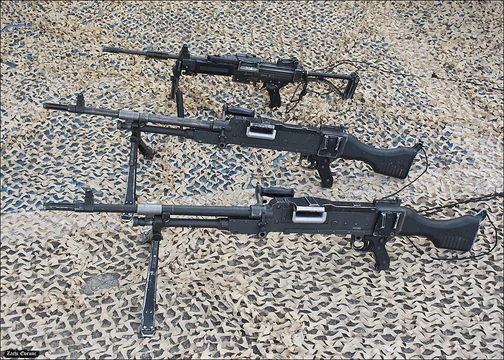
General-purpose machine gun
A versatile, belt-fed machine gun adaptable to multiple tactical roles.

Oleg Yunakov · CC BY-SA 4.0
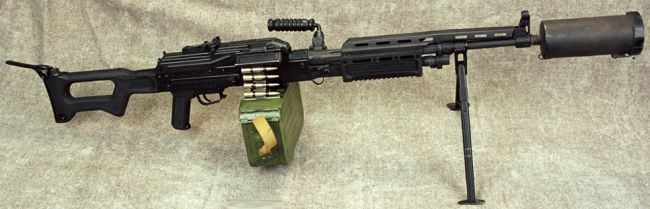
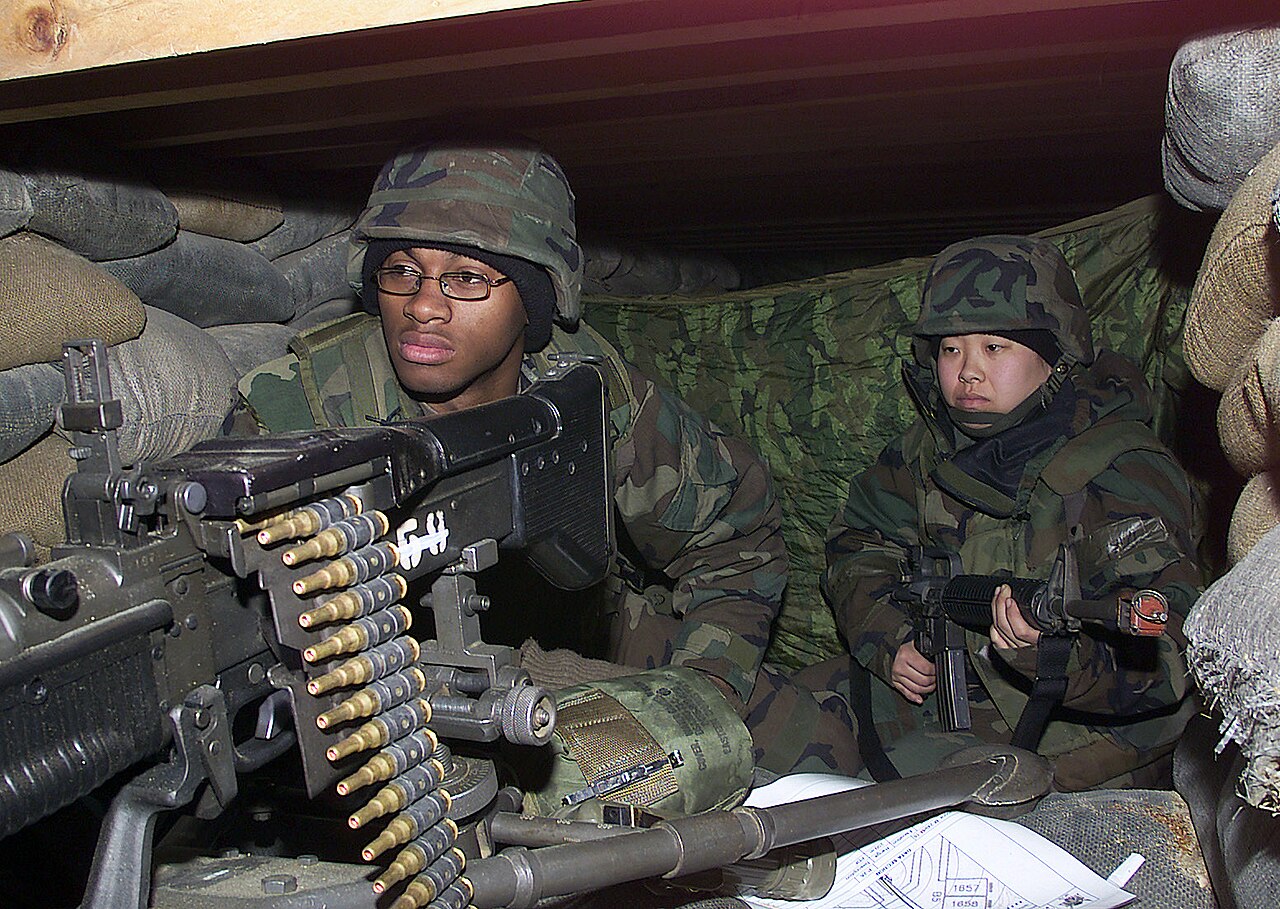
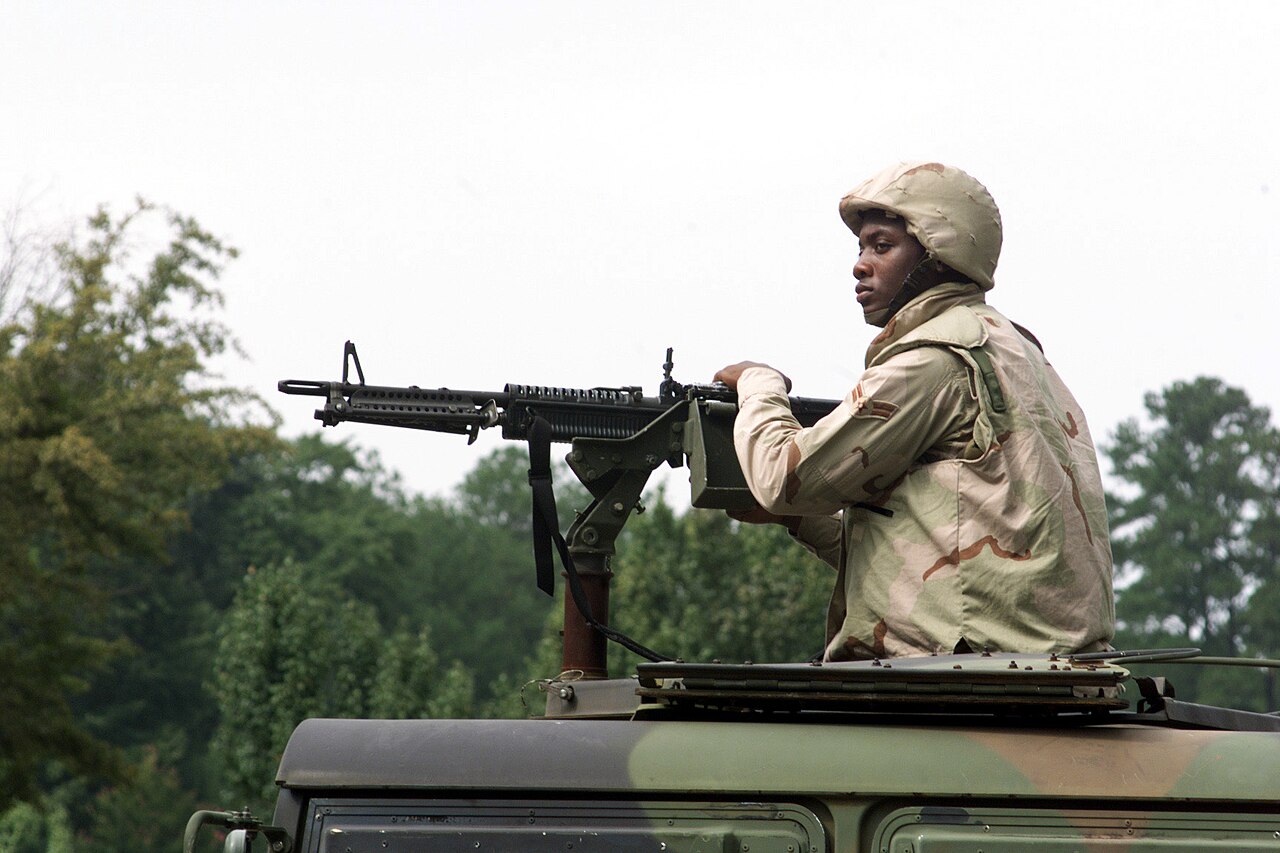
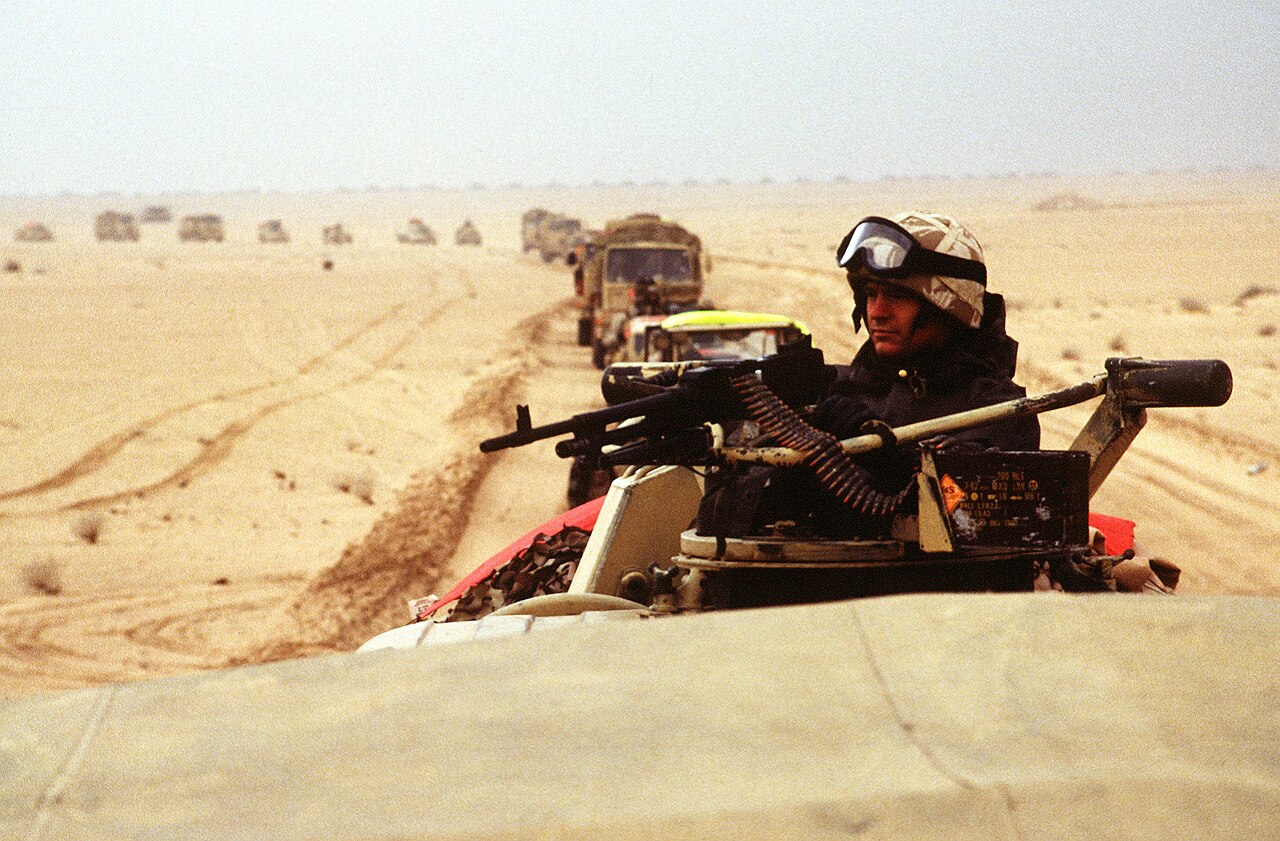
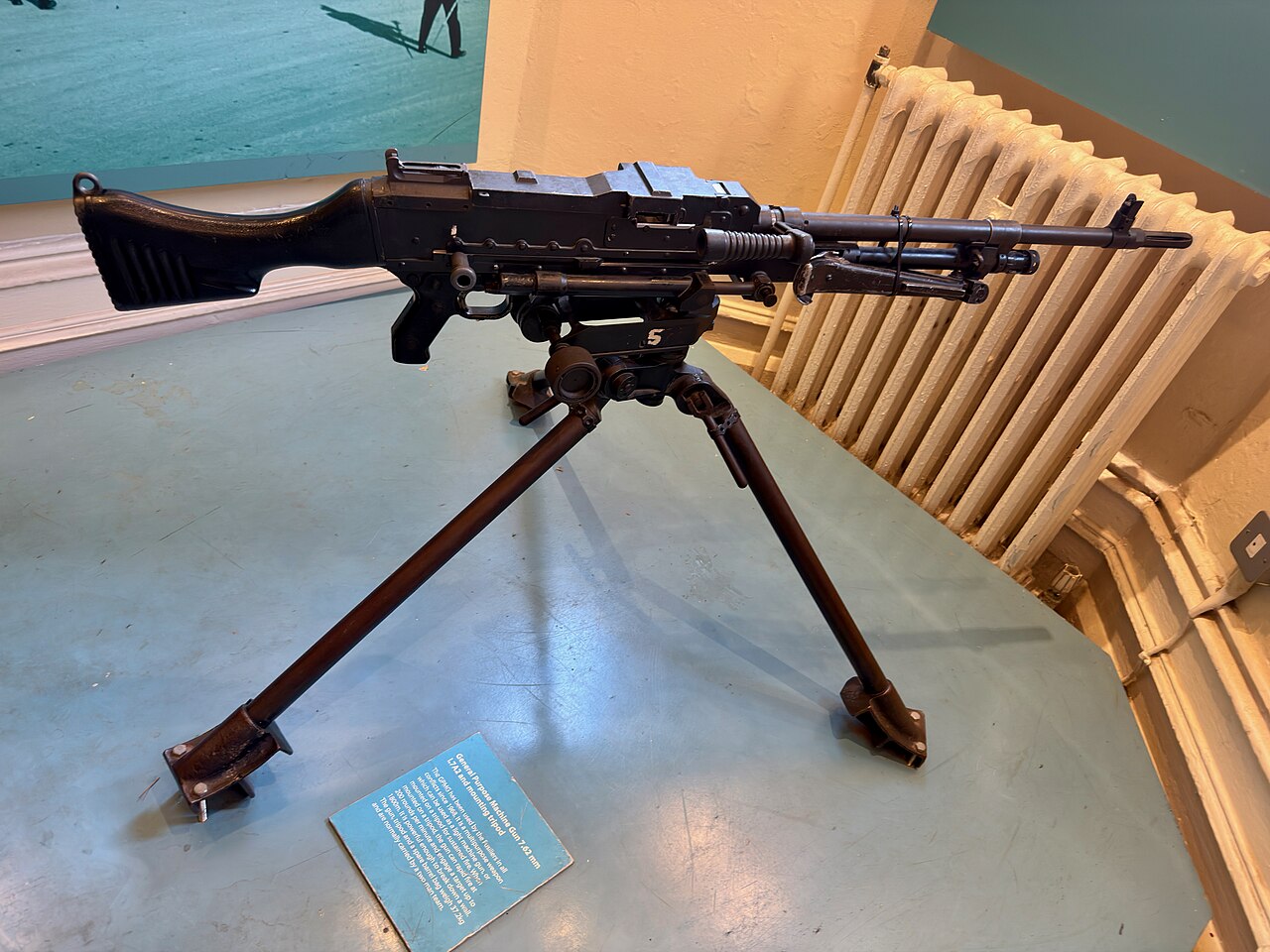
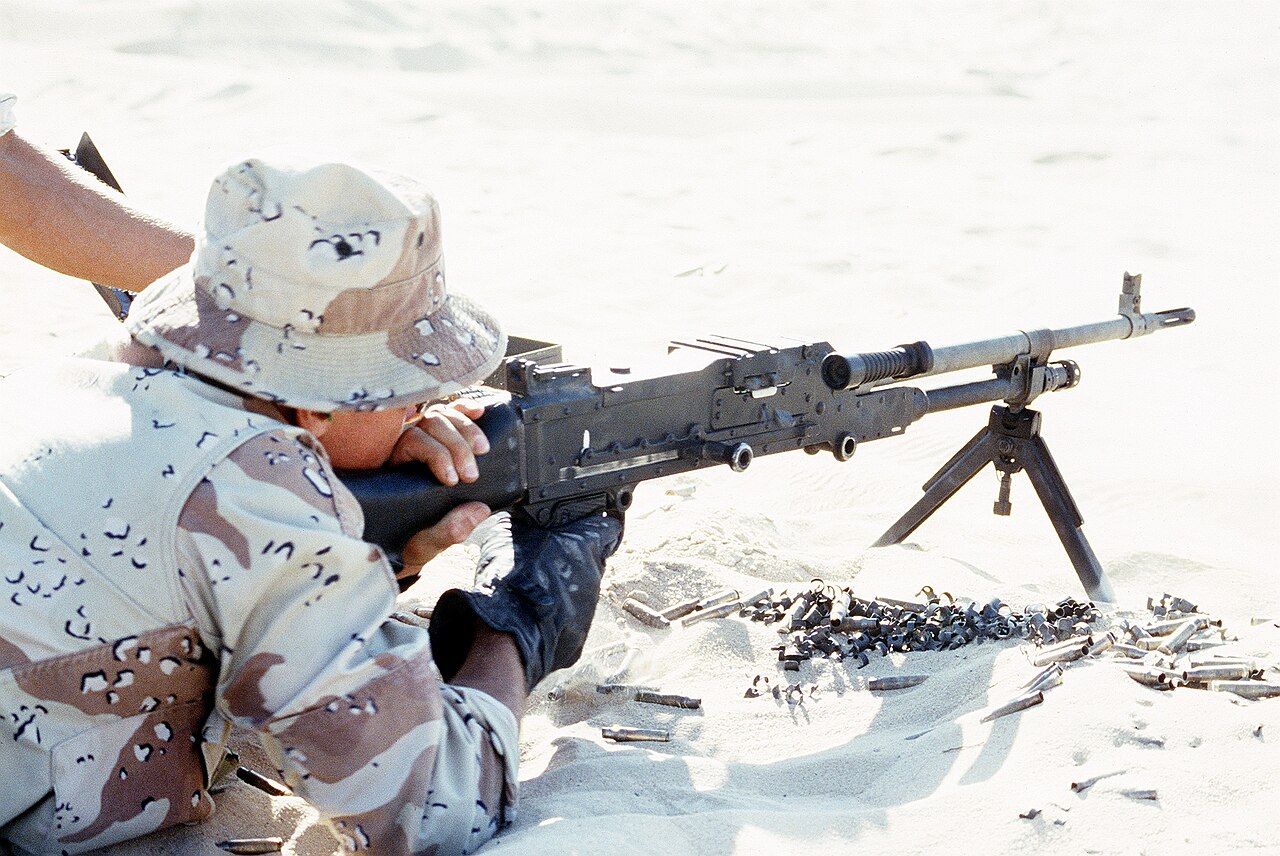
A general-purpose machine gun (GPMG) is an air-cooled, belt-fed firearm designed to be easily switched between different combat roles. While many medium machine guns (MMGs) can fill these roles, not every MMG qualifies as a GPMG, and not every GPMG is an MMG. GPMGs typically have a quick-change barrel and fire powerful, full-sized rifle cartridges like the 7.62×51mm NATO, 7.62×54mmR, 7.5×54mm French, 7.5×55mm Swiss, or 7.92×57mm Mauser. They can be mounted on bipods, tripods, vehicles, aircraft, boats, or fortifications, often serving as infantry support or squad automatic weapons.
**History**
**World War II**
An early GPMG was the MG 34, designed in 1934 by Heinrich Vollmer at Mauser for Nazi Germany. It was created to get around the machine gun limits set by the Treaty of Versailles. The German military called it the *Einheitsmaschinengewehr* ("universal machine gun") and saw it as a new idea in automatic firepower. For its time, the MG 34 was excellent: air-cooled, recoil-operated, and firing 7.92×57mm Mauser ammunition at 850 rounds per minute, with lethal range over 1,000 meters. Its key feature was that changing its mount, sights, and feed system could radically change its function. On a bipod, it worked as a light machine gun for assaults; on a tripod, it became a sustained-fire medium machine gun; mounted on aircraft or vehicles, it served as an anti-aircraft weapon; and it was also used as a coaxial tank gun. During World War II, the MG 34 was joined by the MG 42, a cheaper, more robust GPMG with an extremely high rate of fire of 1,200 to 1,500 rounds per minute. Both remained in combat. One role for these GPMGs was low-level anti-aircraft defense, where a high rate of fire is useful against targets exposed only briefly, such as planes or soldiers moving quickly between cover.
**Prominent history after World War II**
One of the first GPMGs to enter global trade after the war was the Belgian FN MAG. Built in the early 1950s by Ernest Vervier at Fabrique Nationale (FN) in Herstal, Belgium, it was designed to replace the Vickers heavy machine gun and the Bren light machine gun. Chambered in 7.62×51mm, it is an air-cooled, belt-fed weapon that drew heavily from the German MG 42. It is widely regarded as a great example of GPMG design, used around the world and credited with helping win many conflicts.
- Early example
- MG 34, designed in 1934 by Heinrich Vollmer of Mauser
- Caliber examples
- 7.62×51mm NATO, 7.62×54mmR, 7.5×54mm French, 7.5×55mm Swiss, 7.92×57mm Mauser
- Mg 34 cyclic rate
- 850 rounds per minute
- Mg 42 cyclic rate
- 1,200 to 1,500 rounds per minute
- Fn mag designer
- Ernest Vervier at Fabrique Nationale (FN) at Herstal, Belgium, early 1950s
- Fn mag caliber
- 7.62×51mm
- Notable fn mag variants
- American M240, Canadian C6
Lore & Background
An early GPMG was the MG 34, designed in 1934 by Heinrich Vollmer of Mauser on the commission of Nazi Germany to circumvent the restrictions on machine guns imposed by the Treaty of Versailles. It was introduced into the Wehrmacht as an entirely new concept in automatic firepower, dubbed the Einheitsmaschinengewehr, meaning 'universal machine gun' in German. In itself the MG 34 was an excellent weapon for its time: an air-cooled, recoil-operated machine gun that could run through belts of 7.92×57mm Mauser ammunition at a rate of 850 rounds per minute, with lethality at ranges of more than 1,000 meters. The main feature of the MG 34 is that simply by changing its mount, sights and feed mechanism, the operator could radically transform its function: on its standard bipod, it was a light machine gun ideal for infantry assaults; on a tripod it could serve as a sustained-fire medium machine gun; mounting on aircraft or vehicles turned it into an air defence weapon, and it also served as the coaxial machine gun on numerous German tanks. During World War II, the MG 34 was supplemented by a new GPMG, the MG 42, although it remained in combat use. The MG 42 was more efficient and cheaper to manufacture, and more robust, as well as having an extremely high cyclic rate of fire of 1,200 to 1,500 rounds per minute. One of the Einheitsmaschinengewehr GPMG roles was to provide low level anti-aircraft coverage. A high cyclic rate of fire is advantageous for use against targets typically exposed to fire for a limited time span, like aircraft or targets minimizing their exposure by quickly moving from cover to cover.
One of the first GPMGs to enter global trade after the Second World War was the Belgian FN MAG, which was a GPMG built to replace the Vickers Heavy Machine Gun and Bren Light Machine Gun. It was made by Ernest Vervier at the Fabrique Nationale (FN) at Herstal in Belgium in the early 1950s, chambered in 7.62×51mm and is an air-cooled, belt-fed machine gun which took a lot of inspiration from the German MG-42. It is renowned for being a great example of GPMG design, being used all over the world and has helped win many conflicts. Following the Second World War, the victorious Allied nations took an interest in the MG 34 and MG 42, influencing many post-war general-purpose machine guns, many still in use today. They lent design elements to the Belgian FN MAG and the American M60, while spawning the Zastava M53, Swiss M51, and Austrian MG 74. The MG 42's qualities of firepower and usability meant that it became the foundation of an entire series of postwar machine guns, including the MG 1 and MG 3; the latter is still in production and is used by many nations most prominently the German Bundeswehr.
Reader's Guide
The general-purpose machine gun concept, first realized in the German Einheitsmaschinengewehr, fundamentally changed infantry firepower by combining the roles of light and medium machine guns into a single adaptable weapon system. The MG 34 and MG 42 demonstrated that a single design, through different mounts and feeds, could serve as an assault support weapon, sustained-fire base, anti-aircraft platform, and vehicle armament. This flexibility proved so effective that post-war designs across the world adopted similar principles. The FN MAG, directly inspired by the MG 42's feed system and trigger mechanism, became the most widely used GPMG among Western armies, with variants such as the American M240 and Canadian C6 serving in numerous conflicts including the Congo Crisis, Vietnam War, Falkland War, Gulf War, War in Afghanistan, Iraq War, Syrian Civil War, Libyan Civil War, and Russo-Ukrainian war. The MG 42 lineage continued through the MG 1 and MG 3, the latter still in production and used prominently by the German Bundeswehr. Other notable post-war GPMGs include the American M60, Russian PK/PKM family, Chinese Type 67 and later models, South Korean K16, Swiss SIG MG 710-3, Israeli Negev NG7, and the modern FN EVOLYS using 3D printing and polymers. The GPMG remains a core infantry weapon, valued for its ability to deliver sustained automatic fire from various platforms while using fully powered cartridges.
Did You Know?
- The MG 34 was designed by Heinrich Vollmer of Mauser in 1934 to circumvent Treaty of Versailles restrictions on machine guns.
- The American M240 and Canadian C6 are variants of the FN MAG.
Defining the General-Purpose Role
A general-purpose machine gun occupies a distinctive niche in the infantry armory. In modern terminology, the category overlaps heavily with the medium machine gun—a belt-fed weapon chambered for a full-powered rifle cartridge and weighing somewhere between fifteen and forty pounds. What elevates a GPMG above a standard medium gun is its versatility: it must prove itself effective not only in the hands of a single infantryman but also when bolted to a tank turret, slung beneath an aircraft wing, or anchored to a static emplacement. This breadth of application is precisely what separates it from a heavy machine gun, which depends entirely on a weapons platform for stability and is typically hauled to its firing position by a dedicated crew. The relationship between the two classifications is not perfectly symmetrical, however. Some medium guns never achieve the multi-role flexibility that earns the general-purpose label, and conversely, certain GPMGs fall outside the conventional weight band. The result is a weapon family defined less by a single specification than by its ability to serve as the backbone of small-unit firepower across a wide spectrum of tactical environments.
Maxim's Recoil Revolution and the Cooling Dilemma
Before Hiram Maxim's breakthrough, the machine-gun landscape was dominated by externally powered, multi-barrel systems like the Gatling and Nordenfelt. These were essentially heavy weapons—bulky, often chambered in half-inch or one-inch calibers, and reliant on their many barrels to manage heat. Maxim changed the equation by harnessing recoil to drive a single-barrel automatic cycle. His first design weighed a modest twenty-six pounds, fired a .45-inch round from a twenty-four-inch barrel, and could be shouldered complete with its fifteen-pound tripod in a single arm. The catch was endurance: the barrel overheated quickly, limiting sustained fire. Maxim's solution—a water jacket—solved the thermal problem but added considerable mass, especially as cartridges grew more powerful. Yet the underlying insight that recoil could replace external power sources was transformative. It inspired a wave of lighter automatic firearms, from the Borchardt pistol and Cei-Rigotti rifle to the Madsen 1902 and early gas-operated, air-cooled designs, all of which would feed directly into the medium and general-purpose categories that followed.
The World War I Tactical Spectrum
By the time of the First World War, the machine-gun family had fractured into a clear hierarchy of roles. At the heavy end, water-cooled weapons like the .303 Vickers (thirty-three pounds bare, fifty on its tripod), the German MG 08, and the American Browning Model 1917 could deliver hours of continuous fire from a well-supplied crew, making them ideal for pinning down advancing infantry. At the opposite extreme, weapons such as the Chauchat and the Madsen 1902 functioned essentially as bipod-mounted machine rifles, suited to short bursts during assaults but ill-equipped for prolonged engagement or vehicle mounting. Between these poles sat the truly versatile designs. The Lewis gun, at twenty-seven pounds with its distinctive large cooling shroud and forty-seven-round drum, could support a moving squad, serve on aircraft, or substitute for a heavier gun on a tripod. The Hotchkiss Mark I, weighing twenty-seven and a half pounds and fed from linkable thirty-round strips, proved a useful intermediate that remained in service into the Second World War. All shared a common trait: they fired full-power rifle-caliber ammunition, whether eight-millimeter Mauser or .30-06 Springfield, ensuring a single ammunition type could feed the entire spectrum.
The Universal Machine Gun: One Weapon, Every Role
The mid-twentieth century witnessed the culmination of a trend building since the 1930s: the convergence of heavy and light machine-gun roles into a single, adaptable platform. Water-cooled designs, which had dominated from the Maxim era through the 1960s, were gradually retired as air-cooled mediums proved capable of matching their sustained-fire performance through a combination of barrel replacement, metal fins, and heat sinks. A critical tactical shift accelerated this transition: in an era of vehicle-centered warfare, a fixed, well-supplied heavy-gun position was far less decisive than it had been in the trenches. The medium machine gun, mounted on a tripod, could now fulfill the heavy role; swung onto a bipod, it could track with an advancing squad. This dual capability made the concept of a universal machine gun—exemplified by the German pursuit of a Universelles Maschinengewehr—logistically and tactically irresistible. The French Châtellerault M1924, with its one-hundred-fifty-round magazine and internal water cooler, represented an earlier step in this direction. Ultimately, the GPMG became the default infantry support weapon, equally at home in a rifle squad, a tank turret, or an aircraft wing.
Gallery
Frequently Asked Questions
Who is General-purpose machine gun?
A GPMG is a belt-fed, air-cooled support weapon engineered to transition between multiple tactical roles without swapping out the entire platform. It typically chambers full-power rifle cartridges and includes a quick-change barrel to manage heat during prolonged bursts.
What are General-purpose machine gun's powers/role?
It can be slung on a bipod for infantry support, locked onto a tripod for sustained fire, or bolted to vehicles, aircraft, boats, and fixed positions. This multi-platform flexibility is what separates a true GPMG from a simple medium machine gun.
Who designed General-purpose machine gun?
The role was pioneered by Heinrich Vollmer at Mauser with the MG 34 in 1934, which set the template for quick-change barrels and belt feeding. Ernest Vervier at Fabrique Nationale in Belgium later refined the concept with the FN MAG in the early 1950s.
Why is General-purpose machine gun important?
It gives a single infantry squad one weapon that covers both the light and heavy support roles, reducing the logistical burden of carrying two separate machine gun types. Its cyclic rates—ranging from roughly 850 rounds per minute on the MG 34 to 1,200–1,500 on the MG 42—deliver the suppressive volume that smaller weapons simply cannot.
More in Machine Guns 1-24
Spotted an error? Know more?
Reader corrections go straight into our review queue. Suggest an edit · How this site is sourced