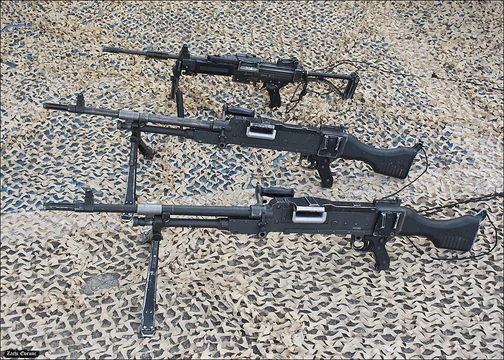
Light machine gun
A portable machine gun for one soldier, providing squad suppressive fire.

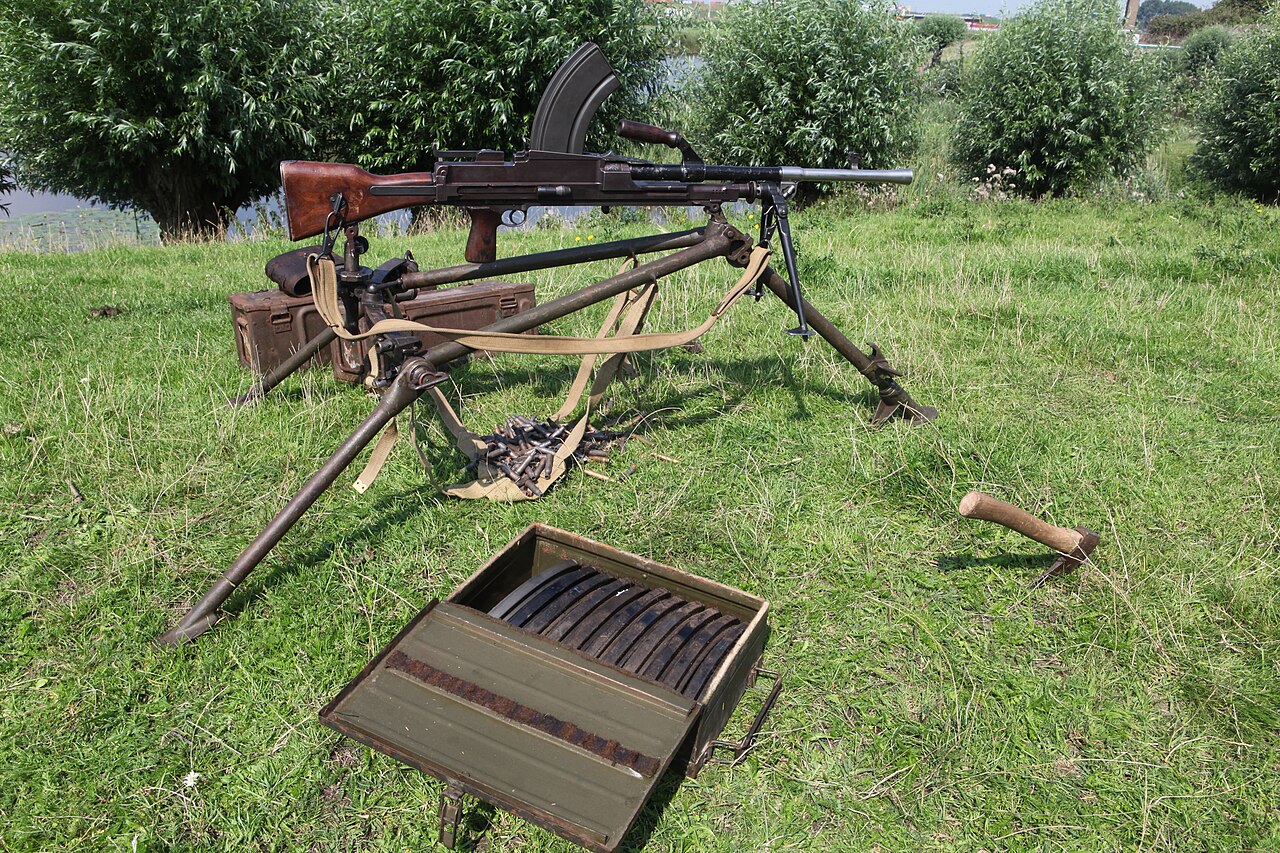
Joost J. Bakker from IJmuiden · CC BY 2.0
A light machine gun (LMG) is a lightweight machine gun built for use by a single soldier, sometimes with an assistant, to support infantry. When an LMG fires the same ammunition as the rest of its unit’s riflemen, it is often called a squad automatic weapon. Unlike submachine guns, LMGs do not fire pistol cartridges.
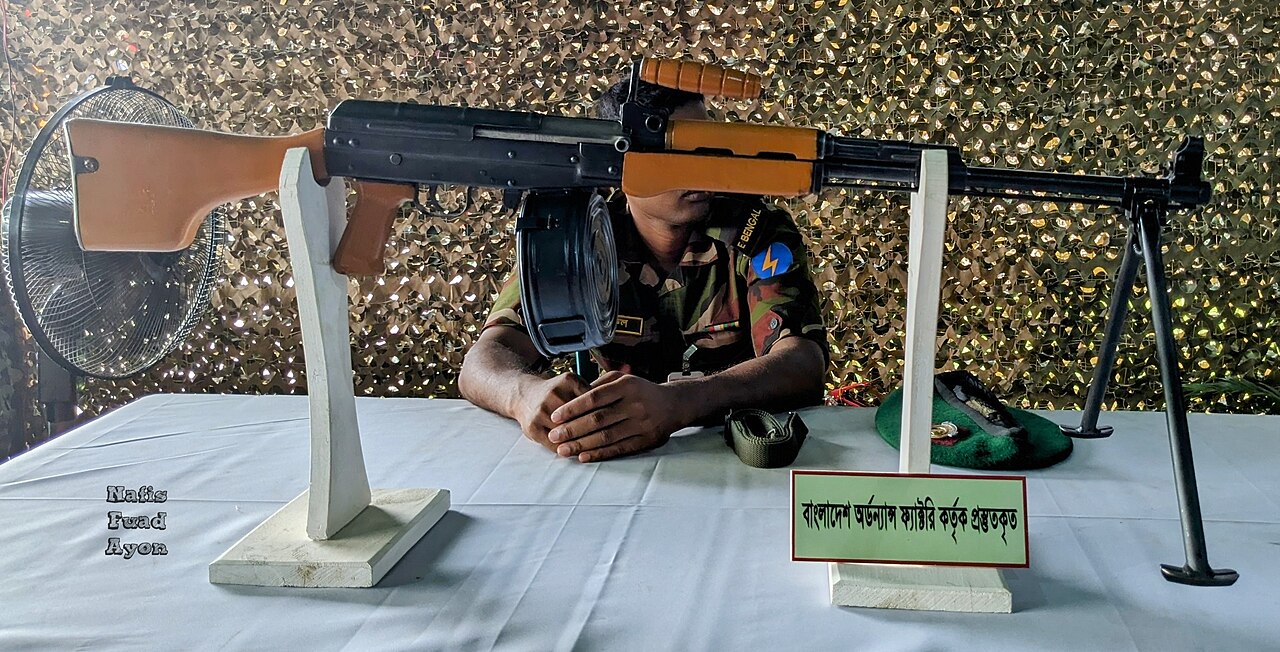
Early LMGs used full-powered rifle cartridges, but modern versions typically fire smaller intermediate cartridges—often the same ones used in standard assault rifles—making them lighter and more compact. Some LMGs, like the Russian RPK, are modified from existing rifles and share their ammunition. These modifications usually include a larger magazine, a heavier barrel to manage heat, a sturdier mechanism for sustained fire, and a bipod.
An LMG is also defined by how it is used. Some machine guns, especially general-purpose models, can serve as either a light or medium machine gun. When mounted on a tripod for sustained fire, it is a medium machine gun; when used with a bipod from a prone position in short bursts, it is a light machine gun.
LMGs can be fired from the hip or while moving to provide suppressive fire that pins down the enemy. Marching fire is a specific tactic relying on this ability. Lighter modern LMGs are now issued at the fireteam level, with two or three per squad.
Many early LMGs, such as the Bren gun or M1918 Browning Automatic Rifle, used magazines. Others, like the Hotchkiss M1922, could feed from a belt, strip, or box magazine. Modern LMGs fire smaller rounds and tend to be belt-fed from an attached container or from a detachable drum magazine. Some, like the FN Minimi, can also accept standard rifle magazines as a backup when belted ammunition runs out.
In 1903, French military theorists noted that heavy machine guns were ineffective in infantry assaults and concluded that "the machine gun must learn to walk." They explored the idea of a portable LMG and theorized marching fire, using incidental suppressive fire to make advancing troops a greater threat than unaimed bullets, forcing the enemy to retreat. Prototypes were not approved for production, and none were in service when World War I began. The French quickly put these prototypes into mass production to increase infantry firepower.
- Caliber
- Often fires smaller-caliber rifle cartridges than medium machine guns, generally the same intermediate cartridge fired by a service's standard assault rifle
- Feed system
- Magazine-fed, belt-fed, or detachable drum magazine; some accept standard rifle magazine feeding as an auxiliary measure
- Typical deployment
- Bipod with operator in prone position firing short bursts, or from the hip/on the move for suppressive fire
- Role
- Infantry support weapon, squad automatic weapon
Lore & Background
In 1903, French military theorists noticed that the heavy machine guns of the day were of little use in infantry assaults. They determined that 'the machine gun must learn to walk' and researched the possibility of a light machine gun which could be carried by troops. A marching fire tactic was theorised, using incidental suppressive fire, with the advancing troops considered a deadlier threat than the un-aimed bullets, causing the enemy to fall back. The prototype guns were not approved for production, and none were in service when World War I began. The French quickly brought the prototypes to mass production to boost the firepower of advancing infantry.
While early light machine guns fired full-powered rifle cartridges, modern light machine guns often fire smaller-caliber rifle cartridges and are usually lighter and more compact. Some LMGs, such as the Russian RPK, are modifications of existing designs and designed to share the same ammunition. Adaptations to the original rifle generally include a larger magazine, a heavier barrel to resist overheating, a more robust mechanism to support sustained fire and a bipod.
A light machine gun is also defined by its usage as well as its specifications: some machine guns – notably general-purpose machine guns – may be deployed either as a light machine gun or a medium machine gun. Deployed on a tripod and used for sustained fire, it is a medium machine gun; if deployed with a bipod with the operator in a prone position and firing short bursts, it is a light machine gun.
Reader's Guide
By the end of World War II, light machine guns were usually being issued on a scale of one per fire team or squad, and the modern infantry squad had emerged with tactics that were built around the use of the LMG to provide suppressive fire. Lighter modern LMGs have enabled them to be issued down at the fireteam level, with two or three at the section/squad level. Examples such as the Belgian Minimi M249, the IWI Negev, the Bren light machine gun, and the .30-06 Browning Automatic Rifle Model 1918 illustrate the variety of designs that have served in the light machine gun role. Modern light machine guns are designed to fire smaller caliber rounds and tend to be belt-fed (from a container attached to the gun) or from a detachable drum magazine, but some, such as the FN Minimi, will also accept standard rifle magazine feeding as an auxiliary measure when belted ammunition has been exhausted. The light machine gun remains a key component of infantry firepower, providing sustained suppressive fire that enables maneuver.
Did You Know?
- The French military theorized in 1903 that 'the machine gun must learn to walk,' leading to early light machine gun prototypes.
- Some light machine guns, such as the FN Minimi, can accept standard rifle magazine feeding as an auxiliary measure when belted ammunition is exhausted.
- The Russian RPK is a modification of an existing rifle design, sharing the same ammunition.
- A general-purpose machine gun deployed on a tripod for sustained fire is considered a medium machine gun; with a bipod and short bursts, it is a light machine gun.
From Competitive Trials to Adoption
After World War I, the British Army relied on two automatic weapons: the heavy, water-cooled Vickers medium machine gun and the Lewis light machine gun, which, despite being lighter, suffered from frequent stoppages and could not have its barrel swapped in the field. In 1922, the Small Arms Committee held competitive trials pitting the Madsen, the Browning Automatic Rifle, the Hotchkiss M1909, the Beardmore-Farquhar, and the Lewis against one another. Though the BAR earned a recommendation, the sheer stock of Lewis guns and tight finances kept it in service. A second round of trials in 1930, overseen by Frederick Hubert Vinden, brought in the SIG Neuhausen KE7, the Vickers-Berthier, and the Czechoslovak ZB vz. 27. The latter stumbled over cordite residue clogging its gas tube and arrived in the wrong caliber. After iterative testing in 1932 and 1933, a refined variant designated ZGB 33 was selected. Ten samples reached England in autumn 1933, and on May 24, 1935, the British secured a manufacturing licence, officially adopting the design under the name Bren—a blend of Brno, the Czech city of origin, and Enfield, home of the Royal Small Arms Factory.
Engineering the Bren
The Bren was a gas-operated weapon chambered for the same .303 Small Arms Ammunition used by the standard Lee-Enfield bolt-action rifle, cycling at between 480 and 540 rounds per minute depending on the model. Propellant gases escaped through a port near the muzzle end of the barrel and passed through a regulator—visible just ahead of the bipod—equipped with four quick-adjustment apertures of varying sizes, allowing the operator to tailor gas volume to ambient conditions, from hot desert to Arctic winter. The vented gas drove a piston that actuated the breech block. A defining visual feature was the top-mounted curved box magazine, shaped to feed the rimmed .303 cartridge, paired with a conical flash hider. Each gun shipped with a spare barrel; a release catch in front of the magazine unlocked it, and a carrying handle above the barrel let the shooter grip and remove the hot tube without burning his hands. Later models incorporated chrome-lined barrels, reducing the frequency of swaps. The sights were offset to the left to clear the overhead magazine, and the lower grip assembly transitioned from a swivelling frame to a sliding one that incorporated the forward tripod mount and a sliding ejection port cover.
A Career Spanning Seven Decades
Although the Bren is most closely associated with its role as the primary infantry light machine gun for British and Commonwealth forces during World War II, its operational life stretched far beyond that conflict. It served in the Korean War and continued to see action throughout the latter half of the twentieth century, most notably in the 1982 Falklands War. The weapon's versatility was one of its enduring strengths: while fitted with a bipod for infantry use, it could also be mounted on a tripod for sustained fire or installed as a vehicle-mounted weapon. This adaptability kept it relevant across multiple theatres and decades. The Bren's magazine-fed design, while requiring more frequent reloading than belt-fed counterparts like the .303 Vickers, offered practical advantages in the field. The ammunition stayed cleaner than the 250-round canvas belts used by the Vickers, the air-cooled barrel was far lighter than liquid-cooled jackets, and the slower cyclic rate mitigated overheating during sustained bursts. These characteristics made the Bren a dependable section-level support weapon from the 1930s well into the 1990s.
Phasing Out and Final Legacy
By the 1950s, the Bren's .303 caliber was becoming obsolete in a NATO standardization environment. Many existing guns were re-barrelled to accept the 7.62×51mm NATO cartridge and modified to feed from the magazine of the L1 rifle—the Commonwealth version of the FN FAL—taking on the designation L4 light machine gun. Nevertheless, the British Army eventually replaced the section LMG role with the L7 general-purpose machine gun, a belt-fed weapon offering a higher sustained rate of fire. In the 1980s, the L86 Light Support Weapon, firing the 5.56×45mm NATO round, further supplemented the L7, leaving the Bren in British service only as a pintle mount on certain vehicles. The weapon's final chapter unfolded in India, where the Indian Ordnance Factories continued manufacturing it under the designation Gun Machine 7.62mm 1B. Production of that variant was discontinued in 2012, marking the end of a lineage that had begun in the Czechoslovak workshops of Brno and carried the name Bren for nearly eighty years of military service.
Gallery
Frequently Asked Questions
What is a light machine gun?
A light machine gun is a portable, fully automatic firearm designed for a single soldier to carry and operate, providing sustained suppressive fire to support their infantry unit. It sits between a standard rifle and a heavier crew-served machine gun in terms of size and weight.
How is a light machine gun different from a submachine gun?
The key distinction is ammunition: LMGs fire full-powered or intermediate rifle cartridges, whereas submachine guns are limited to pistol-caliber rounds. This gives the LMG significantly greater range and penetration while still remaining light enough for one person to handle.
What caliber does a light machine gun typically use?
Modern LMGs generally fire the same intermediate cartridge as their service's standard assault rifle, making them lighter than older models that used full-powered rounds. This shared ammunition simplifies logistics for the whole squad.
How does a light machine gun operator deploy the weapon in the field?
The most common method is setting up a bipod and firing controlled short bursts from a prone position. However, the weapon is also light enough to be fired from the hip or while on the move for quick suppressive fire.
What role does a light machine gun play within an infantry squad?
It serves as the squad's primary automatic support weapon, delivering a higher volume of fire than individual rifles to pin down enemy positions. When it fires the same rounds as the rest of the unit, it is commonly referred to as a squad automatic weapon.
More in Machine Guns 1-24
Spotted an error? Know more?
Reader corrections go straight into our review queue. Suggest an edit · How this site is sourced