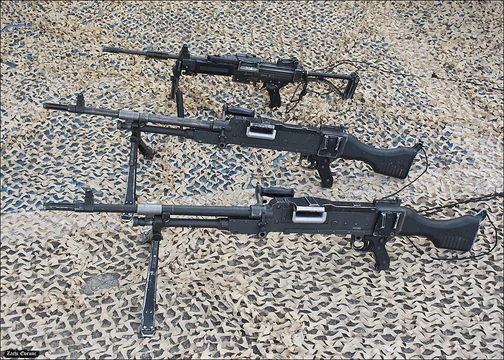
Automatic rifle
An autoloading rifle capable of fully automatic fire.

Gary Todd from Xinzheng, China · CC0
An automatic rifle is a self-loading firearm that can fire continuously when the trigger is held down. These rifles usually have a selector switch, letting the user choose between semi-automatic (one shot per trigger pull) and fully automatic fire, and sometimes a burst-fire setting as well. The key difference from a semi-automatic rifle is that an automatic rifle fires multiple rounds in a row with a single trigger pull. Most automatic rifles fall into the categories of battle rifles or assault rifles.
The first patents for automatic firearms were filed by Hiram Maxim in June 1883. His patents covered semi-automatic and fully automatic versions of Winchester and Martini-Henry rifles, along with an original automatic rifle design and both blowback- and recoil-operated machine guns, in single and multi-barrel configurations.
Ferdinand Mannlicher built an experimental self-loading rifle in 1885, based on work he started in 1883. It could fire in both semi-automatic and fully automatic modes, but it failed in practice because black powder fouled the mechanism. Even so, it influenced later designs. From the early 1890s until his death in 1904, Mannlicher produced automatic rifles that used smokeless powder.
One of the earliest automatic rifles was the Italian Cei-Rigotti. It began in 1891 as a gas-operated conversion of the Vetterli rifle. After further refinements, it was approved and adopted in 1895 for the Royal Italian Navy, and up to 2,000 rifles were ordered, but the order never went through for reasons that remain unknown. Another version appeared in 1900, a gas-operated, selective-fire carbine in 6.5mm Carcano or 7.65×53mm, which drew considerable attention. It used 10-, 20-, and 50-round box magazines. The Cei-Rigotti had problems, including frequent jams and erratic shooting. No army adopted it, and the design was abandoned before further development. Despite never being officially adopted by any military aside from the unfulfilled 1895 order, the Italian Army tested it extensively before World War I.
The Chauchat, designed in 1907, was one of the first automatic rifles actually adopted by a military. Its official name was the Fusil Mitrailleur Modele 1915 CSRG. It was issued to French infantry in 1916 and used by the French army during World War I.
- First patent for automatic firearms
- June 1883, Hiram Maxim
- Early experimental self-loader
- 1885, Ferdinand Mannlicher
- One of the first automatic rifles adopte
- Chauchat (Fusil Mitrailleur Modele 1915 CSRG), placed into French Infantry in 1916
- Fedorov avtomat production
- 3,200 manufactured between 1915 and 1924
- Browning automatic rifle production in w
- Approximately 50,000
- Lewis gun production in wwi
- More than 50,000
- Sturmgewehr 44 cartridge
- 7.92×33mm
Lore & Background
The development of automatic rifles began in the late 19th century. In June 1883 Hiram Maxim filed his first patent covering semi-automatic and fully automatic rifles as well as machine guns. In 1885 Ferdinand Mannlicher made an experimental self-loader in both semi-automatic and fully automatic modes, though it was an impractical failure due to fouling by black powder. Mannlicher later produced smokeless powder automatic rifles from the early 1890s. One of the world's first automatic rifles was the Italian Cei-Rigotti, a gas-operated conversion of the Vetterli rifle from 1891, which was adopted in 1895 for the Royal Italian Navy but the order never came through. Another version presented in 1900 attracted attention but had frequent jams and erratic shooting, and no army took interest.
The Chauchat, designed in 1907, was one of the first automatic rifles adopted by a military, placed into French Infantry in 1916 and used by the American Expeditionary Forces in 1917–18. The Lewis Gun, invented in 1911, was mass-produced in Belgium in 1913 for .303 British and widely used by British infantry and aircraft in WWI, with over 50,000 produced. The Fedorov Avtomat, designed by Vladimir Grigoryevich Fyodorov in 1915, was a select-fire, crew-served automatic rifle; 3,200 were manufactured between 1915 and 1924, seeing combat in WWI, the Russian Civil War, and the Winter War. The Browning Automatic Rifle made its combat debut in WWI, with about 50,000 made before the war ended, arising from the concept of "walking fire" urged by the French.
The Soviet AVS-36 was adopted in 1936 and saw service in early WWII. The German FG 42 was developed in 1942 for airborne infantry, serving as a squad automatic rifle. The Germans pioneered the assault rifle concept with the Sturmgewehr 44, using a shortened 7.92×33mm cartridge for controllable automatic fire.
Reader's Guide
The automatic rifle bridged the gap between the bolt-action rifle and the machine gun, providing infantry with portable, select-fire firepower. Early designs like the Cei-Rigotti and Mannlicher demonstrated the concept but suffered from technical problems. The Chauchat was one of the first to see military adoption, despite its failings. The Lewis Gun became the most common automatic weapon used by British and American troops in WWI, with over 50,000 produced, and was refurbished and reissued after the Dunkirk evacuation in 1940. The Fedorov Avtomat is considered by some an early predecessor or ancestor to the modern assault rifle, though it was used as a crew-served weapon with semi-automatic as the primary mode due to overheating. The Browning Automatic Rifle was praised for reliability and stopping power, serving as the standard squad light automatic of U.S. infantry in WWII, and was used by many countries until the late 1970s. The FG 42 influenced post-war small arms development, with most of its design copied for the M60 machine gun. The Sturmgewehr 44 established the assault rifle concept, influencing later designs such as the AK-47. The AVS-36 was among the early selective fire infantry rifles formally adopted for military service. These weapons collectively shaped infantry tactics and small arms development throughout the 20th century.
Did You Know?
- Hiram Maxim filed his first patent for automatic firearms in June 1883.
- The Fedorov Avtomat was designed by Vladimir Grigoryevich Fyodorov in 1915.
Origins and the Rush to Arm a Nation
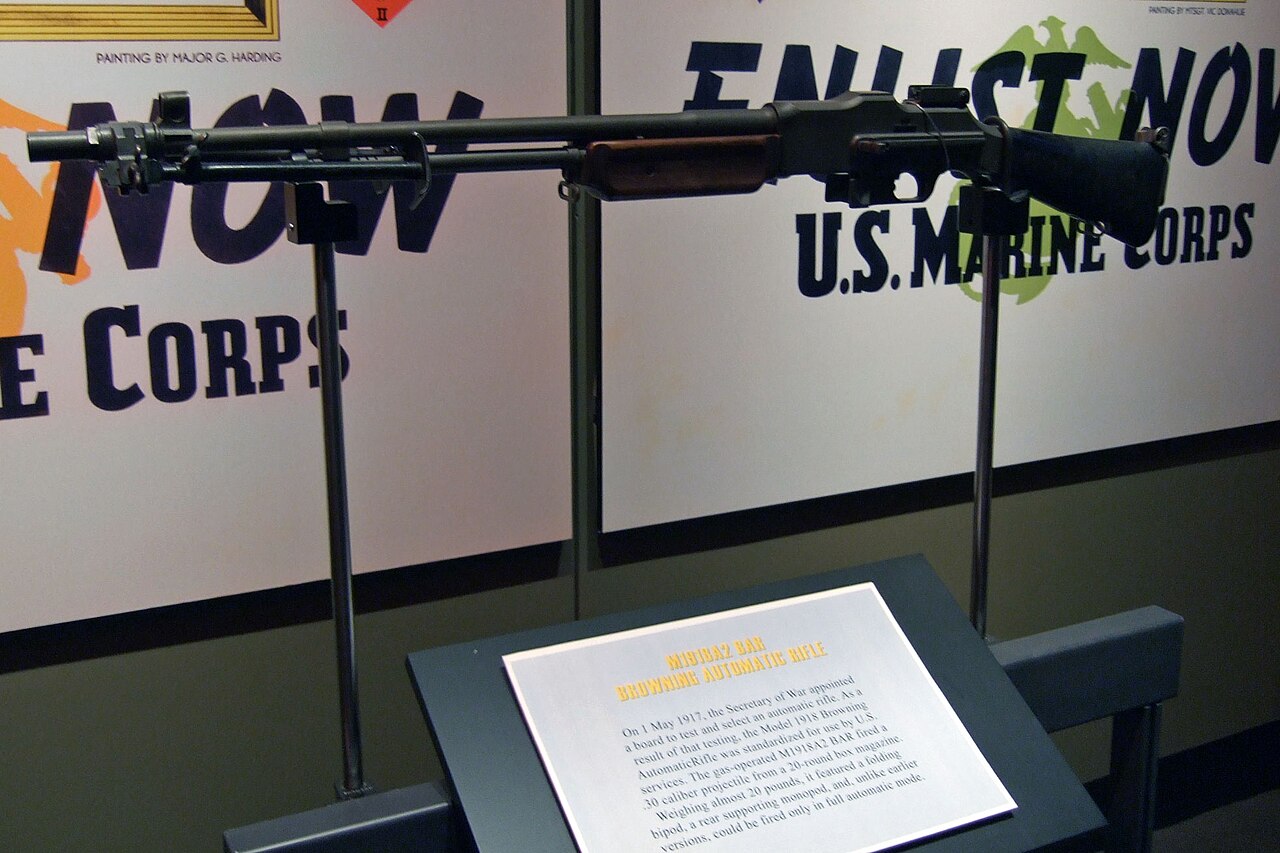
When the United States declared war on Germany in April 1917, its machine gun inventory was shockingly thin: a mere 670 Benét-Merciés, 282 Maxims, and 158 Colt-Browning M1895s. Bureaucratic paralysis and the absence of a clear employment doctrine left American troops dependent on French and British surplus, much of it chambered in 8mm Lebel, which created a logistical headache as machine gunners and riflemen carried incompatible ammunition. John Browning had been developing what would become the BAR since 1910, yet the Army saw no pressing need until the war came. On 27 February 1917, Browning personally hauled two automatic weapons to Congress Heights in southern Washington, D.C., where a live-fire show before roughly 300 spectators—congressmen, senators, foreign dignitaries, and press—won such acclaim that a manufacturing contract was awarded on the spot. Springfield Armory tests in May unanimously endorsed adoption, and by 16 July 1917, twelve thousand units were ordered. To avoid confusion with the belt-fed M1917, the shoulder-fired weapon was designated the M1918.
The Walking Fire Doctrine and Its Discontents
The BAR was conceived around a bold infantry concept called walking fire: the idea that a single soldier could carry an automatic weapon slung over the shoulder during an assault advance and deliver suppressive fire from the hip while still moving. This philosophy grew directly out of trench warfare, where the War Department believed individual riflemen needed more than a bolt-action rifle to break through entrenched positions. In reality, the weapon never fully met the Army's expectations as either a precision rifle or a sustained-fire machine gun. The service ultimately employed it as a light machine gun, typically braced on a bipod that appeared on models produced after 1938. Its standard twenty-round magazine, while functional, constrained sustained engagement. The Colt Monitor, a derivative of the original M1918, remains the lightest production automatic firearm chambered for the .30-06 Springfield cartridge, yet even that variant suffered from the same limited magazine capacity that hampered its effectiveness in the role the Army envisioned.
A Production Gauntlet in Wartime
The compressed 1918 timeline exposed serious manufacturing vulnerabilities. Because Winchester did not begin work until February, the first delivery of 1,800 rifles arrived out of specification—components failed to interchange between individual weapons, forcing a temporary halt while production procedures were overhauled. By June, Winchester was shipping four thousand units and had scaled to nine thousand per month by July. Colt and Marlin-Rockwell joined the effort shortly after; Marlin-Rockwell, already stretched by a Belgian rifle contract, took over the Mayo Radiator Company's plant exclusively for BAR work and peaked at two hundred rifles per day. Colt, still tied up fulfilling Vickers machine gun orders for the British, managed only nine thousand BARs before the armistice. Winchester also contributed critical design refinements, notably redirecting spent casing ejection to the right side of the weapon rather than straight upward. Together the three firms achieved a combined daily output of 706 rifles and delivered approximately 52,000 BARs by war's end.
Decades of Service and a Capability Gap
Although the BAR fired in the closing months of World War I, it did not become standard U.S. Army issue until 1938, when it was formally distributed to infantry squads as a portable light machine gun. From that point it served extensively through World War II and the Korean War, with limited continued use into the Vietnam era. Its retirement in the 1950s created an awkward gap: the Army planned to replace it with a squad automatic weapon variant of the M14, but that transition left American infantry without a dedicated portable light machine gun until the M60 entered service in 1957. Beyond U.S. borders, the BAR was adopted by numerous other nations throughout the twentieth century, embedding it in the arsenals of armies far from American soil. The weapon's arc—from an emergency wartime procurement to a decades-long squad-level staple—mirrors the Army's own evolving thinking about where automatic firepower should sit in the infantryman's hands.
Gallery
Frequently Asked Questions
What is an automatic rifle?
An automatic rifle is a self-loading rifle that discharges multiple rounds in succession with a single trigger pull. It typically features a selector switch allowing the shooter to toggle between semi-automatic, fully automatic, and sometimes a burst-fire mode.
Who holds the earliest patent for an automatic firearm?
Hiram Maxim filed the first patents for automatic firearms in June 1883, laying the groundwork for the entire class of self-loading, continuous-fire rifles that followed.
How does an automatic rifle differ from a semi-automatic one?
The defining distinction is that an automatic rifle cycles and fires multiple rounds while the trigger remains depressed, whereas a semi-automatic rifle releases only one round per trigger pull.
What subcategories do automatic rifles fall into?
Most automatic rifles are classified as either battle rifles or assault rifles, depending on the cartridge they chamber and their intended tactical role.
Which automatic rifle was among the first to see frontline military service?
The Chauchat, formally designated Fusil Mitrailleur Modele 1915 CSRG, was placed into French infantry service in 1916, making it one of the earliest automatic rifles adopted by a major army.
More in Machine Guns 1-24
Spotted an error? Know more?
Reader corrections go straight into our review queue. Suggest an edit · How this site is sourced