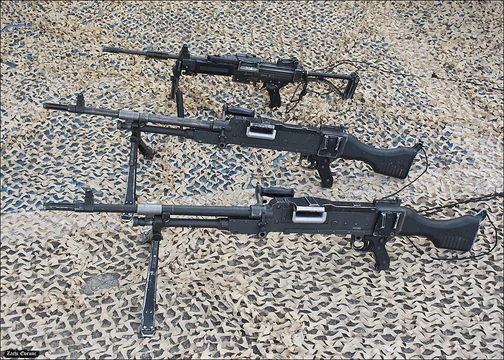
Chain gun
An externally powered autocannon using a chain-driven bolt action.

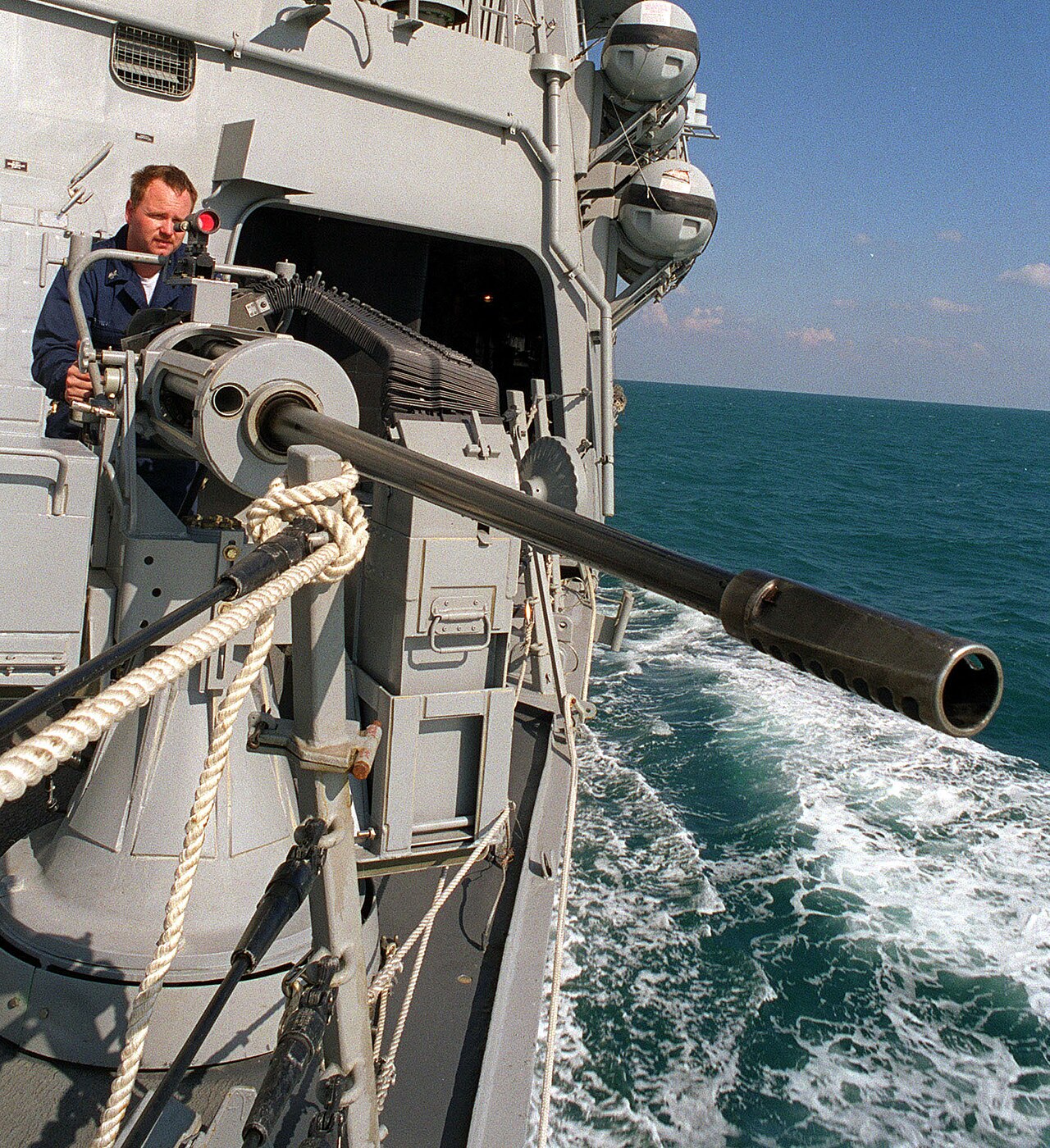
U.S. Navy photo by Photographer’s Mate 2nd Class Rebecca Kearns · Public domain
A chain gun is a type of autocannon or machine gun that relies on an external power source to operate its action. Instead of using energy from a fired cartridge to cycle the mechanism, it uses a continuous loop of chain—similar to a bicycle or motorcycle chain—driven by an electric motor. This chain moves in a rectangular path around four sprockets. One link of the chain connects to the bolt assembly, moving it back and forth to load, fire, extract, and eject cartridges.
The chain’s travel around the rectangle has four distinct periods. The two long sides control the bolt’s forward motion (loading a round) and rearward motion (extracting a spent case). The two short sides, where the chain moves sideways relative to the barrel, determine how long the breech stays locked during firing and how long it stays open for extraction and ventilation.
If a round misfires, the chain gun simply ejects it and continues cycling. This makes the design inherently reliable, unlike recoil-operated or gas-operated guns that depend on the cartridge’s propellant to power the action. A misfire in those weapons can cause a stoppage. The rate of fire is controlled by the motor speed; varying it allows a continuously adjustable rate, from single shots up to a safe maximum. In practice, most chain guns offer two or three set firing speeds.
The chain gun was first developed in 1972, when Hughes Helicopters began a company-funded project to create a machine gun firing the U.S. Army’s M50 round. Test rounds were fired in April 1973 using more powerful WECOM linked ammunition from a prototype A model. In January 1975, a linkless model C was added for the proposed YAH-64 Advanced Attack Helicopter. That helicopter was later adopted as the Hughes Model 77/AH-64A Apache, and the model C became the M230 chain gun, its standard armament. Hughes Helicopters patented the chain gun in 1976, and the design has since been developed into several other systems of different calibers. Today, "chain gun" is a registered trademark of Northrop Grumman Innovation Systems (formerly Orbital ATK), following a series of mergers and acquisitions after Hughes Helicopters, for externally-powered machine guns.
Chain guns differ from rotary guns, which also use an external power source but have multiple rotating barrels and complex rotating cam mechanisms instead of a chain.
- Inventor
- Hughes Helicopters
- Patent year
- 1976
- Initial caliber
- M50 round
- Example rate of fire
- 570 rounds per minute (7.62mm NATO EX-34 version)
- Endurance test rounds
- 29,721 rounds with no parts breakage and no gun stoppages
- Total test rounds without jam
- 101,343 rounds
Lore & Background
In 1972, Hughes Helicopters began a company-funded research effort to design a single machine gun to fire the U.S. Army's M50 round. In April 1973, the program fired test rounds in more powerful WECOM linked ammunition from a prototype A model. In January 1975, a model 'C' was added, a linkless version for the proposed Advanced Attack Helicopter YAH-64. The helicopter was later adopted as the Hughes Model 77/AH-64A Apache, with the model C receiving the designation M230 chain gun as its standard armament. In 1976, Hughes Helicopters patented the chain gun, and it has since been further developed into several other systems of different calibers. 'Chain gun' is a registered trademark of Northrop Grumman Innovation Systems, formerly Orbital ATK, following several mergers and acquisitions after Hughes Helicopters, for 'externally-powered machine guns'.
There are several differences between chain guns and other types of autocannon. While rotary guns can also use an external source of power to cycle the weapon's mechanism, they have multiple rotating barrels, unlike chain guns. The necessary actions are performed by complex rotating cam mechanisms, not a chain. Recoil-operated guns and gas-operated guns depend upon the firing of the cartridges to power the cycle of action, which can affect reliability if a cartridge misfires. In contrast, in a chain gun the action is cycled by a roller chain driven by an electric motor. The chain moves in a rectangular circuit around four sprockets that apply tension to it. One link of the chain is connected to the bolt assembly, moving it back and forth to load, fire, extract, and eject cartridges. Each full cycle consists of four different periods of the key link traveling along the circuit, controlling bolt movement and breech lock timing.
An unclassified report on the EX-34 prepared by the Naval Surface Weapons Center in Dahlgren, Virginia, dated 23 September 1983, said that 29,721 rounds of endurance tests were fired with no parts breakage and without any gun stoppages, and that during firing of 101,343 rounds not one jam or stoppage occurred due to loss of round control in the gun or feeder mechanism. The time that the chain takes to move around a complete loop controls the rate of fire; varying the motor-speed allows a chain gun, in principle, to fire at a continuously variable rate from single rounds to the maximum safe rate. For example, the 7.62mm NATO version EX-34 was advertised to fire 570 rounds per minute, and developmental work was underway for a 1,000-rounds-per-minute version. In practice, chain guns usually have two or three set firing speeds.
Reader's Guide
The chain gun's significance lies in its fundamental design departure from traditional automatic firearms. By using an external electric motor and a roller chain to cycle the action, it eliminates the dependence on cartridge propellant energy that can cause stoppages in recoil-operated or gas-operated weapons. This makes the chain gun inherently reliable, as demonstrated by endurance tests of the EX-34 variant that fired tens of thousands of rounds without a single jam or parts breakage. The design also allows for a continuously variable rate of fire in principle, though practical implementations typically offer two or three set speeds. The chain gun's legacy is tied to its adoption as the standard armament for the AH-64A Apache attack helicopter, where the M230 chain gun was fielded. The technology was patented in 1976 by Hughes Helicopters and has since been developed into several other systems of different calibers. The trademark for 'chain gun' is now held by Northrop Grumman Innovation Systems, reflecting the corporate lineage through mergers and acquisitions. The chain gun's reliability and external power source make it suitable for applications where misfire clearance and sustained fire are critical, distinguishing it from both rotary cannons and gas-operated or recoil-operated weapons.
Did You Know?
- The chain gun uses a roller chain driven by an electric motor, similar to a motorcycle or bicycle chain, to cycle the bolt.
- A misfired round does not stop the weapon; it is simply ejected, contributing to the chain gun's inherent reliability.
- An endurance test of the EX-34 chain gun fired 29,721 rounds with no parts breakage and no gun stoppages.
From Prototype to Apache: The Birth of a New Firing Principle
In 1972, Hughes Helicopters launched an internally funded research program with a clear mission: to create a single machine gun capable of firing the U.S. Army's M50 20 mm cartridge. By April 1973, the team had already pushed beyond that initial scope, test-firing more powerful 30 mm WECOM linked ammunition from a prototype designated the A model. The project accelerated rapidly. In January 1975, a new variant called model C entered the picture, designed specifically as a linkless feed system for the then-proposed Advanced Attack Helicopter, the YAH-64. That helicopter would ultimately be adopted as the Hughes Model 77, better known as the AH-64A Apache, and model C would earn the formal designation M230 chain gun as its standard armament. The following year, in 1976, Hughes Helicopters secured a patent on the chain gun concept, cementing its place in firearms engineering. From that single patent, the technology would spread into multiple weapon systems across a range of calibers, proving that the original 1972 research question had produced something far larger than a single 20 mm gun.
How the Chain Drives the Cycle
At the heart of every chain gun sits a roller chain, powered by an electric motor rather than by the energy of a fired cartridge. The chain travels in a rectangular loop around four sprockets that keep it under tension. A single link on that chain is mechanically tied to the bolt assembly, so as the chain circulates, it drives the bolt forward to chamber a round, holds it for firing, then pulls it back to extract and eject the spent case. The rectangular path is not arbitrary: the two long sides govern the bolt's forward and rearward travel, while the two short sides, which run perpendicular to the barrel axis, control how long the breech stays locked during the firing moment and how it opens to release the case and vent propellant gases. Because the chain's travel time around the full rectangle sets the cyclic rate, adjusting motor speed theoretically allows a continuously variable firing rate, from a single round up to the maximum safe speed. In practice, most chain guns offer two or three preset speeds. The 7.62 mm EX-34, for instance, was rated at 570 rounds per minute, with a 1,000-round version still in development.
Built to Never Jam: The Reliability Advantage
Conventional automatic weapons—whether recoil-operated like the Bofors gun or gas-operated like most assault rifles—rely on the energy released by a successfully fired cartridge to drive the next cycle. A misfire, a hang fire, or a round that discharges with insufficient force can all leave the mechanism dead-stopped. A chain gun sidesteps this vulnerability entirely. Because an external electric motor drives the chain and the chain drives the bolt, a dud round simply sits there until the bolt pulls it out and ejects it; the next round is already on its way. The result is a weapon whose operating principle is inherently resistant to the stoppages that plague cartridge-powered systems. The evidence is striking. An unclassified report from the Naval Surface Weapons Center in Dahlgren, Virginia, dated 23 September 1983, documented 29,721 rounds of endurance testing on the EX-34 with zero parts breakage and zero gun stoppages. In a separate sequence of 101,343 rounds, not a single jam or stoppage occurred due to loss of round control in the gun or feeder mechanism—a result the report called "very unusual in any weapon of any caliber or type."
Trademark, Technology, and the Road Ahead
The chain gun's journey from a Hughes Helicopters research project to a protected commercial brand illustrates how a single engineering insight can reshape an entire product category. After the 1976 patent, the technology was expanded into multiple weapon systems spanning different calibers, and the corporate ownership passed through a series of mergers and acquisitions. By 2019, the words "chain gun" had become a registered trademark held by Northrop Grumman Innovation Systems, the successor entity to Orbital ATK, which itself grew out of the Hughes Helicopters lineage. The trademark covers "externally-powered machine guns," a definition that neatly separates chain guns from rotary cannons—those use multiple rotating barrels and complex cam mechanisms rather than a chain—and from the vast family of recoil- and gas-operated automatic weapons. The distinction matters legally and technically: a chain gun's identity is bound to its externally driven chain, its rectangular circuit, and its electric motor, making it a category unto itself in the world of automatic firearms.
Gallery
Frequently Asked Questions
What is a chain gun?
A chain gun is an externally powered autocannon that cycles its bolt using a motor-driven loop of chain rather than the gas or recoil energy of a fired cartridge. It was developed by Hughes Helicopters and patented in 1976.
How does a chain gun's mechanism actually work?
An electric motor turns a chain around four sprockets in a rectangular loop, and a single link attached to the bolt assembly is pushed back and forth along that path. This linear motion handles loading, firing, extraction, and ejection in sequence.
What caliber and rate of fire does a chain gun support?
The initial design chambered the M50 round, while a later 7.62 mm NATO EX-34 variant achieves roughly 570 rounds per minute. The externally driven action lets the gun maintain a steady cyclic rate independent of individual cartridge pressures.
How reliable is a chain gun in endurance testing?
In a dedicated wear test the weapon cycled 29,721 rounds with zero broken parts and zero stoppages. Across a broader reliability trial it logged 101,343 rounds without a single jam.
Why is the chain gun considered significant in machine-gun design?
It proved that a simple, low-stress chain drive could replace complex gas-operated or recoil-based cycling while delivering high reliability and a consistent rate of fire. That made it attractive for aircraft and other platforms where weight, vibration, and maintenance are critical concerns.
More in Machine Guns 1-24
Spotted an error? Know more?
Reader corrections go straight into our review queue. Suggest an edit · How this site is sourced