Foster mounting
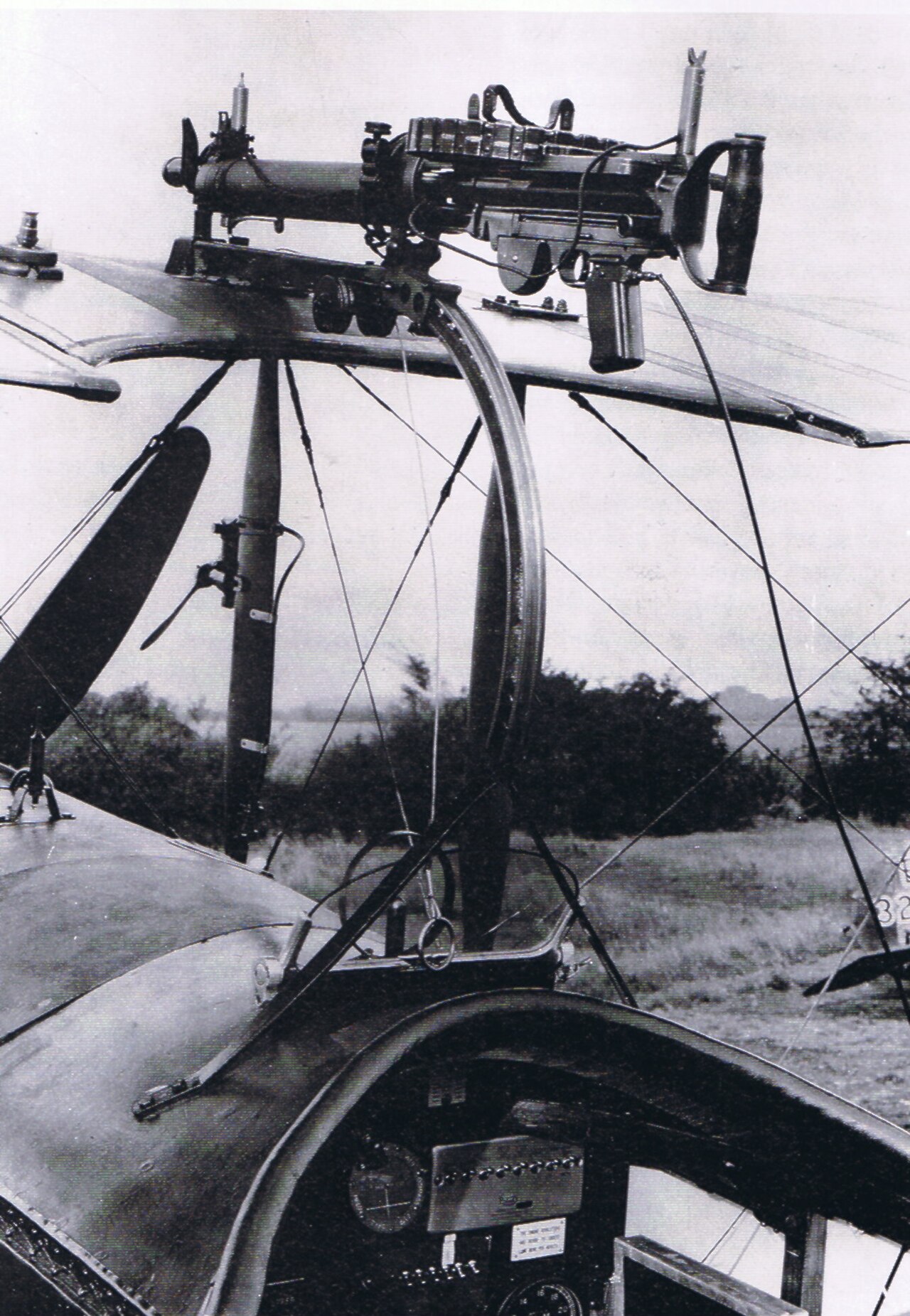
Quadrant rail mount for over-wing Lewis guns on RFC fighters.

Unknown author · Public domain
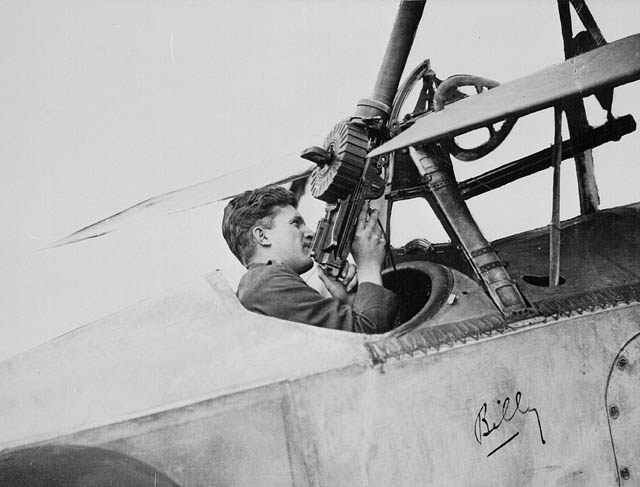
The Foster mounting was a device used on certain fighter aircraft of the Royal Flying Corps in the First World War. Its purpose was to allow a machine gun—specifically a Lewis Gun—to fire over the spinning propeller rather than through its arc. Although the mounting took different forms on various aircraft types, each version shared a common feature: a quadrant-shaped I-beam rail that allowed the gun to slide backward and downward in a single motion. The main reason for this design was to make it easier to replace spent ammunition drums, but some pilots also discovered that the mounting allowed the gun to be aimed directly upward or at an angle, enabling a fighter to attack an enemy from below.
Before reliable synchronization gears became widely available, several methods were tried to position a machine gun so it could fire past the propeller rather than through it. Even after reasonably dependable synchronization existed for closed-bolt weapons like the Vickers gun, there were reasons to avoid it. The best synchronization gears could still fail, and firing incendiary or explosive ammunition through the propeller arc posed special risks. Some weapons, such as the Lewis gun, were difficult to synchronize at all. An alternative was to fire over the propeller, especially on biplanes, where the upper wing structure provided a convenient mounting point. A drawback was that such a mount was less sturdy than one on the forward fuselage, and vibration affected the gun’s accuracy, particularly at long range. The main difficulty, however, was that the pilot or gunner needed access to the breech to change drums or clear jams.
The earliest mountings for an over-wing Lewis gun on light scout aircraft were fixed. In some cases, the inaccessibility of the breech was simply accepted; in others, pilots had to stand up—sometimes on their seats—to reach the gun. A hinged arrangement that allowed the breech to swing back and down into a position where the pilot could change drums while seated was preferable. Several versions of such mountings allowed the Lewis or Hotchkiss guns on French Nieuport 11 fighters to counter the German Fokker Eindeckers in early 1916. Typically, two hinges were attached to a pillar-type support for the gun’s breech.
- Primary weapon
- Lewis Gun
- Inventor
- Sergeant Foster of 11 Squadron RFC
- First applied to
- Nieuport 11 or 16
- Also used on
- Nieuport 17, Nieuport 24, S.E.5a, Sopwith 2F.1 Camel, Avro 504K Night Fighter
Lore & Background
Before the ready availability of a reliable synchronization gear, several methods were tried to mount a machine gun in a position from which it would be able to fire past rather than through the arc of the propeller. Even after reasonably reliable synchronization was available for closed bolt weapons such as the Vickers gun there were reasons for avoiding synchronization. Even the best synchronization gears were liable to failure, and there were special hazards in firing incendiary and explosive ammunition through the propeller arc. Some weapons, such as the Lewis gun, were not easy to synchronize at all. An alternative was to fire over the propeller, especially in the case of a biplane aircraft, where the structure of the upper wing formed a convenient base.
In early 1916 Sergeant Foster of 11 Squadron RFC improved the French hinged mounting for the upper wing Lewis gun on a Nieuport 11 or 16, by replacing the awkward double hinge of the French mount with a quadrant-shaped I-beam rail. This rail became the feature of all later "Foster" mountings, and enabled the breech of the gun to slide back and down in one movement, bringing the breech conveniently in front of the pilot, and making it much easier to change ammunition drums or to clear stoppages. The mounting also permitted the Lewis gun to be fired obliquely forwards and upwards, to attack an enemy aircraft from behind and below: a favourite tactic of several "ace" pilots, including Albert Ball.
Due to the different disposition of the wings and fuselage, adaptation of the mounting to the S.E.5a was not straightforward. The "S.E.5" version of the mount required a much longer and more robust quadrant rail. Rather than being fitted instead of a synchronised weapon, the Foster-mounted Lewis in the S.E.5 was fitted in addition. The 2F.1 (the shipboard variant of the Camel), carried an over-wing Lewis gun, mainly as an anti-airship weapon. As the adaptation of either type of Foster mounting to a normal Camel was not feasible, a special mounting, officially termed the "Admiralty upper-plane mounting", became standard for the 2F.1.
Reader's Guide
The Foster mounting was significant as a practical solution to the problem of firing a machine gun past the propeller arc without synchronization, particularly for the Lewis gun which was difficult to synchronize. Its quadrant rail design simplified the process of changing ammunition drums and clearing stoppages, making it more effective in combat than earlier hinged mounts. The mounting also enabled a novel upward-firing tactic, allowing pilots to attack enemy aircraft from below, a technique later used by German night fighters in the Second World War under the name Schräge Musik.
On the S.E.5a, the Foster mounting was retained throughout production life, despite consideration of twin-gun alternatives, because twin-gun versions of the hydraulic C.C. synchronisation gear were not available until late 1917 and early examples were needed for Sopwith Camels. The mounting also found use on night fighter variants of the Sopwith Camel and Avro 504K, and on the Sopwith 1½ Strutter in home defence squadrons. Some pilots complained of quadrants twisting or breaking under forceful handling, and some used elastic cord to supplement the spring that returned the gun to its forward position. Nevertheless, the mounting was generally considered highly successful and preferable to unreliable early mechanical synchronisation gears for RFC Nieuport squadrons.
Did You Know?
- The Foster mounting was invented by Sergeant Foster of 11 Squadron RFC in early 1916.
- It allowed the Lewis gun to be fired obliquely upwards, enabling attacks on enemy aircraft from below.
- The mounting was adapted for the S.E.5a with a longer, more robust quadrant rail.
- On some Sopwith Camel night fighters, twin Foster mountings were fitted with the pilot's seat moved aft of the upper wing.
Design & Engineering Innovation
The Foster mounting emerged from a practical problem that plagued early fighter pilots: accessing the breech of a wing-mounted machine gun to swap spent ammunition drums or clear mechanical stoppages. Before Sergeant Foster's improvement, French Nieuport squadrons relied on a double-hinge arrangement where the pilot had to stand up—sometimes on his own seat—to reach the gun. Foster, serving with 11 Squadron RFC in early 1916, replaced that awkward two-hinge pillar with a single quadrant-shaped I-beam rail. This elegant simplification let the breech slide back and down in one smooth motion, positioning it directly in front of the seated pilot. Metal springs or bungee cords assisted in returning the gun to its forward firing position. Though some pilots reported the quadrant twisting or breaking under the rough handling of aerial combat, and a few substituted elastic cord for the original clock-type spring, the design proved highly successful. It became the defining feature of all subsequent Foster mountings and was widely preferred over the unreliable early mechanical synchronization gears of the period.
Tactical Applications & Combat Use
Beyond its primary role of simplifying drum changes, the Foster mounting unlocked a tactical capability that proved devastating in combat. Because the quadrant rail allowed the Lewis gun to pivot upward and obliquely forward, a pilot could direct fire at an enemy aircraft positioned above and behind him—an angle otherwise impossible with a fixed forward-facing weapon. Albert Ball made this upward-firing technique a signature element of his aerial victories, and several other ace pilots adopted it as a favourite tactic. The principle was so effective that decades later, German night fighter pilots in the Second World War employed the same basic concept in their Schräge Musik fittings. In practice, the firing method differed depending on the gun's orientation: when aimed forward, the trigger was operated through a Bowden cable, while in the upward position the pilot gripped the pistol grip to steady the weapon and pulled the trigger directly. This dual-mode capability gave RFC pilots a flexible offensive option during the chaotic close-quarters combat of 1916 and 1917.
Adaptation Across Aircraft Types
Transferring the Foster mounting from one airframe to another was far from a simple copy-and-paste exercise. On the Nieuport 11, 16, 17, and 24, the upper wing structure provided a natural mounting base, and the quadrant rail could be relatively compact. The S.E.5a, however, presented a different geometry: its wing and fuselage disposition demanded a much longer and more robust quadrant rail. When the S.E.5 was equipped with a geared engine that raised the thrustline and the top of the propeller arc, the entire mounting had to be elevated accordingly to keep the line of fire clear. The S.E.5 also featured a hybrid armament arrangement—the Foster-mounted Lewis supplemented rather than replaced a synchronised weapon, with both guns aimed through a shared Aldis sight. Engineers considered replacing this setup with twin Lewis guns, but calculations showed the upper wing centre section would need reinforcement to withstand the recoil and vibration of two guns firing simultaneously. Twin hydraulic C.C. synchronisation gears did not become available until late 1917, and even then were prioritised for early Camels, leaving the S.E.5a's armament unchanged throughout its production run.
Context & Legacy in Early Aviation Armament
The Foster mounting must be understood against the broader backdrop of early aviation armament challenges. Synchronisation gears, even when reasonably reliable for closed-bolt weapons like the Vickers, remained prone to failure, and firing incendiary or explosive rounds through a propeller arc carried special hazards. The Lewis gun, in particular, was difficult to synchronise at all. These factors made the fire-over-the-propeller approach an attractive alternative, especially on biplanes where the upper wing offered a convenient structural base. French squadrons treated wing-mounted Lewis guns as a temporary stop-gap, planning to replace them with synchronised Vickers as soon as possible. British airmen, by contrast, had compelling reasons to retain the Nieuport's wing-mounted Lewis, and the Foster improvement cemented that choice. While the mounting carried drawbacks—reduced robustness compared to a forward-fuselage mount and accuracy degraded by vibration at range—it offered a dependable, mechanically simple solution. By 1918, S.E.5s in advanced training units still carried the Foster mount, a testament to its enduring practical value in an era when reliability often trumped theoretical elegance.
Gallery

Frequently Asked Questions
What is the Foster mounting?
It is a gun mount developed for Royal Flying Corps fighter aircraft during World War I that let a Lewis Gun fire above the propeller arc rather than through it. The name comes from Sergeant Foster of 11 Squadron RFC, who originated the concept.
Which aircraft used the Foster mounting?
It first appeared on the Nieuport 11 and Nieuport 16, and was later fitted to the Nieuport 17, Nieuport 24, S.E.5a, Sopwith 2F.1 Camel, and the Avro 504K Night Fighter. Each airframe got its own variation, but they all shared the same basic sliding-rail principle.
What problem did the Foster mounting solve?
It eliminated the need for a synchronization gear by simply placing the Lewis Gun outside the propeller's sweep, letting it fire freely over the arc. The curved rail also let the gunner yank the gun back and down in one motion to swap out empty ammunition drums quickly.
How did the Foster mounting's rail work?
The gun rode on a quadrant-shaped I-beam rail that guided it backward and downward in a single smooth motion. This one-movement design was chosen deliberately so crews could detach the gun for drum changes without wrestling with multiple locking points.
Why is the Foster mounting notable in machine-gun history?
It represents an early, pragmatic alternative to the more famous firing-pin synchronization systems by moving the weapon entirely out of the propeller's path. Its simple sliding-rail approach made it a practical stopgap that saw service across a wide range of RFC fighters throughout the war.
More in Machine Guns 1-24
Spotted an error? Know more?
Reader corrections go straight into our review queue. Suggest an edit · How this site is sourced