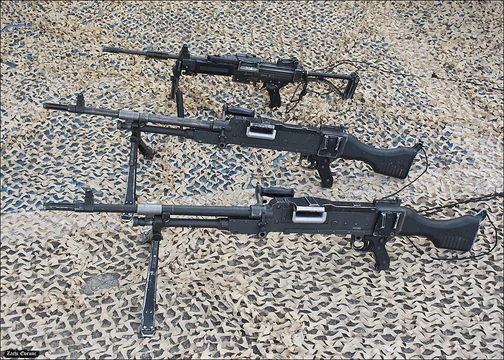
Sentry gun
Automated weapon that detects and engages targets without direct human control.

Jebulon · CC0
A sentry gun is a weapon system that automatically acquires and engages targets identified by its sensors. The earliest operational military examples were close-in weapon systems like the Phalanx CIWS, designed to detect and destroy short-range incoming missiles and enemy aircraft. These were initially deployed only on naval vessels but are now also used on land.
The Samsung SGR-A1 is a stationary South Korean military robot sentry, built by Samsung Techwin to replace human guards along the Korean Demilitarized Zone.
In 2007, the Israeli military began deploying the Sentry Tech system—called Roah-Yora (Sees-Fires)—along the Gaza border fence. Pillboxes spaced hundreds of meters apart each contain an automated M2 Browning .50 caliber machine gun and a SPIKE guided missile, protected by an opaque shield. A single soldier operates the system, receiving data from cameras, long-range electro-optical sensors, ground sensors, crewed aircraft, drones, and radar. Connected by fiber optics to a remote operator station and command center, each station functions as a robotic sniper, enforcing a denial zone nearly 1,500 meters deep. The weapon is based on the Samson Remote Controlled Weapon Station. It can independently acquire targets and maintain a firing solution, but requires human authorization to fire. Dozens of people have been shot by this system. The first reported killing occurred during Operation Cast Lead in December 2008. Israeli sources describe the kill authorization process as "complex" yet executable in under two minutes. They also report the weapons are mainly used for warning shots, as simply opening the protective dome often deters potential contacts.
In December 2010, South Korean firm DoDAAM introduced the Super aEgis II, an automated turret that uses thermal imaging to lock onto vehicles or humans up to 3 kilometers away. It operates at night and in any weather. The system issues a verbal warning before firing, and while capable of automatic fire, all customers have configured it to require human confirmation. It is used at facilities in Qatar and the United Arab Emirates, including Abu Dhabi, and has been tested in the Korean Demilitarized Zone.
In 2024, the U.S. Department of Defense tested the "Bullfrog," an AI-enabled sentry gun developed by Allen Control Systems in response to increasing drone attacks on American personnel.
- First reported killing (sentry tech)
- Operation Cast Lead, December 2008
- Sentry tech cost
- 4 million USD (3.35 million Euro)
- Sentry tech area of denial
- Nearly 1,500-meter-deep
- Super aegis ii range
- Up to 3 km
- Sky sentinel cost per turret
- Around $150,000
- Sky sentinel turrets needed for small to
- 10 to 30
Lore & Background
The Samsung SGR-A1 is a South Korean military robot sentry designed to replace human counterparts in the demilitarized zone at the South and North Korean border. It is a stationary system made by Samsung defense subsidiary Samsung Techwin. In 2007, the Israeli military deployed the Sentry Tech system, dubbed Roah-Yora (Sees-Fires) by the IDF, along the Gaza border fence with pillboxes placed at intervals of some hundreds of meters. The system mounts a .50BMG automated M2 Browning machine gun and a SPIKE guided missile in each pillbox covered by an opaque protective shield. The weapon is operated by one soldier and fed information from cameras, long-range electro-optical sensors, ground sensors, crewed aircraft, and overhead drones, as well as radar. Connected via fiber optics to a remote operator station and a command-and-control center, each machine gun-mounted station serves as a type of robotic sniper. The gun is based on the Samson Remote Controlled Weapon Station. The weapon is capable of acquiring targets and maintaining a firing solution independently, but still requires human input to fire or release ordnance. Dozens of people have been shot with the Sentry Tech system. The first reported killing of an individual appears to have taken place during Operation Cast Lead in December 2008. According to Israeli sources, the process to authorize a kill is 'complex' but can still be carried out in under two minutes. The same sources report that the weapons are mainly used for 'warning shots' if they are fired at all, since the mere opening of the protective dome is often enough to intimidate any potential contacts into retreat. In December 2010, the South Korean firm DoDAAM unveiled the Super aEgis II, an automated turret-based weapon platform that uses thermal imaging to lock onto vehicles or humans up to 3 km away. It is able to function during nighttime and is unaffected by weather conditions. The system gives a verbal warning before firing, and though it is capable of firing automatically, the company reports that all of its customers have configured it to require human confirmation. It is used at various facilities in Qatar and the United Arab Emirates, including Abu Dhabi, among other places, and has been tested in the Korean Demilitarized Zone. In response to increasing attacks using drones on US military personnel abroad, the United States Department of Defense tested an artificial intelligence-enabled sentry gun system developed by Allen Control Systems known as the 'Bullfrog' in 2024. The system consists of an M240 machine gun mounted on a rotating turret with an electro-optical sensor, proprietary AI and computer vision software. In May 2025, Ukraine unveiled an AI operated turret, called Sky Sentinel, fitted to an M2 Browning machine gun that shot down its first Shahed drone without human input using radar. The system costs around $150,000 per turret and some 10 to 30 turrets are required to protect a small town from drones. In 2025, a crowdfunding effort was underway to purchase more turrets.
Reader's Guide
Sentry guns represent a significant evolution in automated warfare, transitioning from naval point-defense systems like the Phalanx CIWS to land-based robotic snipers and anti-drone platforms. The Sentry Tech system along the Gaza border demonstrated the practical application of such weapons in a static defense role, with a reported kill authorization process under two minutes, though Israeli sources emphasized its primary use for warning shots and intimidation. The Super aEgis II and Samsung SGR-A1 highlight South Korea's investment in automated border security, with the former deployed in Qatar and the UAE. The 2024 US test of the Bullfrog system and Ukraine's 2025 deployment of the Sky Sentinel—which autonomously engaged a Shahed drone—underscore the growing role of AI and computer vision in sentry guns, particularly for countering drone threats. These systems raise questions about the balance between autonomous targeting and human oversight, as all known operational configurations require human confirmation to fire, despite technical capability for full autonomy. The crowdfunding effort for Sky Sentinel turrets indicates public interest in such defenses for civilian protection.
Did You Know?
- The Sentry Tech system is also known as Roah-Yora, meaning 'Sees-Fires' in Hebrew.
- The Super aEgis II gives a verbal warning before firing.
- The Bullfrog system uses an M240 machine gun with proprietary AI and computer vision software.
From Naval Point-Defense to Land Perimeters
A sentry gun is, at its core, a weapon platform that detects targets through sensors and then automatically aims and fires at them. While the concept might sound like science fiction, its earliest real-world military applications trace back to close-in weapon systems designed as point-defense platforms. The Phalanx CIWS stands as a landmark example: a system built to detect and destroy short-range incoming missiles and enemy aircraft. These early implementations were exclusively mounted on naval vessels, serving as the last line of defense for warships facing aerial and missile threats. Over time, the technology that powered these maritime defenses began migrating ashore, finding new roles as land-based defensive installations. This transition from sea to land marked a significant evolution in how militaries approached automated perimeter protection, laying the groundwork for the diverse array of sentry gun platforms that would follow in the decades ahead.
Guarding the World's Most Sensitive Borders
Several nations have turned to sentry gun technology to guard their most sensitive border zones. South Korea's Samsung Techwin developed the SGR-A1, a stationary military robot sentry intended to replace human soldiers along the heavily fortified demilitarized zone separating North and South Korea. In Israel, the IDF deployed the Sentry Tech system along the Gaza border fence in 2007, a network of pillboxes spaced hundreds of meters apart. Each station housed a .50 BMG M2 Browning machine gun and a SPIKE guided missile behind an opaque protective shield, all connected via fiber optics to a remote command center. The system, completed in late spring 2008 at a cost of four million dollars, drew data from cameras, electro-optical sensors, ground sensors, crewed aircraft, drones, and radar. Each station functioned as a robotic sniper capable of enforcing roughly 1,500 meters of denial, based on the Samson Remote Controlled Weapon Station platform. Meanwhile, South Korea's DoDAAM unveiled the Super aEgis II in December 2010, a thermal-imaging turret that could lock onto vehicles or humans up to three kilometers away, deployed in Qatar and the UAE.
Who Pulls the Trigger? The Human-in-the-Loop Question
One of the most consequential design questions surrounding sentry guns is who ultimately authorizes the shot. The Israeli Sentry Tech system could independently acquire targets and maintain a firing solution, yet it still required explicit human input before any round was released. Israeli sources described the authorization process as complex while noting it could be completed in under two minutes. In practice, the weapons were often used for warning shots, and the mere mechanical opening of the protective dome frequently proved sufficient to drive potential intruders away. Dozens of people were reportedly shot by the system, with the first confirmed killing occurring during Operation Cast Lead in December 2008. South Korea's Super aEgis II, though technically capable of fully autonomous firing, was configured by every customer to require human confirmation before engaging, and it issued a verbal warning prior to any shot. This recurring pattern across different nations reveals a persistent institutional reluctance to grant a machine unmediated lethal authority, even as the underlying technology grows increasingly capable of doing so.
The AI Drone-Defense Era
The rise of inexpensive drone warfare has accelerated the evolution of sentry gun technology into fully AI-driven platforms. In 2024, the United States Department of Defense tested the Bullfrog system, developed by Allen Control Systems, in response to a growing wave of drone attacks on American personnel deployed abroad. The Bullfrog pairs an M240 machine gun on a rotating turret with an electro-optical sensor and proprietary artificial intelligence and computer vision software, enabling it to identify and engage aerial threats. Then in May 2025, Ukraine unveiled the Sky Sentinel, an AI-operated turret fitted with an M2 Browning machine gun that successfully shot down a Shahed drone entirely without human input, using radar for detection. Each Sky Sentinel turret costs approximately 150,000 dollars, and protecting a small town typically requires somewhere between ten and thirty units. By 2025, a crowdfunding campaign was already underway to finance additional turrets, signaling that this class of autonomous air defense is moving rapidly from military testing grounds into broader operational deployment.
Gallery


Frequently Asked Questions
What is a sentry gun?
A sentry gun is an automated defensive weapon platform that uses built-in sensors to independently detect, track, and fire upon hostile targets without a human operator pulling the trigger. These systems are designed to provide continuous area denial around a protected position.
What was the earliest military sentry gun in service?
The Phalanx CIWS is widely regarded as the first operational automated close-in weapon system, originally developed to intercept incoming anti-ship missiles and low-flying aircraft on warships. Over time, similar automated defense concepts were adapted for land-based installations as well.
What is the Samsung SGR-A1 and where is it deployed?
The SGR-A1 is a stationary robotic guard developed by Samsung Techwin for the South Korean military, tasked with patrolling and defending the Demilitarized Zone in place of human soldiers. It represents one of the first large-scale uses of an autonomous sentry in a real combat-border environment.
What is the Israeli Sentry Tech system and when did it first engage a target?
Sentry Tech is an Israeli automated perimeter-defense system that began field deployment in 2007 to protect military positions from ground threats. Its first confirmed lethal engagement occurred during Operation Cast Lead in December 2008, and the system can deny an area roughly 1,500 meters deep.
How much does a sentry gun system cost?
Pricing varies widely by platform; the Israeli Sentry Tech system is reported at around four million dollars, while individual Sky Sentinel turrets run approximately $150,000 each. A full installation for a small-to-medium site may require anywhere from 10 to 30 turrets depending on coverage needs.
More in Machine Guns 1-24
Spotted an error? Know more?
Reader corrections go straight into our review queue. Suggest an edit · How this site is sourced