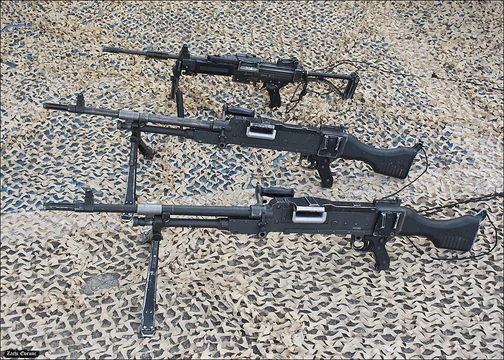
Hotchkiss machine gun
A line of gas-actuated machine guns used widely by France and others.

The Hotchkiss machine gun is a family of weapons made by Hotchkiss et Cie, a firm founded by American gunsmith Benjamin B. Hotchkiss. After moving to France, he opened a factory in Viviez near Rodez in 1867, then relocated to Saint-Denis near Paris in 1875, where he produced arms for the French during the Franco-Prussian War. Around 1900, the company launched a gas-operated machine gun known for its toughness and dependability, which saw heavy use by the French Army in World War I and later conflicts. The line includes the 1897 model, the M1909 Benét–Mercié light machine gun (called the Hotchkiss Mark I by the British and Benét–Mercié by the Americans), the Mle 1914 medium machine gun, a 37mm autocannon based on the M1897-M1914, the M1922 light machine gun, the M1929 heavy machine gun, a 25 mm anti-aircraft autocannon sometimes classed as a machine gun, and the Type Universal submachine gun. Foreign variants include the Japanese Type 3 heavy, Type 11 light, and Type 92 heavy machine guns, the Italian Breda Model 1931, the Polish Ckm wz. 25 Hotchkiss, and the Greek EYP Hotchkiss, a World War II modification.
- Manufacturer
- Hotchkiss et Cie (Société Anonyme des Anciens Etablissements Hotchkiss et Cie)
- Founder
- Benjamin B. Hotchkiss
- First factory location
- Viviez near Rodez (1867)
- Second factory location
- Saint-Denis near Paris (1875)
- Notable variants
- Hotchkiss 1897, M1909 Benét–Mercié, Mle 1914, M1922, M1929, 37mm autocannon, 25 mm anti-aircraft gun, Type Universal submachine gun
Lore & Background
The Hotchkiss machine gun line began with the gas-actuated design introduced at the turn of the twentieth century, noted for its sturdiness and reliability. The company produced several variants, including the Hotchkiss 1897 machine gun, the Hotchkiss M1909 Benét–Mercié light machine gun (known as the 'Hotchkiss Mark I' in British service and the 'Benét–Mercié' in American service), and the Hotchkiss Mle 1914 medium machine gun. Other variants included the Hotchkiss 37mm autocannon based on the M1897-M1914 model, the Hotchkiss M1922 light machine gun, the Hotchkiss M1929 heavy machine gun, the 25 mm Hotchkiss anti-aircraft gun (sometimes referred to as a machine gun), and the Hotchkiss Type Universal submachine gun.
The Hotchkiss design was also used on foreign productions, including the Japanese Type 3 heavy machine gun, Type 11 light machine gun, and Type 92 heavy machine gun; the Italian Breda Model 1931 machine gun; the Polish Ckm wz. 25 Hotchkiss; and the EYP Hotchkiss, a Greek modification used in World War II. British troops were photographed firing a captured Hotchkiss machine gun during the Battle for Caen on 10 July 1944.
Reader's Guide
The Hotchkiss machine gun line holds significance as a widely used family of weapons, particularly by the French Army during World War I and thereafter. Its gas-actuated design, introduced at the turn of the twentieth century, proved sturdy and reliable in combat. The company's production spanned multiple variants, from light machine guns to heavy machine guns and autocannons, reflecting the adaptability of the basic design. The Hotchkiss design was also adopted and produced by several foreign nations, including Japan, Italy, Poland, and Greece, indicating its international influence. The appearance of a captured Hotchkiss machine gun in use by British troops during the Battle for Caen in 1944 illustrates its continued presence on battlefields even after the original manufacturer's era. The legacy of the Hotchkiss machine gun is thus tied to its widespread deployment across different conflicts and its role as a foundational design for several national variants.
Did You Know?
- The Hotchkiss company was established by United States gunsmith Benjamin B. Hotchkiss.
- Hotchkiss set up a factory at Viviez near Rodez in 1867, then at Saint-Denis near Paris in 1875.
- The Hotchkiss M1909 Benét–Mercié was known as the 'Hotchkiss Mark I' in British service.
More in Machine Guns 1-24
Spotted an error? Know more?
Reader corrections go straight into our review queue. Suggest an edit · How this site is sourced