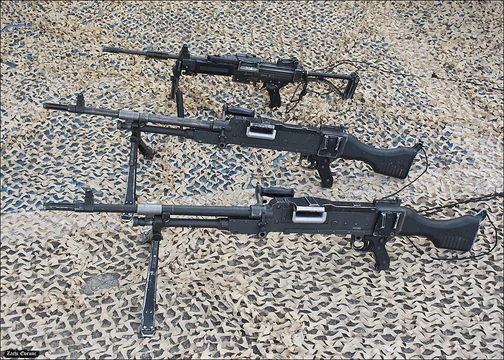
Dror light machine gun
An Israeli light machine gun derived from the M1941 Johnson.

The Dror light machine gun, whose name means "Sparrow" in Hebrew, was an Israeli adaptation of the M1941 Johnson light machine gun. In 1946, Ta'as examined plans to create a domestically produced light machine gun. By the end of that year, the Haganah—the predecessor to the Israel Defense Forces—secured the manufacturing rights to the M1941 Johnson from the Winchester Repeating Arms Company. Development took place in secret workshops, using manufacturing tools purchased cheaply as scrap in the United States. Yisrael Galili oversaw the Dror's production.
The Dror is air-cooled and recoil-operated, with a barrel that uses a rotary bolt featuring multiple radial lugs. It fires from an open bolt in full-auto mode for better cooling, or from a closed bolt in semi-auto for improved accuracy. The Pattern 1 Dror closely resembled the Johnson, including a tall front sight and barrel release. The Pattern 2 introduced many changes, adapting to a rimless cartridge and using modified 20-round BAR magazines to balance the weapon. Its barrel release moved to the front barrel bearing, which includes a heat shield colored orange or brown, allowing removal without protective gloves. A folding cover over the magazine well prevents dirt from entering when the weapon is not in use. The fire selector sits on the right side above the pistol grip, and the metal butt consists of two parallel steel tubes with a sheet-steel buttplate.
Because large quantities of British rifle ammunition were available, the Pattern 1 Dror was initially chambered in .303 British. Around 800 to 1,000 were made before production stopped due to feeding problems that armourers could not resolve. The Pattern 2, built by IMI, was chambered in 7.92×57 mm Mauser to use recently imported Mauser ammunition. In this version, the magazines were mounted vertically under the receiver.
The Dror did not see combat during the 1947–1949 War of Independence because it was overly sensitive to dusty environments. After combat simulation testing, the Israel Defense Forces chose the FN Model D—a derivative of the M1918 Browning Automatic Rifle—to replace the Dror in 1952. Some Drors are now on display at the IDF History Museum.
Quick Facts
- Is Ranged
- yes
- Origin
- Israel
- Design Date
- 1946
- Designer
- Winchester Repeating Arms Co.
- Manufacturer
- Haganah (Pattern 1) / Israel Military Industries (Pattern 2)
- Production Date
- 1947 to 1952
- Service
- 1947 to 1950
- Used By
- Haganah (1948) / IDF (After 1948)
- Wars
- Not used in combat
- Weight
- 10 kg
- Part Length
- 680 mm
- Length
- 1240 mm
Facts from the source article.
Lore & Background
In 1946, Ta'as studied plans to produce an indigenous light machine gun. By the end of that year, the Haganah bought the manufacturing rights to the M1941 Johnson machine gun from the Winchester Repeating Arms Company and developed the Dror in its own clandestine workshops, alongside manufacturing tools bought cheaply as scrap in the United States. Yisrael Galili was in charge of overseeing the Dror's production.
The Dror is air-cooled and recoil-operated, using a rotary bolt with multiple radial lugs. It fires from an open bolt in full auto for better cooling, or from a closed bolt in semi-auto for better accuracy. The Pattern 1 Dror bore a physical resemblance to the Johnson, including the tall front sight and the barrel release. The Pattern 2 Drors had many changes, adapting to a rimless round and using modified 20-round BAR LMG magazines mounted vertically under the receiver. Its barrel release is located at the front barrel bearing with a heat shield, colored orange/brown, and can be removed without protective gloves. A folding cover over the magazine well prevents dirt from entering when not in use. A fire selector is on the right side above the pistol grip, and the LMG has a metal butt made of two parallel steel tubes with a sheet-steel buttplate.
Because large amounts of British rifle ammunition were available, the Pattern 1 Dror was initially chambered in .303 British. Around 800–1000 were made before production was halted due to feeding problems the armourers could not handle. The Pattern 2 Dror was built by IMI and chambered in 7.92×57 mm Mauser to take advantage of imported Mauser ammunition.
Reader's Guide
The Dror light machine gun did not see combat service in the 1947–1949 War of Independence due to its oversensitivity to dusty environments. Following combat simulation testing, the Israel Defense Forces selected the FN Model D (a derivative of the M1918 Browning Automatic Rifle) to replace the Dror in 1952. Some Drors are on display at the IDF History Museum. The weapon's development reflected the early efforts of Israeli clandestine arms production, but its reliability issues in field conditions prevented it from becoming a standard-issue arm. Its legacy lies in being an early indigenous Israeli design that was ultimately superseded by more robust foreign-derived weapons.
Did You Know?
- The Dror's name means 'Sparrow' in Hebrew.
- The Pattern 1 Dror was chambered in .303 British due to available British rifle ammunition.
- The Pattern 2 Dror used modified 20-round BAR LMG magazines mounted vertically.
- The Dror was replaced by the FN Model D in 1952 after combat simulation testing.
More in Machine Guns 1-24
Spotted an error? Know more?
Reader corrections go straight into our review queue. Suggest an edit · How this site is sourced