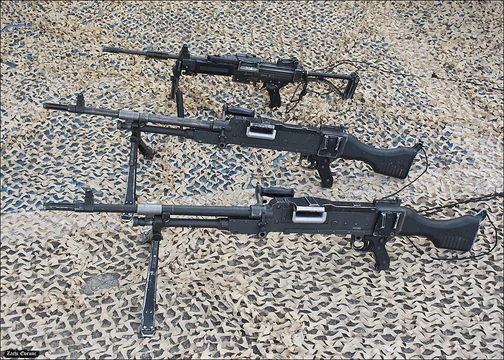
Daewoo Precision Industries K3
South Korean light machine gun, standard squad automatic weapon until 2022.

The Daewoo Precision Industries K3 is a South Korean light machine gun, the third firearm designed domestically by the Agency for Defense Development after the K1 and K2 rifles. It is produced by Daewoo Precision Industries, now known as SNT Motiv.
The K3 entered frontline service with South Korean forces in 1989, replacing the M60 machine gun. It was itself replaced in 2022 by the SNT Motiv K15.
Visually similar to the FN Minimi, the K3 fires the standard 5.56×45mm NATO cartridge and can also chamber .223 Remington rounds, matching the K2 assault rifle. Its main advantage over the M60 is lighter weight and the ability to share ammunition with the K1A and K2. It feeds from a 30-round box magazine or a 200-round disintegrating M27 belt. A bipod is used for the squad automatic role, and a tripod can be fitted for sustained fire. The rear sight adjusts for elevation and windage; the front sight adjusts for elevation during zeroing. The barrel includes a built-in carry handle for quick changes. The weapon is gas-operated with a rotating bolt. It was not designed for extensive customization, as most South Korean soldiers do not use their weapons for extended periods.
Variants include the experimental XK3, the standard K3, and the K3Para—a shortened version with a RAS and minor modifications, first shown in 2015. By 2015, the Republic of Korea forces sought a new light machine gun due to the K3’s age and reliability issues. S&T Motiv attempted to win the contract by modernizing the K3 with a side-folding adjustable stock, an integral MIL-STD-1913 rail on the feed cover, detachable side and underside rails, a carbon fiber heat shield over the barrel, an improved muzzle brake and flash hider, folding iron sights, and an upgraded feed system. These improvements were also applied to the Para version. As of 2019, this improved version had not been adopted for general service, though it was suggested for special forces.
In late 2018, the S&T Motiv “Next-Generation LMG” was standardized as the K15, a heavily upgraded K3 planned for fielding by 2020. It features an adjustable buttstock, a redesigned pistol grip and trigger group for better ergonomics, and internal parts made with closer tolerances for improved reliability. Unlike the K3, it uses a push button to hold and release the barrel, with three upper positioning lugs to ensure correct barrel alignment.
Quick Facts
- Origin
- South Korea
- Is Ranged
- Yes
- Service
- 1991–present
- Wars
- Colombian conflict / Gulf War / War in Afghanistan / Iraq War / Syrian Civil War / Moro conflict / Siege of Marawi
- Designer
- Agency for Defense Development / Daewoo Precision Industries
- Design Date
- 1978–87
- Manufacturer
- Daewoo Precision Industries / (1981-1999) · Daewoo Telecom / (1999-2002) · Daewoo Precision / (2002-2006) · S&T Daewoo / (2006-2012) · S&T Motiv / (2012-2021) · SNT Motiv / (2021-present)
- Production Date
- 1988–present
- Weight
- 6.85 kg (K3) / 6.3 kg (K3 Para)
- Length
- 1030 mm (K3) / 953 mm (K3 Para extended) / 805 mm (K3 Para collapsed)
- Part Length
- 533 mm (K3) / 365 mm (K3 Para)
- Cartridge
- 5.56×45mm NATO / .223 Remington
Facts from the source article.
Lore & Background
The K3 light machine gun entered service in 1989, replacing the M60 machine gun in frontline use. It was replaced by the SNT Motiv K15 in 2022. The K3 is visually similar to the FN Minimi and uses a standard 5.56×45mm NATO cartridge. It is capable of firing both 5.56×45mm NATO and .223 Remington rounds, like the K2 assault rifle, and its greatest advantage is that it is lighter than the M60 and can interchange cartridges with both the K1A and K2. Feed can come from either a 30-round box magazine or a 200-round disintegrating M27 ammunition belt. The K3 can be used with a bipod for the squad automatic role, or fitted with a tripod for sustained fire support. The rear sight is adjustable for elevation and windage, and the foresight can be adjusted for elevation for zeroing. The barrel has a built-in carry handle for ease of changing the barrel. The gun is gas operated with a rotating bolt. The weapon system was not designed for customization, as most soldiers of the South Korean military would not see extended use of their weapons.
Reader's Guide
The K3 served as the standard squad automatic weapon of the Republic of Korea Armed Forces from 1989 until its replacement by the K15 in 2022. Its significance lies in being the third indigenous firearm developed in South Korea, following the K1 and K2 assault rifles, and in replacing the heavier M60 in frontline use. The K3 was also exported, with 400 acquired by Indonesia in 2006, 110 by the Philippines in 2006 (with an additional 803 in 2011), and 6,540 units acquired by the Philippine Army in 2008. The Philippine National Police acquired K3s in 2019. Two examples were purchased by Thailand in 2006, and one example was purchased by South Africa in 2006. A controversy arose in the Philippines in 2007 when the Armed Forces initially selected the FN Minimi over the K3 and the Ultimax, but ultimately 6,540 K3s were acquired. By 2015, the K3 was suffering from age and reliability issues, leading to modernization efforts by S&T Motiv and eventual development of the K15. The K3 was retired from active service in South Korea and replaced by the K15 in 2025.
Did You Know?
- The K3 was the third indigenous firearm developed in South Korea, after the K1 and K2 assault rifles.
- 6,540 K3s were acquired by the Philippine Army for their SAW requirement.
More in Machine Guns 1-24
Spotted an error? Know more?
Reader corrections go straight into our review queue. Suggest an edit · How this site is sourced