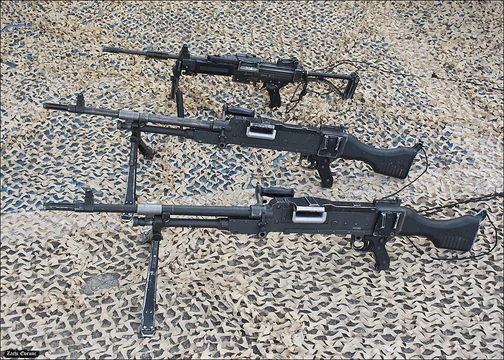
Bren light machine gun
A gas-operated light machine gun with a top-mounted curved magazine.

The Bren gun (short for Brno-Enfield) was a family of light machine guns produced by the United Kingdom starting in the 1930s, remaining in service until 1992. It is most famous as the standard infantry light machine gun for British and British Empire forces during World War II, but it also saw action in the Korean War, the Falklands War of 1982, and other conflicts throughout the latter half of the 20th century. Although it came with a bipod, it could also be placed on a tripod or mounted on a vehicle.
The Bren was a licensed copy of the Czechoslovak ZGB 33 light machine gun, itself a modified version of the ZB vz. 26, which British Army officials had tested in a firearms competition during the 1930s. The designer was Václav Holek, a gun inventor and engineer. The Bren was recognizable by its top-mounted curved box magazine, conical flash hider, and quick-change barrel.
During the 1950s, many Brens were re-barreled to fire the 7.62×51mm NATO cartridge and modified to accept magazines from the L1 rifle (the Commonwealth version of the FN FAL), becoming the L4 light machine gun. It was eventually replaced in British Army infantry sections by the L7 general-purpose machine gun, a belt-fed weapon. In the 1980s, the L86 Light Support Weapon, firing 5.56×45mm NATO rounds, supplemented it, leaving the Bren only in use as a pintle-mounted weapon on some vehicles. Indian Ordnance Factories manufactured the Bren as the "Gun Machine 7.62mm 1B" until production ended in 2012.
The name "Bren" came from Brno, the Czech city where the ZB vz. 26 was designed at the Zbrojovka Brno Factory, and Enfield, the site of the British Royal Small Arms Factory.
After World War I ended in 1918, the British Army relied on two main automatic weapons: the heavy Vickers medium machine gun, which needed water to keep cool and was mostly used for static defense or indirect fire, and the lighter Lewis gun, which was still heavy, prone to frequent stoppages, and had a barrel that could not be changed in the field, causing it to overheat during sustained fire. In 1922, the Small Arms Committee ran trials to find a replacement for the Lewis, testing the Madsen, the M1918 Browning Automatic Rifle (BAR), the Hotchkiss M1909, the Beardmore–Farquhar, and the Lewis itself.
Quick Facts
- Origin
- First Czechoslovak Republic (design) / United Kingdom (manufacture)
- Is Ranged
- yes
- Service
- 1938–2012
- Designer
- Václav Holek
- Design Date
- 1935
- Manufacturer
- Royal Small Arms Factory / John Inglis and Company / Lithgow Small Arms Factory / Rifle Factory Ishapore
- Production Date
- 1935–1971
- Weight
- Mk1 & Mk2: / 22.8 lb, 25 lb loaded · Mk3 & Mk4: / 19.15 lb, 21.6 lb loaded
- Part Length
- 25 in
- Crew
- 2, gunner and assistant
Facts from the source article.
Lore & Background
The Bren gun was a licensed version of the Czechoslovak ZGB 33 light machine gun, itself a modified version of the ZB vz. 26, which British Army officials tested during a firearms service competition in the 1930s. The designer was Václav Holek. The name Bren was derived from Brno, the city in Czechoslovakia where the Zb vz. 26 was designed, and Enfield, site of the British Royal Small Arms Factory. The Bren featured a distinctive top-mounted curved box magazine, conical flash hider, and quick-change barrel. It was gas-operated, using the same .303 ammunition as the standard British bolt-action rifle, the Lee–Enfield, firing at a rate between 480 and 540 rounds per minute. Propellant gases vented from a port near the muzzle through a regulator with four quick-adjustment apertures to tailor gas volume to different ambient temperatures. Each gun came with a spare barrel that could be quickly changed when hot; later guns featured a chrome-lined barrel. The sights were offset to the left to avoid the magazine, meaning the Bren could be fired only from the right shoulder.
Reader's Guide
The Bren gun served as the primary infantry light machine gun for British and Commonwealth forces during World War II, and continued in use through the Korean War, the Falklands War, and beyond. It was generally issued one per rifle section, operated by a two-man crew: the gunner (Number 1) and a loader (Number 2) who carried extra magazines, a spare barrel, and a tool kit. The Bren was regarded as the principal weapon of an infantry section, providing the majority of its firepower. In the 1950s, many Bren guns were re-barrelled to accept the 7.62×51mm NATO cartridge and modified to feed from the L1 rifle magazine as the L4 light machine gun. It was replaced in the British Army as the section LMG by the L7 general-purpose machine gun, a belt-fed weapon, and supplemented in the 1980s by the L86 Light Support Weapon firing 5.56×45mm NATO, leaving the Bren in use only as a pintle mount on some vehicles. The Bren gun was manufactured by Indian Ordnance Factories as the 'Gun Machine 7.62mm 1B' before it was discontinued in 2012.
Did You Know?
- The name Bren is derived from Brno (Czechoslovakia) and Enfield (England).
- It could be mounted on a bipod, tripod, or vehicle.
- Many Bren guns were re-barrelled to 7.62×51mm NATO in the 1950s as the L4.
Frequently Asked Questions
What is the Bren light machine gun?
The Bren (short for Brno-Enfield) is a British light machine gun that entered service in the 1930s and stayed in use until 1992. It was a licensed British production of the Czechoslovak ZB-33, originally designed by Václav Holek.
What role did the Bren light machine gun play in combat?
It served as the standard squad-level automatic weapon for British and Commonwealth infantry throughout World War II. It also saw action in the Korean War, the 1982 Falklands conflict, and various other engagements across the latter half of the 20th century.
How does the Bren light machine gun operate?
It uses a gas-operated action and feeds from a distinctive top-mounted curved box magazine. The standard .303 British round version cycles at roughly 480–540 rounds per minute, while the later L4 variant switched to 7.62×51mm NATO ammunition.
Why is the Bren light machine gun considered important?
Its nearly sixty-year service life made it one of the longest-serving infantry weapons in British military history. Its versatility—usable from a bipod, a tripod, or a vehicle mount—gave squad leaders a flexible suppressive-fire option across multiple theatres.
Who is behind the design of the Bren light machine gun?
The original ZB-33 was designed by Czechoslovak engineer Václav Holek in the early 1930s. The British adopted and refined it as the Bren, producing it under licence at Enfield and other domestic factories.
More in Machine Guns 1-24
Spotted an error? Know more?
Reader corrections go straight into our review queue. Suggest an edit · How this site is sourced