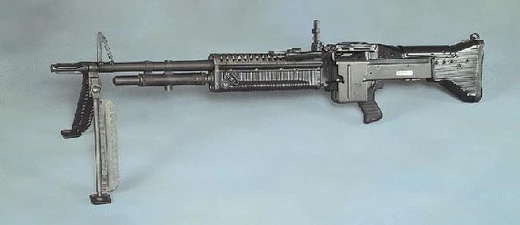
Type 67 machine gun
Chinese general-purpose machine gun used by multiple forces.

The Type 67 is a general-purpose machine gun firing 7.62×54mmR ammunition, which the People's Liberation Army formerly used. It was created to serve as a lighter alternative to the Type 53 and Type 57 medium machine guns. Initial testing began in 1963.
The weapon’s development was overseen by Dr. Duo Ying Jian of the Beijing Industrial Technology Academy. Work started in 1959, driven by concerns that worsening relations with the Soviet Union would cut off technical support, including access to the Soviet PKM. The Type 67 first saw combat in 1980, used by Mujahideen forces in Afghanistan fighting pro-Soviet troops; these weapons reached them through smuggling routes in Pakistan. Later, Syrian opposition forces used the Type 67 in the Syrian Civil War from 2015, likely captured from Syrian government troops. It also appeared in the Yemeni Civil War against Houthi forces.
According to a U.S. Army Materiel Command analysis, the Type 67 combines parts from several designs: the DP trigger mechanism, the SG-43’s quick-change barrel, a gas regulator similar to the RPD, the ZB vz. 30 bolt mechanism, and a modified Maxim-type feed system. The original furniture was wood, with a non-detachable bipod attached to the gas tube. A tripod could be added for long-range use. The Type 67 was initially intended solely as a tripod-mounted medium machine gun, but after Chinese engineers studied a captured M60 GPMG from the Vietnam War, the bipod became standard. Since 1967, two model upgrades have appeared: the Type 67-1 and Type 67-2.
The Type 67-1 has a non-fluted barrel and a removable bipod clamped to the barrel’s front. Its furniture is plastic. The Type 67-2 uses a lighter version of the same barrel, a stamped-steel tripod instead of a bipod, and can mount telescopic or night sights. Late production models removed the anti-aircraft sight base.
Users include the Palestine Liberation Organization, the Syrian Arab Army, and the Free Syrian Army. Former users include the Vietcong and the North Vietnamese Army. The weapon has also been used by non-state actors.
Quick Facts
- Origin
- People's Republic of China
- Is Ranged
- yes
- Service
- 1967–present
- Wars
- Vietnam War / Lebanese Civil War / Sino-Vietnamese War / War in Afghanistan (2001-2021) / Syrian Civil War / Yemeni Civil War
- Designer
- Dr. Duo Ying Jian
- Design Date
- 1959
- Manufacturer
- China North Industries Corporation
- Production Date
- 1967–
- Variants
- Type 67-1, Type 67-2
- Weight
- 11 kg
- Length
- 1650 mm
- Part Length
- 605 mm
Facts from the source article.
Lore & Background
The Type 67 was developed in 1959 as a lightweight replacement for the Type 53 and Type 57 medium machine guns, with research led by Dr. Duo Ying Jian from the Beijing Industrial Technology Academy. First tests began in 1963. After Soviet-Chinese relations began to break down, concerns arose that further technological assistance, including supply of Soviet-made PKMs, would not be rendered. According to a United States Army Materiel Command analysis, the Type 67 uses the DP trigger mechanism, the quick-change barrel of the SG-43, a gas regulator similar to the RPD, the ZB vz. 30 bolt mechanism, and a modified Maxim-type feed mechanism. The furniture was originally wood with an integral non-detachable bipod attached to a gas tube; a tripod could be used for long-range fire. The Type 67 was initially intended as a medium machine gun with a tripod, but after Chinese engineers studied a captured M60 GPMG from American-led forces in the Vietnam War, the bipod was made standard. Since 1967, two model modifications have been produced: the Type 67-1 and Type 67-2.
Reader's Guide
The Type 67 machine gun saw its first combat use with Mujahideen forces fighting in Afghanistan against pro-Soviet forces in 1980, having reached them through smuggling across Pakistani soil. It later appeared in the Syrian Civil War from 2015 with Syrian opposition forces, likely captured from Syrian troops, and has also been used in the Yemeni Civil War against the Houthis. Users include the Palestine Liberation Organization, the Syrian Arab Army, and the Free Syrian Army; former users include the Vietcong and the North Vietnamese Army. The Type 67-1 variant features a non-fluted barrel with a removable bipod clamped below the front, and plastic furniture. The Type 67-2 uses a lighter barrel, a tripod made from stamped steel instead of steel tubing, and can attach a telescopic or night sight; late production models remove the AA sight base. Its design reflects a blend of components from several earlier machine guns, adapted for Chinese production under conditions of reduced Soviet technical support.
Did You Know?
- Its first combat use was with Mujahideen forces in Afghanistan in 1980.
- The design incorporates elements from the DP, SG-43, RPD, ZB vz. 30, and Maxim machine guns.
- The Type 67-2 variant can mount a telescopic or night sight.
More in Machine Guns, Part 5 1-24
Spotted an error? Know more?
Reader corrections go straight into our review queue. Suggest an edit · How this site is sourced