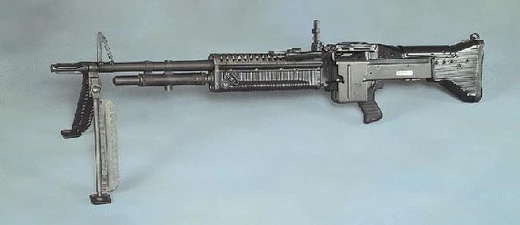
Hotchkiss Mle 1914 machine gun
Standard French heavy machine gun of World War I.

The Mitrailleuse Automatique Hotchkiss modèle 1914 was a gas-actuated, air-cooled machine gun chambered for the 8mm Lebel cartridge. It became the standard machine gun of the French Army during the latter half of World War I. Manufactured by Hotchkiss et Cie, the design was based on an 1893 patent by Odkolek von Ujezda, later improved by American Laurence Benét and his French assistant Henri Mercié.
Quick Facts
- Origin
- France
- Is Ranged
- yes
- Service
- 1914–1960s
- Designer
- A. Odkolek von Augeza / Laurence V. Benét / Henri Mercié.
- Design Date
- 1897 (Mle 1897) · 1900 (Mle 1900) · 1909 (Mle 1909) · 1914 (Mle 1914)
- Production Date
- 1914–1920 (Mle 1914)
- Number
- Over 65,000
- Mass
- 23.6 kg
- Length
- 1270 mm
- Part Length
- 770 mm
- Cartridge
- 8×50mmR Lebel
- Action
- Gas-actuated
Facts from the source article.
Lore & Background
The Hotchkiss Mle 1914 was the final version of a series of nearly identical designs that included the Mle 1897, Mle 1900, and Mle 1909. The Hotchkiss Mle 1914 became the French infantry standard in late 1917, replacing the unreliable St. Étienne Mle 1907. The gun had only 32 parts, no screws or pins, and fired from an open bolt to prevent cook-offs. Its barrel featured five cooling rings and could sustain continuous fire of about 120 aimed shots per minute, with barrel changes needed approximately every 1,000 rounds. The feed system used 24-round metal strips, which were ejected automatically after the last round, leaving the bolt open. A new strip triggered the bolt forward to resume firing. For tank use, a 250-round articulated metal belt was adopted in 1917. The gun was mounted on a tripod, with the final Mle 1916 tripod becoming standard. The American Expeditionary Forces purchased 7,000 Mle 1914 guns in 8mm Lebel and used them extensively in 1917–1918.
Reader's Guide
The Hotchkiss Mle 1914 was a sturdy and reliable weapon that remained in active French service until the early 1940s. By the end of 1918, 47,000 had been delivered to the French Army alone, and total international sales across various calibers exceeded 100,000 units. It was used by Japan, Chile, Mexico, Spain, Belgium, Brazil, and Poland, and saw service in French tanks such as the Renault FT and Char 2C, as well as on naval mounts. The design also influenced Japanese licensed versions, including the Type 3 Heavy Machine Gun and the later Type 92. The Republic of China purchased over 1,400 guns between 1930 and 1937, and also produced copies in 7.92×57mm Mauser. The gun's main shortcomings were its weight (50 kg with tripod) and the limited capacity of its feed strips, which required frequent reloading compared to belt-fed contemporaries like the Maxim.
Did You Know?
- The Hotchkiss Mle 1914 had only 32 parts and no screws or pins.
- The American Expeditionary Forces purchased and used 7,000 Hotchkiss Mle 1914 machine guns in 1917–1918.
Design & Engineering Heritage
The Hotchkiss M1909 traces its mechanical roots to an unexpected source: Adolf Odkolek von Újezd, an Austrian nobleman who also served as an Army officer. In 1893 he sold the manufacturing rights for his design to Hotchkiss et Cie, and the company's American manager Laurence Vincent Benét—son of General Stephen Vincent Benét—alongside his French assistant Henri Mercié, refined the concept into several improved iterations. The resulting weapon was gas-operated and air-cooled, tipping the scales at just 12 kilograms (27 pounds) while delivering a maximum range of 3,800 metres (4,200 yards). Early production models relied on a 30-round feed strip, though later variants offered the choice between strip and belt feeding. Support furniture varied by customer: U.S.-specification guns carried a bipod, while other models mounted a compact tripod beneath the receiver. Unlike the bulky, heavy tripods common to the era, this smaller mount could be repositioned along with the weapon itself, granting the gun a degree of portability that larger support systems simply could not match.
Wartime Production & Manufacturing
When the First World War erupted, the Hotchkiss factory in Saint-Denis, just outside Paris, found itself in the path of the advancing German army. French military authorities ordered the plant relocated to Lyon to keep production alive. The following year, the British government extended an invitation for Hotchkiss to establish a dedicated factory in Coventry, a move that proved enormously consequential. By the war's end, the Coventry works had turned out more than 40,000 M1909s, supplying a vast number of Allied units. In the United States, Springfield Armory and Colt's Manufacturing Company each contributed to a combined total of 670 guns. While that figure looks modest against the huge production runs of firearms in later decades, it represented a meaningful share of the comparatively small early-twentieth-century U.S. Army. The M1909's entry into American service also coincided with the withdrawal of the .30-06 manually operated Gatling guns from Army arsenals, marking a notable transition in the Army's automatic-weapon inventory.
Combat Record & Operational Challenges
The M1909 saw action across multiple theatres and decades. In France, 700 U.S.-made examples manned the fortresses at Verdun in a defensive role, while others were mounted on fighter aircraft and in British-supplied Mark V* tanks. British forces fielded a .303 variant called the Hotchkiss Mark I with cavalry regiments, and the MkI*—distinguished by a pistol grip replacing the wooden stock—became a staple inside British tanks. American troops employed the Benét–Mercié at the 1912 Battle of Masaya, during the 1915 Haitian Campaign, at the 1916 Battle of Guayacanas, and at the Battle of Columbus, where four guns discharged 20,000 rounds in a single engagement. The weapon also served in the Pancho Villa Expedition of 1916–17. Yet reliability was a persistent headache: firing pins and extractors failed often, and American journalists mockingly dubbed it the "daylight gun" because broken parts were nearly impossible to replace in darkness. Major Julian Hatcher's investigation after Columbus traced most malfunctions to inadequate training rather than design flaws, and after additional instruction the gun earned a reputation for effectiveness.
Global Adoption & Long Service Life
Few weapons of the early 1900s enjoyed a user list as broad as the Hotchkiss M1909. Beyond France and Britain, the gun served in the armed forces of Australia, Belgium, Brazil, the Republic of China, Greece, India, Italy, Mexico, the Ottoman Empire, Qajar Iran through the South Persia Rifles, Russia, Spain, Sweden, and New Zealand. Irish National Army units mounted the weapon in armored cars during the Irish Civil War. In the Sinai and Palestine Campaign of 1915 to 1917, the Australian Light Horse, the New Zealand Mounted Rifles Brigade, the Imperial Camel Corps, and the Duke of Lancaster's Own Yeomanry all relied on the Hotchkiss in the field. France and Britain continued to employ the M1909 well past the end of the First World War and into the Second. In the United States, production had already ceased before 1914, leaving only a small stock available; nevertheless, the U.S. Navy retained the weapon in service during that later period, a mark of the gun's sustained practical utility across more than two decades of military history.
Frequently Asked Questions
What is the Hotchkiss Mle 1914 machine gun?
It is a gas-operated, air-cooled heavy machine gun that served as the standard automatic weapon of the French Army during the second half of World War I. Chambered for the 8mm Lebel cartridge, it was produced by Hotchkiss et Cie and became the backbone of French machine-gun firepower on the Western Front.
Who actually designed the Hotchkiss Mle 1914?
The core mechanism traces back to an 1893 patent filed by Odkolek von Ujezda. American engineer Laurence Benét, working with his French assistant Henri Mercié, later refined the design before Hotchkiss et Cie brought it into full production.
What are the key specs of the Hotchkiss Mle 1914?
It fires roughly 450 rounds per minute of 8mm Lebel ammunition and weighs about 50 kg mounted on its tripod. With the Balle D projectile, its effective range extends to approximately 3,800 meters (around 4,150 yards).
How was the Hotchkiss Mle 1914 fed in the field?
Infantry crews originally loaded 24-round feed strips into the receiver. For tank-mounted applications the gun was adapted to accept a 250-round articulated metal belt, allowing far more sustained automatic fire.
Why is the Hotchkiss Mle 1914 considered important in WWI history?
As the standard heavy machine gun of the French Army for the latter half of the war, it anchored trench defensive positions and supplied the bulk of French sustained automatic firepower. Its reliability and widespread adoption made it one of the defining weapons of the Western Front.
More in Machine Guns, Part 5 1-24
Spotted an error? Know more?
Reader corrections go straight into our review queue. Suggest an edit · How this site is sourced