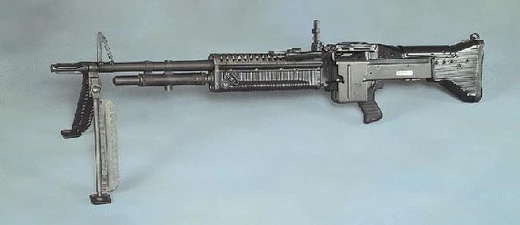
FN MAG
Belgian 7.62 mm general-purpose machine gun used by over 80 countries.

The FN MAG is a Belgian general-purpose machine gun chambered in 7.62 mm, developed in the early 1950s by Ernest Vervier at Fabrique Nationale (FN). It has seen service in over 80 countries and has been manufactured under license in Argentina, Canada, Egypt, India, and the United Kingdom. The weapon comes in three main configurations: the standard infantry model (60-20), a coaxial version for armored vehicles (60-40), and an aircraft variant (60-30).
After World War II, the Swedish Army sought to replace its 6.5×55 mm Browning Automatic Rifles with a belt-fed alternative. Swedish firm FFV-Carl Gustaf attempted a derivative but failed military trials due to a problematic belt-feed system. FN Herstal was then approached, and Belgian designers inverted the BAR action and combined it with the belt-feed mechanism from the German MG 42. Work began in the late 1940s under Dieudonné Saive and was completed by Vervier in 1953, with Swedish trials starting in 1955. The MAG complemented the FN FAL battle rifle and entered production in 1958 as the Ksp 58, initially in 6.5×55 mm; it is sometimes called the MAG-58.
The Model 60-20 is an automatic, air-cooled, gas-operated weapon that fires 7.62×51 mm NATO ammunition from an open bolt using a belt feed. Its locking mechanism is based on the Browning M1918 (BAR), which FN had produced under license, while the feed and trigger systems come from the MG 42. The gun uses a long-stroke gas piston: ignited powder gases vented from the barrel drive a piston rod connected to the locking assembly. The breech locks via a vertically tilting lever that engages a shoulder at the receiver base. Unlocking begins after the piston moves 15 mm rearward, ensuring the bolt stays locked until the bullet exits and pressure drops. The extractor and ejector are spring-powered and housed in the bolt; spent casings eject downward through a port covered by a spring-loaded dust cover. The firing mechanism is striker-fired (the bolt carrier acts as the striker), with an automatic-only trigger and a manual cross-bolt safety above the pistol grip.
The receiver is made from stamped sheet metal reinforced with steel plates and rivets. The front is reinforced to accept the permanently mounted barrel nut and gas cylinder.
Quick Facts
- Service
- 1958–present
- Designer
- Dieudonné Saive, Ernest Vervier
- Number
- 200,000+
- Length
- 1263 mm
- Height
- 263 mm
- Action
- Gas-operated long-stroke piston, open bolt
- Origin
- Belgium
- Is Ranged
- yes
- Design Date
- 1950
- Manufacturer
- FN Herstal / Colt Canada / Fabricaciones Militares / Heckler & Koch / U.S. Ordnance / Ordnance Factory Board / Royal Small Arms Factory / Barrett Firearms Manufacturing
- Weight
- 11.8 kg
- Part Length
- 630 mm
Facts from the source article.
Lore & Background
After World War II, the Swedish Army sought a belt-fed replacement for its 6.5×55mm Browning Automatic Rifles. FFV-Carl Gustaf attempted a derivative but its belt-feeding mechanism failed military trials. FN Herstal was then approached, and Belgian designers inverted the BAR action and combined it with the MG 42 belt-feeding mechanism. Work began in the late 1940s by Dieudonné Saive and was finished by Ernest Vervier in 1953, with Swedish trials starting in 1955. The MAG entered production in 1958 as the Ksp 58 chambered in 6.5×55mm, and is sometimes referred to as the MAG-58.
The MAG Model 60-20 is an automatic, air-cooled, gas-operated machine gun firing from an open bolt. Its locking mechanism is modeled on the Browning M1918 (BAR), while the feed and trigger mechanisms come from the MG 42. The long-stroke piston system vents propellant gases through a barrel port to drive a gas piston rod connected to the locking assembly. The barrel breech locks with a vertically tilting, downward locking lever. The MAG fires from an open bolt, with a striker firing mechanism and an automatic-only trigger assembly. A manual cross-bolt push-button safety is located above the pistol grip.
The receiver is sheet metal stampings reinforced by steel plates and rivets. The quick-change barrel has a slotted flash suppressor, chrome-lined or stellite-lined chamber and bore, and four right-hand grooves with a 305 mm rifling twist. The barrel assembly weighs 3050 g. The weapon feeds from the left side using either American disintegrating M13 links or non-disintegrating German DM1 belts; after firing, spent links or belt sections exit on the right. The feeding mechanism uses three pawls actuated by a roller connected to the bolt carrier, producing smooth belt flow during both rearward and forward cycles.
Reader's Guide
The FN MAG has served as a complement to the FN FAL battle rifle and has been adopted by more than 80 countries, with licensed production in Argentina, Canada, Egypt, India, and the United Kingdom. Its design combines proven elements from the Browning M1918 (BAR) and the MG 42, resulting in a reliable and adaptable general-purpose machine gun. The three primary variants—infantry, coaxial, and aircraft—allow it to fill roles from light machine gun support to mounted armament. The adjustable gas valve enables the cyclic rate to be set between 650 and 1,000 rounds per minute, suiting it for both anti-aircraft and sustained fire roles. The quick-change barrel, adjustable iron sights, and compatibility with two belt types contribute to its longevity in service. Later production models often feature a MIL-STD-1913 rail for mounting optical or night-vision devices. The MAG remains in widespread use, with manufacture by at least ten companies including FN Herstal, Fabricaciones Militares, and Changfeng Mach.
Did You Know?
- The MAG's locking mechanism is modeled on the Browning M1918 (BAR) automatic rifle.
- The feed and trigger mechanisms are derived from the World War II-era MG 42 universal machine gun.
- The MAG can be adjusted to fire at cyclic rates from 650 up to 1,000 rounds per minute via a user-adjustable gas valve.
- The weapon was first produced in 1958 as the Ksp 58 chambered in 6.5×55mm for Sweden.
From Swedish Need to Belgian Innovation
After World War II, the Swedish military found itself still relying on two variants of the 6.5×55mm Browning Automatic Rifle that had served since the 1920s. Seeking a modern belt-fed successor, the state-owned FFV-Carl Gustaf attempted to develop a derivative, but their proposed belt-feeding arrangement—positioned beneath the action in the same fashion as the original BAR—failed to satisfy military trial requirements. With that domestic effort stalled, the Swedish Army turned to Fabrique Nationale in Belgium. There, a radical yet elegant solution emerged: take the proven BAR action, invert it, and pair it with the belt-feeding system already trusted in the wartime MG 42. Dieudonné Saive initiated the project in the late 1940s, and Ernest Vervier brought it to completion by 1953. Swedish field trials followed in 1955, and by 1958 the weapon entered production as the Ksp 58, chambered in the Swedish 6.5×55mm round. The design was conceived as a squad-level support companion to the FN FAL battle rifle, and the weapon would later be informally known as the MAG-58 before its wider NATO-standard evolution.
A Hybrid of Proven Mechanisms
The MAG's internal architecture is a deliberate marriage of two battle-tested systems. The locking arrangement draws directly from the Browning M1918 BAR, which FN itself had produced under licence, while the feed and trigger mechanisms descend from the MG 42 universal machine gun of World War II. In operation, the weapon is air-cooled and gas-operated, firing from an open bolt. A long-stroke piston, driven by powder gases vented through a barrel port, pushes a rod connected to the locking assembly. The breech is secured by a vertically tilting lever that locks downward, linked to the bolt carrier via an articulated joint. Crucially, unlocking does not begin until the piston rod has travelled fifteen millimetres rearward, ensuring the breech stays fully locked while the projectile is still in the barrel and chamber pressures remain at their peak. Both extractor and ejector are spring-driven and housed within the bolt. Spent casings eject downward through a port at the receiver's base, normally sealed by a spring-loaded dust cover. The firing system is striker-type: the bolt carrier contains a channel for the firing pin, which protrudes to strike the primer. The trigger is automatic-only, with a manual cross-bolt push-button safety sitting above the pistol grip.
Barrel, Gas Regulation, and Belt Feeding
The MAG's quick-change barrel is 630 millimetres long, with 487.5 millimetres rifled in four right-hand grooves at a 305-millimetre twist rate. The chamber and bore are chrome-lined or stellite-lined to extend service life, and the assembly carries a slotted flash suppressor. The barrel unit weighs about 3,050 grams and includes the front sight base, carry handle, and gas block. Since different barrel assemblies may introduce slight zero shifts, the front sight is tool-adjustable to compensate. The gas block houses an exhaust-type regulator valve with three settings, and a user-adjustable gas valve lets the operator dial the cyclic rate from 650 to 1,000 rounds per minute—useful against fleeting targets like aircraft or infantry popping between cover. On the feeding side, the weapon accepts open-link metal belts from the left: either the NATO-standard disintegrating M13 belt or the non-disintegrating segmented German DM1 belt, whose 50-round sections can be chained through a cartridge. Switching between the two requires reconfiguring several feed components, since the cartridge-stop position and pawl angles in the top cover differ. The pawl-type feed system uses three pawls actuated by a roller on the bolt carrier, keeping the feed link moving through both rearward and forward bolt travel for smooth flow.
Global Proliferation and Multi-Role Variants
The FN MAG was conceived in the early 1950s at the Fabrique Nationale works, with Ernest Vervier seeing the project through to completion, and it has since achieved a level of international adoption that few small arms can match. More than eighty countries have fielded the weapon, and licensed production has been established in Argentina, Canada, Egypt, India, and the United Kingdom. This breadth of use is underpinned by the MAG's availability in three primary configurations tailored to distinct operational roles. The Model 60-20 is the standard infantry general-purpose machine gun, the workhorse of squad and platoon-level fire support. The Model 60-40 is a coaxial variant designed for mounting inside armoured fighting vehicles. The Model 60-30 is an aircraft variant, adapting the same core action for use in fixed or rotary-wing platforms. The receiver itself is built from sheet-metal stampings reinforced with steel plates and rivets, a construction philosophy that balances strength with manufacturability. Early models featured a fixed wooden stock, pistol grip, and carrying handle, while later production switched to polymer furniture. The weapon's 7.62×51mm NATO chambering and belt-feed design made it a natural complement to the FN FAL battle rifle in allied arsenals, cementing its role as a cornerstone of post-war collective defence.
Frequently Asked Questions
Who designed the FN MAG and when was it finished?
Ernest Vervier completed the design in 1953 at Fabrique Nationale in Belgium, building on preliminary work that Dieudonné Saive had begun in the late 1940s.
What caliber does the FN MAG use and what is its rate of fire?
It is chambered in 7.62×51 mm NATO (with an early Swedish variant in 6.5×55 mm) and cycles at roughly 650 to 1,000 rounds per minute, a range the operator can adjust through a gas valve.
What are the three standard FN MAG configurations?
The family includes the 60-20 infantry general-purpose model, the 60-40 coaxial mount built for armored vehicles, and the 60-30 variant adapted for aircraft use.
How does the FN MAG's action work?
It employs a gas-operated, long-stroke piston system with an open-bolt firing cycle, and the barrel measures 630 mm overall with a 487.5 mm rifled section.
Why is the FN MAG considered so influential in modern military history?
Adopted by more than 80 nations and produced under license in Argentina, Canada, Egypt, India, and the United Kingdom, it became one of the most widely fielded 7.62 mm general-purpose machine guns of the post-war era.
More in Machine Guns, Part 5 1-24
Spotted an error? Know more?
Reader corrections go straight into our review queue. Suggest an edit · How this site is sourced