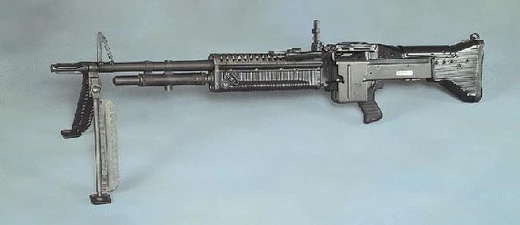
NSV machine gun
Soviet heavy machine gun replacing the DShK, adopted 1971.

The NSV Utyos is a Soviet heavy machine gun chambered in 12.7×108mm, named after its designers G. I. Nikitin, Y. M. Sokolov, and V. I. Volkov. It was adopted by the Soviet Army in 1971 to replace the DShK machine gun and has been widely used on vehicles and in anti-aircraft roles.
Quick Facts
- Origin
- Soviet Union
- Is Ranged
- yes
- Service
- 1971–present
- Designer
- G.I. Nikitin, Y.М. Sokolov, V.I. Volkov
- Design Date
- Central Design Bureau of Sports and Hunting Weaponry, Tula, 1969
- Manufacturer
- West-Kazakhstan machine building company JSC (ZKMK)
- Variants
- NSVT
- Weight
- 25 kg (gun only) / 41 kg on tripod / 11 kg (50-round belt)
- Length
- 1560 mm
- Cartridge
- 12.7×108mm / 12.7×99mm NATO / (For Polish WKM-B)
- Caliber
- 12.7 mm
- Action
- Gas-operated
Facts from the source article.
Lore & Background
The Soviet Army began seeking a new heavy machine gun to replace the older SGM and DShK weapons in the early 1950s. Inspired by the versatility of the German MG 42, two design teams were tasked with creating a weapon using the same principle. Mikhail Kalashnikov's submission won the trials for the new standard machine gun (the PK), but the design by Grigory Nikitin and Yuri Sokolov was not abandoned. It was later developed into the NSV heavy machine gun about ten years later, selected in 1969 as the successor to the DShK and DShKM, and accepted into service in 1971.
The NSV was manufactured at the Metallist plant in Uralsk, Kazakh SSR. A vehicle-mounted variant, the NSVT, is used on the T-72, T-64, and T-80 main battle tanks. Like many Soviet weapons, it was license-produced by Yugoslavia as the M87. After the Soviet Union's dissolution, Russia developed the Kord heavy machine gun to replace the NSV, while Belarus, Poland, Bulgaria, Ukraine, and Vietnam introduced their own copies. The Metallist factory in Oral, Kazakhstan struggled for customers in the 1990s and converted to industrial production for the oil and gas sector in 2003.
Reader's Guide
The NSV machine gun's significance lies in its role as the standard Soviet heavy machine gun replacing the DShK, serving from 1971 onward. Its high rate of fire made it suitable for close-range anti-aircraft defense against helicopters, UAVs, and aircraft, as well as ground combat on a special mount. The NSVT variant became standard on major Soviet tanks, including the T-72, T-64, and T-80. The weapon's design also spawned numerous foreign copies and adaptations, such as the Polish NSW and WKM-B, the Ukrainian KT-12.7, the Bulgarian MG-U, and the Vietnamese SCX-12,7V with modern features. In Finland, it is designated the 12,7 Itkk 96 and used on vehicles like the Pasi armored personnel carrier and Leopard 2R tank, as well as by the Finnish Navy. The NSV's legacy includes its influence on the Russian Kord heavy machine gun, which entered service in 1998, and its continued production and use by multiple nations.
Did You Know?
- The NSV is named after its designers Nikitin, Sokolov, and Volkov.
- The NSVT variant is mounted on T-72, T-64, and T-80 main battle tanks.
- A loaded 50-round ammunition belt weighs 11 kg.
The Rivalry That Forged a Legend
In 1955, the Soviet Main Artillery Directorate issued a specification calling for a new seven-millimeter general-purpose machine gun chambered for a rifle cartridge. By 1958, the Nikitin-Sokolov PN1, developed by G.I. Nikitin and Yuri M. Sokolov, had passed field tests and was selected for batch production at the Kovrov Mechanical Plant. Yet the PN1 carried a critical weakness: water and snow could infiltrate its gas piston, causing the weapon to jam after just a few rounds in wet conditions. When Nikitin proved too slow in resolving the defect, the Artillery and Missile Directorate reopened the competition. A team from the Izhevsk Mechanical Plant, led by M.T. Kalashnikov alongside Krupin, Pushchin, Kryakushin, and others, entered the contest even while simultaneously developing the AKM and RPK. Their prototype drew on the proven gas-operated rotary-bolt architecture of Kalashnikov-pattern rifles. Service trials across the Central Asian, Odessa, and Baltic Military Districts ultimately favored the Kalashnikov design, which handled moisture without issue and reused existing ammunition belts from the Maxim and SG-43. The PK was formally adopted in 1961.
Engineering for Sustained Fire
The PK grew directly from the stamped-receiver architecture of the AKM assault rifle and its RPK light machine gun companion, yet it addressed the demands of sustained automatic fire in ways those weapons never had to. Chambered for the 7.62×54mmR rimmed cartridge, the PK generates substantially greater bolt thrust than the intermediate 7.62×39mm or 5.45×39mm rounds used in the Eastern Bloc's smaller arms. To manage that energy, the bolt and carrier are oriented upside down relative to the AKM, with the gas piston positioned beneath the barrel. Crucially, the PK fires from an open bolt, a departure from the closed-bolt AKM and RPK. This design choice allows air to flow through the chamber and action between bursts, keeping temperatures low enough to prevent the dangerous cook-off phenomenon where a heated chamber ignites a chambered round unintentionally. The result is a weapon far better suited to prolonged fully automatic fire. Quick-change barrels further extend service life, and the modernized PKM guarantees at least 25,000 rounds from a single spare-parts kit paired with two barrel assemblies.
From Kovrov to the World
Adopted in 1961 and manufactured at the Kovrov Mechanical Plant, the PK quickly became the backbone of Soviet and later Russian infantry and vehicle-mounted firepower. The improved PKM variant, introduced in 1969, brought ergonomic refinements and replaced the aging SGM and RP-46 machine guns that had previously served in Soviet arsenals. What began as a domestic standard weapon soon spread far beyond the USSR's borders. The PK and its derivatives have been exported extensively and produced under license in numerous countries. Serbia's Zastava Arms, for example, manufactures the PK as the M84 and the PKT variant as the M86, both of which remain in active service across many former Yugoslav successor states. In Russia itself, the family continues to evolve: a remotely controlled PKT version reportedly entered military service in November 2023, and the PKP Pecheneg modification introduces a forced-air-cooled barrel rated for up to 10,000 rounds before replacement. The PKM and related variants remain in active production in Russia to this day.
A Lineage That Keeps Growing
The story of the PK does not end with its own adoption; it seeds an entire family of weapons that continues to shape modern arsenals. The very design that lost the 1961 competition, the Nikitin-Sokolov PN1, found a second life when its engineering principles were adapted into the 12.7 mm NSV heavy machine gun, which entered production in 1971. Thus the rivalry between Kalashnikov's team and Nikitin's group produced two enduring platforms rather than one. Within the PK family itself, the lineage stretches from the original 1961 model through the 1969 PKM, the vehicle-mounted PKT, and the air-cooled PKP Pecheneg, each iteration refining the gas-operated rotary-bolt concept that Kalashnikov pioneered in the 1950s. Looking ahead, reports from June 2024 indicate that the PKZ is expected to eventually supplant the PKM in Russian military service, signaling yet another chapter in a design philosophy that has outlasted the Soviet Union itself. The Kalashnikov pattern, from the AK-47 through the PK to the NSV, remains one of the most influential families of firearms ever developed.
Frequently Asked Questions
What is the NSV Utyos and when did it enter service?
The NSV Utyos is a Soviet heavy machine gun chambered in 12.7×108mm that the Soviet Army adopted in 1971. It was developed to replace the older DShK and quickly became a staple on vehicle mounts and anti-aircraft emplacements.
What does the 'NSV' designation stand for?
The letters are an acronym built from the surnames of the gun's three designers: G. I. Nikitin, Y. M. Sokolov, and V. I. Volkov. The 'Utyos' nickname is the common Russian name used alongside the military designation.
What are the NSV's key performance specs?
The barrel assembly weighs roughly 25 kg and cycles at 700–800 rounds per minute. Effective range reaches about 2,000 meters against ground targets and 1,500 meters against airborne ones, while a standard 50-round belt adds approximately 11 kg.
Why did the Soviets replace the DShK with the NSV?
The DShK had served for decades but the Army needed a more modern, reliable heavy machine gun, and the NSV filled that gap starting in 1971. Its design suited both sustained ground-suppression fire and short-burst anti-aircraft work from vehicle mounts.
Is the NSV a man-portable weapon?
In practice it is a crew-served system rather than a single-soldier carry, given the 25 kg gun plus an 11 kg ammunition belt. You will most often see it fixed to armored vehicles or dedicated anti-aircraft tripods rather than slung over a soldier's shoulder.
More in Machine Guns, Part 5 1-24
Spotted an error? Know more?
Reader corrections go straight into our review queue. Suggest an edit · How this site is sourced