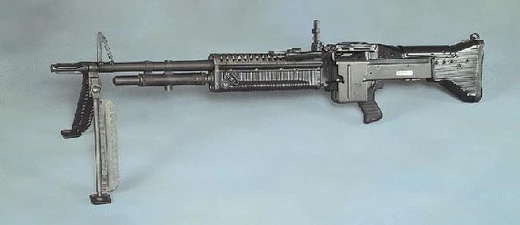
MG 34
The world's first general-purpose machine gun, versatile and mobile.

The MG 34 (Maschinengewehr 34) is a German recoil-operated, air-cooled machine gun. It was first tested in 1929, introduced in 1934, and issued to units in 1936. This weapon pioneered the *Einheitsmaschinengewehr* (universal machine gun) concept and is widely regarded as the first general-purpose machine gun (GPMG). Chambered for the 7.92×57mm Mauser cartridge, it was arguably the most advanced machine gun in the world when it entered service. It was designed to provide portable light and medium infantry cover, anti-aircraft defense, and even sniping capability. Its combination of mobility—light enough for one man to carry—and a high rate of fire up to 900 rounds per minute was unmatched. It entered service in large numbers from 1939. However, its design proved too complex for mass production, and it was supplemented by the cheaper, simpler MG 42. Both guns remained in service and production until the war’s end.
Even before World War I, the German military sought to replace the heavy machine guns that had been so successful in that conflict. The MG 13 was an early step toward a multi-role weapon, created by reengineering the water-cooled Dreyse machine gun. The twin-barreled Gast gun was developed for a high cyclic rate for anti-aircraft use, reportedly reaching 1,600 rounds per minute. The *Einheitsmaschinengewehr* concept required that the operator could radically adapt the gun for different roles by changing its mount, sights, and feed mechanism. One role was low-level anti-aircraft coverage, where a high cyclic rate is useful against targets exposed for only a short time, like aircraft or troops moving between cover. For targets that can be engaged for longer periods, the cyclic rate becomes less important.
After World War I, the Treaty of Versailles restricted the German Reichswehr to stockpiling no more than 792 heavy water-cooled machine guns and 1,134 light machine guns, and it banned production of machine guns and development of sustained-fire weapons. From 1933, Nazi Germany began repudiating these restrictions. As part of a clandestine military revitalization, German arms designers worked abroad and sought foreign assistance to circumvent the treaty.
In 1932, the Reichswehrministerium ordered several companies, including Rheinmetall, to develop a new universal machine gun to replace various role-specific guns.
Quick Facts
- Origin
- Nazi Germany
- Is Ranged
- yes
- Service
- 1936–1945 (Wehrmacht service) / 1936–present (other militaries)
- Designer
- Heinrich Vollmer
- Design Date
- 1934
- Manufacturer
- Rheinmetall-Borsig AG Soemmerda / Mauserwerke AG / Steyr-Daimler-Puch AG / Waffenwerke Brünn
- Production Date
- 1935–1945
- Number
- 577,120
- Weight
- 12.1 kg / 32 kg (with tripod)
- Length
- 1219 mm
- Part Length
- 627 mm
- Cartridge
- 7.92×57mm Mauser
Facts from the source article.
Lore & Background
The MG 34 was developed to fulfill the Einheitsmaschinengewehr concept, replacing several role-specific machine guns. In 1932 the Reichswehrministerium ordered companies including Rheinmetall to develop a new universal machine gun with specifications for light weight, simplified operation, quick-change barrel, and single-shot capability with two cyclic rates. The design was based on the MG 30, a 1930 Rheinmetall design by Louis Stange, adapted by Heinrich Vollmer. Vollmer designed the feed mechanism to accept 75-round Patronentrommel 34 saddle-drum magazines, later redesigned in 1937 to use reusable non-disintegrating Gurt 33 and Gurt 34 metal belts and a 50-round Gurttrommel 34. The feeding system used direct push-through of the cartridge from the half-open link into the chamber. The double crescent trigger allowed semiautomatic or fully automatic fire. A little-known feature of the first 2,300 weapons was a cadence regulator in the grip, designed as a flick-force brake, for which Louis Stange was granted patent No. 686 843 in 1939. The final version was adopted for main service on 24 January 1939. The MG 34 was the mainstay of German Army support weapons from 1935 until 1942, when it was supplanted by the MG 42, though both remained in service and production until the end of the war.
Reader's Guide
The MG 34's significance lies in its establishment of the general-purpose machine gun concept, combining the roles of light and medium machine guns, anti-aircraft coverage, and sniping in a single portable weapon. Its combination of mobility—light enough to be carried by one man—and a high rate of fire up to 900 rounds per minute was unmatched at the time. However, the design proved complex for mass production due to elaborately milled precision engineering, tight tolerances, and use of high-quality metal alloys, resulting in high costs and slow production. Attempts to incrementally improve the fundamental drawbacks failed. The Germans continued widespread MG 34 production in parallel with the cheaper, simpler MG 42 until the war's end, with wartime production exceeding 350,000 units. The MG 34 was reliable when competently maintained but sensitive to extreme weather, dirt, and mud. Both the MG 34 and MG 42 were erroneously nicknamed 'Spandau' by Allied troops, a carryover from the World War I nickname for the MG 08 produced at the Spandau Arsenal.
Did You Know?
- The first 2,300 MG 34s included a cadence regulator in the grip that could change the rate of fire.
- The MG 34 and MG 42 were both erroneously nicknamed 'Spandau' by Allied troops.
Frequently Asked Questions
What is the MG 34?
The MG 34 (Maschinengewehr 34) is a German recoil-operated, air-cooled machine gun that entered service in the mid-1930s. It was chambered for the 7.92×57mm Mauser round and could fire up to 900 rounds per minute.
Who designed the MG 34?
Louis Stange at Rheinmetall conceived the original design, which was later refined by Heinrich Vollmer at Mauser Industries before it was finalized for military use.
Why is the MG 34 considered so important in firearms history?
It is widely credited as the world's first general-purpose machine gun, establishing the Einheitsmaschinengewehr (universal machine gun) concept that later weapons like the MG 42 and M60 would follow. When it entered service in 1936, it was arguably the most advanced machine gun available anywhere.
What roles could a single MG 34 fulfill?
A single weapon could serve as portable light or medium infantry support, an anti-aircraft gun, and even a precision rifle for sniping, making it remarkably versatile for its era.
How many MG 34s were manufactured?
Over 350,000 units were produced during the wartime period, reflecting how central the weapon became to German infantry and support units.
More in Machine Guns, Part 5 1-24
Spotted an error? Know more?
Reader corrections go straight into our review queue. Suggest an edit · How this site is sourced