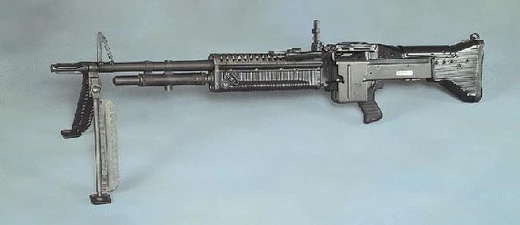
Breda 38
Italian tank machine gun adapted for infantry use.

The Mitragliatrice Breda calibro 8 modello 38 per carri armati (Breda 38) was an Italian tank-pattern machine gun used during the Second World War. It was mounted on the Fiat L6/40, Fiat M11/39, and Fiat M13/40 tanks, and was also adapted for infantry use. The Breda 38 was based on the Breda M37 and received the German identification code Kampfwagen-Maschinengewehr 350(i).
Quick Facts
- Origin
- Italy
- Is Ranged
- yes
- Service
- 1938–1943
- Used By
- Italy / Portugal
- Wars
- World War II / Portuguese Colonial War
- Manufacturer
- Breda Meccanica Bresciana
- Cartridge
- 8×59mm RB Breda / 7.92×57mm Mauser
- Action
- Gas-operated
Facts from the source article.
Lore & Background
The Breda 38 was developed from the Breda M37 and was primarily intended for use in Italian tanks such as the Fiat L6/40, Fiat M11/39, and Fiat M13/40. In some installations, such as the Fiat M13/40, two Breda 38s were mounted side by side in the hull. The gun was later adapted for infantry use by mounting it on a tripod via an adapter, with temporary open sights replacing the optical sight used in the tank role. The temporary front sight was placed on the right of the barrel at the muzzle, and the temporary rear sight on the right of the body.
The Breda 38 was air-cooled, gas-operated, and magazine-fed, with a quick-change barrel. Its operational features were simple, and it was considered extremely easy to field-strip or disassemble completely. The barrel was heavy at 4.5 kg, which allowed it to fire a large number of rounds in quick succession without overheating.
Reader's Guide
The Breda 38 served as the standard tank machine gun for several Italian armored vehicles during the Second World War, including the Fiat L6/40, M11/39, and M13/40. Its adaptation for infantry use extended its utility beyond the armored role, though it retained the same basic design as the tank-mounted version. The gun's German identification code, Kampfwagen-Maschinengewehr 350(i), reflects its capture and use by German forces. The Breda 38's design was based on the earlier Breda M37, and its quick-change barrel and simple field-stripping were notable features. The heavy barrel allowed sustained fire without overheating, a practical advantage in both tank and infantry configurations. The Breda 38 remains an example of Italian small arms development during the war, with its dual-role capability and straightforward mechanical design.
Did You Know?
- The barrel weighed 4.5 kg to allow sustained fire without overheating.
- When used as an infantry machine gun, it was mounted on a tripod via an adapter.
Frequently Asked Questions
What is the Breda 38?
The Breda 38 is an Italian 8 mm tank-pattern machine gun developed during the Second World War. Its full designation, Mitragliatrice Breda calibro 8 modello 38 per carri armati, reflects its intended role as a vehicle-mounted weapon, and it evolved directly from the earlier Breda M37 design.
Which tanks carried the Breda 38?
The Breda 38 was the standard machine gun fitted to the Fiat L6/40, Fiat M11/39, and Fiat M13/40 tanks. Beyond armored vehicles, the weapon was also adapted and issued for infantry use.
How does the Breda 38 operate mechanically?
The gun runs on a gas-operated cycle and relies on air cooling to dissipate heat from the barrel during firing. Its barrel weighs 4.5 kg, keeping the overall weapon compact enough for tank turret mounting.
What German designation was given to the Breda 38?
German forces identified the weapon as Kampfwagen-Maschinengewehr 350(i), following their standard naming convention for enemy tank-mounted machine guns encountered in the field.
What caliber does the Breda 38 fire and why did that matter?
The Breda 38 chambered 8 mm rounds, a caliber consistent with other Italian small arms of the period. That relatively small and light cartridge made the weapon practical both in cramped tank turrets and in the hands of infantry soldiers.
More in Machine Guns, Part 5 1-24
Spotted an error? Know more?
Reader corrections go straight into our review queue. Suggest an edit · How this site is sourced