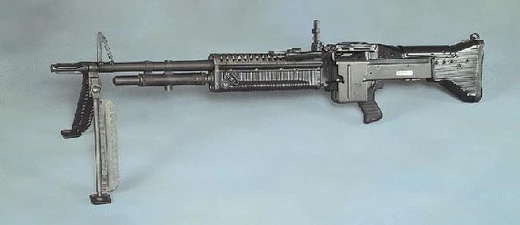
M240 machine gun
U.S. military designation for the FN MAG, a reliable 7.62mm general-purpose machine gun.

The M240 is the American military’s name for the FN MAG, a family of gas-operated, belt-fed medium machine guns that use the 7.62×51mm NATO round. The U.S. armed forces have been using it since the late 1970s. It sees heavy use in infantry units, especially rifle companies, and is also mounted on ground vehicles, boats, and aircraft. While it’s heavier than some similar machine guns, it’s known for being very reliable, and the fact that it’s standard across NATO is a big plus.
All versions feed from disintegrating belts and can fire most types of 7.62 NATO ammunition. Some variants can be converted to use non-disintegrating belts. There are notable differences in weight and certain features between versions, which limits how many parts can be swapped between them. The M240s used by the U.S. military are currently made by U.S. Ordnance in Reno, Nevada, and by FN America, the American branch of the Belgian company FN Herstal.
The M240B and M240G are usually fired from built-in bipods, tripods, or vehicle mounts. For tripod use, the Army mainly uses the M192 lightweight ground mount, while the Marine Corps uses the M122A1 tripod, a slightly updated version of the M2 tripod.
The FN MAG was chosen by the U.S. military for various roles after large worldwide searches and competitions. It’s a belt-fed, gas-operated, air-cooled, crew-served general-purpose machine gun. Its versatility shows in how it can be fired effectively from its bipod, a tripod, or mounts on vehicles, boats, and aircraft.
The U.S. Army first adopted it in 1977 as a coaxial tank gun, then slowly expanded its use through the 1980s and 1990s. The M240 and M240E1 were adopted for vehicles, which led to further adoption, especially by Army and Marine Corps infantry.
Compared to its predecessor, the M60, the MAG system’s durability gives it better reliability. The MAG actually has a more complex gas system than the M60, but that gives better reliability and lower maintenance needs, though it costs more to make and is heavier. Its mean rounds between failure (MRBF) rating of 26,000 is quite high for its weight—back in the 1970s when it was first adopted, it achieved about 7,000 MRBF. It’s not as reliable as some much heavier older designs, but it’s very reliable for its weight.
The U.S.
Quick Facts
- Service
- 1977–present
- Wars
- Operation Urgent Fury / Operation Just Cause / First Liberian Civil War / Gulf War / War in Afghanistan / Iraq War / Syrian Civil War / War in Iraq (2013–2017) / Russo-Ukrainian War
- Designer
- Ernest Vervier
- Unit Cost
- US$6,600
- Length
- 49.7 in
- Height
- 10.4 in
- Action
- Gas-operated long-stroke piston, open bolt
- Origin
- Belgium (designed) / United States (manufactured)
- Is Ranged
- Yes
- Design Date
- 1950s
- Manufacturer
- FN America / U.S. Ordnance / Barrett Firearms Manufacturing / Daycraft Systems
- Weight
- 27.6 lb (M240B)
Facts from the source article.
Lore & Background
The M240 originated from a U.S. Army competition in the late 1960s and early 1970s to procure a new coaxial 7.62mm machine gun for tanks, replacing the troublesome M73 and M219. The FN MAG was tested against the M60E2 and older M219; the FN MAG emerged as the clear winner and was designated M240 in 1977. It was first adopted as a coaxial tank gun, then slowly adopted for more applications in the 1980s and 1990s. The M240 and M240E1 were used on vehicles, leading to further infantry adoption as the M240G (USMC, 1991) and M240B (U.S. Army, late 1990s).
The M240 fires from the open bolt position, with a static firing pin. Its rate of fire is controlled by three gas regulator settings: 650–750, 750–850, and 850–950 rounds per minute. Barrels can be rapidly exchanged via a barrel release button. The M240 has a mean rounds between failure (MRBF) of 26,000, considered high for its weight. All variants feed from disintegrating belts and can be converted to use non-disintegrating belts. Significant differences in weight and features among versions restrict interchangeability of parts.
Reader's Guide
The M240's significance lies in its role as the U.S. military's standard medium machine gun, replacing the M60 in most applications. Its adoption began with vehicle mounting, then expanded to infantry use, providing commonality across branches and with NATO allies. The M240 is used on the M1 Abrams tank, Bradley Fighting Vehicle, and LAV-25, as well as by infantry with bipods, tripods (M192 lightweight ground mount for Army, M122A1 for Marines), or vehicular mounts. Its reliability, with a MRBF of 26,000, is a key advantage over the M60, despite greater weight and cost. The M240 has not entirely replaced all M60 versions; the Navy still uses the M60 in some cases. As of March 2022, the U.S. Army had a solicitation for a conversion kit to adapt the M240B and M240L to fire 6.8×51mm ammunition, indicating ongoing evolution.
Did You Know?
- The M240 is the U.S. military designation for the Belgian FN MAG.
- It achieved a mean rounds between failure (MRBF) of 26,000, up from about 7,000 when first adopted in the 1970s.
- The M240 has three gas regulator settings controlling rate of fire from 650 to 950 rounds per minute.
- The U.S. Army and Marine Corps use different tripods: the M192 lightweight ground mount and the M122A1, respectively.
Design Philosophy and the Road to the M60
After World War II, the U.S. Army recognized that its aging Browning M1919 inventory needed a lighter successor in the 7.62 mm class. The program drew heavily on the German universal machine gun philosophy, in which a single platform could serve as a shoulder-fired light gun, a sustained-fire crew weapon, or a vehicle mount. Early American interest in the MG 42 even produced two T24 test copies chambered in .3006 Springfield, but Aberdeen testing found them unsatisfactory. The path forward began in 1946 when Bridge Tool and Die modified a captured FG-42 paratrooper rifle, grafting an MG-42 top cover onto its receiver to create the belt-fed T44. From that proof of concept, engineers built the T52 from scratch, retaining the German-derived top cover and bolt group while adding interchangeable barrels, a disintegrating-link feed, and the new 7.62×51 mm NATO cartridge. The feed was relocated to the top and the structure reinforced for sustained fire. The final evaluation model, the T161E3, was accepted in 1957, beating out the Belgian FN MAG and other foreign contenders.
The Pig in the Jungle: Vietnam Service
During the Vietnam War, the M60 became the backbone of squad-level automatic fire. Every rifleman in a squad was expected to shoulder an extra two hundred linked rounds, a spare barrel, or both, making the weapon a shared burden rather than one soldier's problem. The up-gunned M113 armored personnel carrier paired two M60 gunners alongside its primary .50-caliber mount, while Patrol Boat, River crews carried one M60 in addition to two .50-cal guns. Soldiers gave the gun the nickname "The Pig" for its bulk and voracious ammunition consumption. Tropical heat and humidity accelerated wear on the bolt and operating rod, and the weapon's relatively light construction made it vulnerable to damage. Despite these setbacks, troops valued its mechanical simplicity and the ability to fire from multiple positions. Navy SEALs shortened the barrels, removed front sights, and even rigged feed chutes from backpacks to keep hundreds of rounds ready without a reload. In 1966, Lance Corporal Richard Pittman of 1st Battalion, 5th Marine Regiment earned the Medal of Honor while using the M60 to suppress two machine gun positions of the 324th North Vietnamese Division.
Crew, Feed, and the Ammunition System
Because of its weight and the volume of rounds it consumes in sustained fire, the M60 is designed as a crew-served weapon operated by a team of two or three. The gunner carries the weapon itself plus anywhere from two hundred to a thousand rounds, depending on physical condition. The assistant gunner handles the spare barrel, extra ammunition, target spotting, and reloading. The ammunition bearer shoulders additional belts and the tripod with its traversing and elevation mechanism, fetching more rounds as the fight demands. The gun can be fired accurately from the shoulder at short range—a design requirement inherited from the M1918 Browning Automatic Rifle concept—and it also mounts on an integral bipod, the M122 tripod, or other fixtures. Ammunition arrives in a cloth bandolier holding a cardboard box of one hundred pre-linked rounds connected by the M13 link, which is incompatible with the older M1 system. In Vietnam, crews improvised by locking B3A cans from C-ration packs into the ammunition box to roll belts over more smoothly and reduce feed jams. Later production models revised the box attachment point, making that field fix unnecessary.
Adoption, Global Reach, and the Long Tail of Service
The M60 was formally adopted in 1960 and began reaching units later that same year. Over the following decades it served in every branch of the U.S. military and was adopted by armed forces around the world, becoming a recognizable fixture of Cold War and post-Cold War arsenals. The weapon has been continuously updated and modernized to satisfy evolving tactical requirements, and its manufacture for both military procurement and the commercial market has persisted well into the twenty-first century. Although the U.S. has since replaced or supplemented the M60 in most roles with the M240 machine gun, the M60's footprint remains visible in allied and partner nations that continue to field it. Its design lineage—rooted in the German universal machine gun concept, refined through the T44, T52, and T161E3 prototypes, and validated in the jungles of Vietnam—established a template for how a single belt-fed platform could bridge the gap between light and medium machine gun duties, a role the M240 now inherits in American service.
Frequently Asked Questions
What is the M240 machine gun?
The M240 is the U.S. military's name for the FN MAG, a gas-operated, belt-fed general-purpose machine gun chambered in 7.62×51mm NATO that has served American forces since 1977.
What role does the M240 fill in combat units?
It acts as the primary squad-level automatic weapon for infantry rifle companies, delivering sustained suppressive fire, and it is also mounted on ground vehicles, boats, and aircraft for added firepower.
How reliable is the M240 compared to similar machine guns?
With a mean rounds between failures rating of roughly 26,000 rounds, it is widely regarded as one of the most dependable belt-fed weapons in the NATO inventory, even though it runs a bit heavier than some competing designs.
Why is the M240 important to NATO logistics?
Because it is standard across multiple allied nations and fires the common 7.62mm NATO round, armies can share ammunition, spare parts, and maintenance procedures without needing separate supply chains.
Who manufactures the M240 and where is it built?
U.S. Ordnance in Reno, Nevada, and FN America produce the various M240 variants for the American military, both building on the original Belgian FN MAG design.
More in Machine Guns, Part 5 1-24
Spotted an error? Know more?
Reader corrections go straight into our review queue. Suggest an edit · How this site is sourced