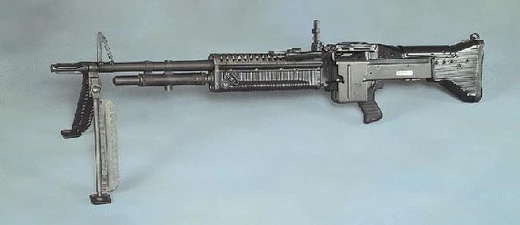
FN Minimi
Belgian squad automatic weapon in service with over 75 countries.

The FN Minimi, short for "mini machine gun," is a Belgian light machine gun and squad automatic weapon designed by Ernest Vervier for FN Herstal. It entered service in the late 1970s and is now used by over 75 countries. Production takes place at FN's Herstal facility and at its U.S. subsidiary, FN Manufacturing LLC. The Minimi fires only fully automatic from an open bolt, using an air-cooled, gas-operated long-stroke piston system. It accepts ammunition via disintegrating-link belts or detachable STANAG magazines. Three main variants exist: the Standard model for squad or platoon support, the compact Para version for paratroopers, and the Vehicle model, which serves as secondary armament for fighting vehicles.
Quick Facts
- Origin
- Belgium
- Is Ranged
- Yes
- Service
- 1980–present
- Designer
- Ernest Vervier
- Design Date
- Early 1970s
- Manufacturer
- FN Herstal / FN USA / Thales Australia / Beretta / Bofors Carl Gustav / Caracal International / Pindad / Sumitomo Heavy Industries
- Production Date
- 1977–present
- Weight
- 7.1 kg
- Length
- 1040 mm
- Part Length
- 465 mm
- Cartridge
- 5.56×45mm NATO / 7.62×51mm NATO
- Action
- Gas-actuated, open bolt
Facts from the source article.
Lore & Background
The Minimi uses a gas-actuated long-stroke piston system with a rotary bolt locked by two massive locking lugs. Upon firing, expanding propellant gases bled through a port near the muzzle force the piston rearward, acting against the bolt carrier. A cam in the bolt carrier rotates and unlocks the bolt after a slight delay, ensuring chamber pressure has dropped to a safe level. The weapon fires from an open bolt, reducing the danger of cook-off after extended fire, and gas escaping the gas cylinder is directed upward to avoid kicking up dust. The Minimi has a manually adjustable gas valve with two positions: normal and adverse, the latter increasing cyclic rate to 950–1,150 rounds per minute for extreme conditions or heavy fouling. The spring extractor is inside the bolt, while the tilting lever ejector is in the receiver housing. Spent casings exit through a port on the right side of the receiver, protected by a spring-loaded dust cover. The Minimi is striker-fired, with the bolt carrier functioning as the striker mechanism. A push-button manual safety in the trigger housing disables the sear; pushing the button to the right exposes a red rim indicating the weapon is ready to fire. The black polymer pistol grip from the FAL and FNC rifles was initially used, but current models have a modified grip with lateral grooves at a smaller angle to the receiver. The welded receiver is made from stamped steel. Both standard and Para variants have a fixed, folding bipod mounted to the gas tube with three height settings and 15° rotation to either side. The Minimi can also be fired from the Belgian FN360° tripod or the American M122 mount. The vehicle-mounted version has an electrically powered trigger for remote firing. The standard model has a 465 mm barrel and a skeletonized aluminium stock with a folding wire shoulder strap; the Para has a 349 mm barrel and a collapsible metal stock; the vehicle model has a 465 mm barrel but no stock or iron sights. All models can alternatively use a fixed synthetic stock with a hydraulic buffer.
Reader's Guide
The FN Minimi's significance lies in its widespread adoption as a squad automatic weapon, serving in more than 75 countries. Its design allows for both belt and magazine feed without modification, a feature developed by FN's Maurice V. Bourlet. The pawl-type feeding mechanism, modeled on the system used in the MAG general-purpose machine gun and originally from the MG 42, provides a smooth and continuous feeding cycle. The quick-change barrel system, with a lever on the left side, allows a trained soldier to change barrels in 6 to 7 seconds. The Minimi's legacy includes the M249 variant adopted by the US military in 1982, with production since 1984 by FN Manufacturing LLC in South Carolina. The M249 Product Improvement Program introduced a synthetic stock, modified buffer, single-position gas regulator, birdcage flash hider, polymer barrel heat guard, and folding carry handle, increasing weight to 7.47 kg. Many of these upgrades were later incorporated into the Minimi. A lightweight variant, the Minimi Special Purpose Weapon (SPW), features a Picatinny top cover rail adapter and has the magazine feed port removed. The Minimi remains a standard squad support weapon, with its open-bolt operation and ventilating gas system reducing cook-off risk during sustained fire.
Did You Know?
- The Minimi's name is short for 'mini machine gun'.
- The Minimi can be fed from either disintegrating-link M27 belts or STANAG magazines without modification.
- The Minimi's gas valve has an adverse setting that increases cyclic rate to 950–1,150 rounds per minute.
- The M249 variant adopted by the US military is produced by FN Manufacturing LLC in South Carolina.
Operating Mechanism & Firing Philosophy
The Minimi's heart is a gas-actuated long-stroke piston system that drives a rotary bolt locked by two massive lugs, guided into battery by a helical camming guide. When a round fires, expanding gases bleed through a port near the muzzle end and drive the piston rearward. The piston rod pushes the bolt carrier along two rails welded to the receiver walls, but the bolt itself stays locked during this initial travel. This deliberate delay lets chamber pressure drop to safe levels before a cam in the carrier rotates and releases the bolt. The practical benefit is extraction reliability: the spent casing has time to cool and contract, reducing friction against the chamber walls. The weapon fires from an open bolt, meaning a cartridge is only momentarily seated in the chamber before ignition. This design choice mitigates the risk of a round cooking off during sustained fire, and the reciprocating bolt and carrier force air through the chamber and barrel after every shot, ventilating heat. Gas escaping the cylinder is vented upward, a small but meaningful detail that prevents the weapon from kicking up dust and debris that could betray the shooter's position.
Feeding System & Ammunition Handling
Amenability to two feeding methods is one of the Minimi's most practical design choices. The primary method uses disintegrating-link M27 belts, a miniaturized derivative of the 7.62mm M13 belt, fed from the left side. These can be run as loose belts or housed in a 200-round polymer box attached to the receiver base. As a secondary option, the weapon accepts standard STANAG magazines of the type used in M16 and FNC rifles, seated at a 45-degree angle in a port beneath the feed tray. The two systems are mutually exclusive: inserting a belt covers the magazine port, and vice versa. An L-shaped hinged flap with an engaging tooth, designed by FN engineer Maurice V. Bourlet, closes the magazine port when unused and doubles as a magazine release, enabling an instant switch between belt and magazine feeding without any mechanical modification. The pawl-type feeding mechanism draws from the MAG general-purpose machine gun lineage, which itself traces back to the WWII-era MG 42. The belt advances in two stages during both the forward and rearward strokes of the bolt carrier, producing a smooth, continuous feed cycle. A small indicator on the top cover shows whether a cartridge is present in the feed path.
Variants & Configuration Options
FN offers the Minimi in three principal configurations, each tailored to a specific operational role. The Standard model, intended as a platoon or squad support weapon, carries a 465 mm barrel and a skeletonized aluminium stock with a folding wire shoulder strap. The Para variant, designed for paratroopers, shortens the barrel to 349 mm and swaps in a collapsible metal stock. The Vehicle model retains the 465 mm barrel but drops both the stock and iron sights, instead fitting an electrically powered trigger that allows the gunner to fire remotely from inside an armoured fighting vehicle. Both the Standard and Para versions mount a fixed, folding bipod to the gas tube, stowed under the handguard, with three height settings per leg and a 15-degree range of lateral rotation. Fully extended, the bipod raises the bore axis to 465 mm. The weapon can also be mounted on the Belgian FN 360-degree tripod or the American M122 mount via an M60 pintle. Any variant can alternatively accept a fixed synthetic stock, the same one used on the M249, that incorporates a hydraulic buffer to stabilize the cyclic rate and dampen recoil.
Development, Production & Global Service
The Minimi's name is a French contraction of mini-mitrailleuse, meaning mini machine gun, and it was developed by Ernest Vervier for FN Herstal, the Belgian firearms manufacturer. Introduced in the late 1970s, the weapon was conceived as a squad automatic weapon and light machine gun chambered in either 5.56mm or 7.62mm. Production runs at the FN facility in Herstal, Belgium, and at FN Manufacturing LLC, the company's U.S. subsidiary, ensuring supply across allied and partner nations. The weapon's adoption has been remarkably broad: it is in service in more than 75 countries, a testament to its reliability and NATO-standard ammunition compatibility. Its striker-fired design, with the bolt carrier doubling as the striker mechanism, and its manually adjustable gas valve offering both normal and adverse settings, reflect a philosophy of field-serviceability. The adverse gas setting raises the cyclic rate from 700 to 850 rounds per minute up to 950 to 1,150 rounds per minute, a reserve capacity reserved for extreme environmental conditions or heavy fouling. Together, these engineering choices underpin the Minimi's decades-long presence on battlefields worldwide.
Frequently Asked Questions
What is the FN Minimi and who designed it?
The FN Minimi is a Belgian light machine gun and squad automatic weapon designed by Ernest Vervier for FN Herstal. It entered service in the late 1970s and is now fielded by more than 75 countries around the world.
How does the FN Minimi's firing mechanism work?
It runs on a gas-operated, long-stroke piston system with an air-cooled barrel and fires exclusively in full-auto mode from an open bolt. Under normal gas settings it cycles at roughly 700 to 850 rounds per minute, with an adverse-setting option pushing that to 950–1,150 rpm.
What types of ammunition can the FN Minimi accept?
Operators can feed it via disintegrating-link M27 belts or standard detachable STANAG magazines, giving flexibility in how rounds are carried. The standard chambering is 5.56mm NATO, though a 7.62mm variant is also available.
What are the main FN Minimi variants and how do they differ?
Three primary models exist: the Standard version for squad or platoon support with a 465 mm barrel, a shorter 349 mm Para variant for special-operations and vehicle crews, and a dedicated Vehicle variant also using the 465 mm barrel. The U.S.-designated M249 PIP weighs about 7.47 kg.
Where is the FN Minimi manufactured?
Production takes place at FN's original plant in Herstal, Belgium, and at FN Manufacturing LLC, the company's U.S. subsidiary. This two-site setup helps fulfill demand from its 75-plus customer nations.
More in Machine Guns, Part 5 1-24
Spotted an error? Know more?
Reader corrections go straight into our review queue. Suggest an edit · How this site is sourced