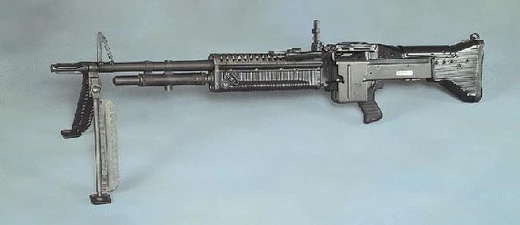
M85 machine gun
A compact .50 caliber machine gun for armored vehicle cupolas.

The M85 is a heavy machine gun that fires .50 BMG ammunition and was designed mainly for use in the turrets of armored fighting vehicles. Its purpose was to replace the M2 machine gun with a weapon that was both smaller and significantly lighter, making it practical for mounting inside vehicles rather than only on external fittings. It saw service on the M60 series of tanks and the LVTP-7 amphibious landing vehicle.
General Electric developed the M85 as a more compact and lighter alternative to the older M2 Browning. It offered selectable rates of fire—a slow setting of 400 rounds per minute and a high setting of 900 rounds per minute—allowing it to engage both ground and air targets, a capability the M2 lacked. The weapon was air-cooled and recoil-operated, with a short receiver and a quick-change barrel. It could be configured for left- or right-hand feeding, and it weighed about 20 pounds less than the M2, a critical advantage for use inside cramped vehicle interiors. Firing and charging were done by pulling one of two color-coded chains (black for charging, red for firing), or firing could be triggered by a solenoid-activated switch on the M-19 cupola elevation mechanism.
The M85 used M15 push-through links to feed ammunition, unlike the M2 and M3 Browning machine guns, which used M2 or M9 pull-out links. This difference caused problems with ammunition supply because, although both guns used the same .50 BMG cartridges, ammunition was delivered already linked. Relinking in the field was not practical. In service, the M85 proved unreliable because the metallic links often caught in the feed system, unlike the standard M2. It was tested on the XM-1 Abrams but was not fitted to the production M1 Abrams, and it was replaced by the M2 on the improved AAVP-7.
An infantry variant, the M85C, was developed to replace the M2 in that role. It featured standard spade grips and could be mounted on the M3 heavy tripod, but it was unpopular and never adopted. The United Kingdom also tested the M85 under the designations XL17E1 and XL17E2, fitting it with special-purpose barrels for use as a ranging machine gun, but did not adopt it.
Quick Facts
- Is Ranged
- yes
Facts from the source article.
Lore & Background
The M85 was produced by General Electric as a smaller, lighter, more capable replacement for the M2 Browning machine gun. It featured selectable high and low rates of fire for engagement of both ground and air targets, a feature lacking in the older M2. The weapon has a short receiver and quick change barrel, and can be configured for left or right hand feeding. Firing and charging are achieved by pull on one of two color-coded pull chains (black for charging and red for firing), or firing could be initiated by means of a switch activated solenoid on the M-19 cupola elevation mechanism.
The M85 used the M15 push-through link to feed ammunition, as opposed to the M2 or M9 pull-out links used on the M2 and M3 Browning machine guns. This link difference created issues with ammunition supply, since despite the same .50 BMG cartridges being used in both machine guns, the ammunition was supplied already packed on links; re-linking was not practical in the field. In service the M85 was found to be unreliable due to the metallic link catching in the feed system, compared to the stock M2 machine gun.
The weapon was tested on the XM-1 Abrams but not fitted to the production M1 Abrams, and was replaced by the M2 machine gun on the improved AAVP-7. An attempt to make a version that would replace the M2 in the infantry role was designated the M85C, featuring standard spade grips and fitting to the M3 heavy tripod; the M85C was unpopular and not adopted. The M85 was also tested by the United Kingdom under the designations XL17E1 and XL17E2, equipped with special-purpose barrels and evaluated as ranging machine guns, but was not adopted.
Reader's Guide
The M85's significance lies in its attempt to provide a compact, lightweight .50 caliber machine gun for armored vehicle use, addressing the M2's bulk and weight. It was the standard heavy tank machine gun for the M60 series and also used on the LVTP-7 amphibious vehicle. However, its reliance on the M15 push-through link created a critical logistical and reliability problem: ammunition supplied on links for the M2 could not be used without impractical field re-linking, and the metallic link itself caused feed system malfunctions. This unreliability led to its rejection for the M1 Abrams and its replacement by the M2 on the improved AAVP-7. The infantry variant, the M85C, was also unsuccessful. The M85 thus represents a well-intentioned but flawed effort to modernize vehicle-mounted heavy machine guns, ultimately failing to displace the M2 it was meant to replace.
Did You Know?
- The M85 is 20 lb lighter than the M2 Browning machine gun.
- It offered selectable rates of fire: 400 rpm (slow) and 900 rpm (high).
- The M85 used M15 push-through links, which were incompatible with the M2's pull-out links.
Birth from the Trenches of World War I
By the latter years of the First World War, the battlefield had shifted dramatically. Armored platforms like Germany's Junkers J.I aircraft rendered conventional rifle-caliber machine guns nearly useless, prompting General John J. Pershing to demand a weapon firing at least a half-inch round at a minimum velocity of 2,700 feet per second. Around mid-1917, John Browning set about adapting his existing M1917 .30-caliber platform to chamber a far more powerful cartridge. Winchester developed the new round, initially adding a rim for an intended anti-tank rifle role, but Pershing overruled that choice, insisting on a rimless design. The first prototype was tested on 15 October 1918, yet the results were underwhelming: the gun managed fewer than 500 rounds per minute, produced only 2,300 feet per second of muzzle velocity, and proved too heavy and unwieldy for practical use. Captured German 13.2-millimeter T-Gewehr ammunition, which punched through a quarter-inch of armor at 250 yards, gave Winchester a benchmark to match. Through iterative refinement, the final .50 BMG round achieved 2,750 feet per second, meeting the performance threshold Pershing had demanded.
From Water Jacket to Heavy Barrel: A Family of Variants
After the initial trials, Browning and Fred T. Moore produced the water-cooled M1921, which saw experimental service from 1921 through 1937. Following Browning's death in 1926, S. H. Green spent the late 1920s and early 1930s reworking the architecture, arriving at a single universal receiver that could be outfitted with different jackets, barrels, and feed mechanisms to yield seven distinct configurations. A critical innovation was the ability to feed ammunition from either the right or left side. Colt began production in 1933 with Navy backing, and FN Herstal has manufactured the weapon continuously since that same decade. The M2HB variant dropped the water jacket in favor of a thicker, air-cooled barrel, cutting the weight from 121 pounds to 84 pounds while retaining enough thermal mass for sustained fire. For aviation, the AN/M2 light-barrel version weighed just 60 pounds and became the standard .50-caliber gun on virtually every American fighter of the Second World War. FN Herstal later introduced the QCB quick-change barrel system to address the lengthy barrel-swap procedure. Cyclic rates varied by model, ranging from 450 to 575 rounds per minute on the ground M2HB up to 1,200 on the AN/M3 aircraft variant.
A Century of Combat: From the Pacific to the Middle East
Since the 1930s, the M2 has served as a vehicle-mounted and aircraft weapon for the United States, seeing heavy action in every major conflict from World War II through the Korean War, the Vietnam War, the Gulf War, the War in Afghanistan, and the Iraq War. Its roles span the full spectrum of heavy fire support: suppressing infantry positions, engaging light armored vehicles and watercraft, reducing light fortifications, and engaging low-flying aircraft. The weapon's status as the primary heavy machine gun across all NATO nations, combined with its adoption by numerous non-NATO countries, makes it one of the most universally deployed heavy weapons in modern military history. Remarkably, U.S. forces have kept the M2 in continuous service longer than any other firearm in their arsenal, with the sole exception being John Browning's own .45 ACP M1911 pistol. This extraordinary longevity speaks to the design's fundamental soundness and the .50 BMG cartridge's unmatched combination of range, accuracy, and destructive power against a wide array of targets.
Engineering Philosophy and the Manufacturing Ecosystem
At its core, the M2 is a belt-fed, air-cooled weapon that fires from a closed bolt using the short-recoil operating principle, essentially a scaled-up evolution of Browning's M1917 .30-caliber design. The closed-bolt firing cycle proved particularly significant in aviation, as it allowed the gun to function as a synchronized machine gun on aircraft such as the early Curtiss P-40 fighter before and during the Second World War. The .50 BMG cartridge delivers long range, high accuracy, and immense stopping power, making the platform effective against a broad spectrum of threats. In terms of fire control, the M2HB offers full automatic fire alongside selectable single-shot, slow (under 40 rounds per minute), and rapid (over 40 rounds per minute) modes, though sustained maximum-rate fire wears the bore within a few thousand rounds. Production is spread across several manufacturers: General Dynamics, Ohio Ordnance Works, U.S. Ordnance, and FN Herstal all build the M2HB for the U.S. government and allied nations through Foreign Military Sales channels, ensuring a resilient supply chain that has sustained the weapon for nearly a century.
Frequently Asked Questions
What is the M85 machine gun?
The M85 is a compact, heavy machine gun chambered in .50 BMG that was built specifically to fit inside the cupolas of armored fighting vehicles. It uses a recoil-operated, air-cooled action and was developed by General Electric as a lighter, smaller successor to the M2 Browning.
How does the M85 compare to the M2 Browning?
The M85 was engineered to be roughly 20 pounds lighter and more compact than the M2, making it practical to mount within a vehicle turret rather than bolted to an external pedestal. It also added a selectable fire rate, offering both a slow 400 rpm setting and a high 900 rpm setting.
Which vehicles carried the M85 in service?
The M85 saw operational use mounted in the cupolas of M60-series tanks and on the LVTP-7 amphibious landing vehicle. A flexible infantry variant, the M85C, was also produced for ground-level deployment outside of vehicle mounts.
What are the M85's key technical specifications?
The gun fires .50 BMG rounds at either 400 or 900 rounds per minute, operates on a recoil principle with air cooling, and feeds ammunition through an M15 push-through link system. Its primary mounting configuration is the M85 vehicle cupola, while the M85C variant allows flexible infantry use.
Why was the M85 important in armored vehicle design?
By shrinking and lightening the .50 caliber heavy machine gun, the M85 let crews mount the weapon inside the turret cupola, freeing up external space and reducing the vehicle's overall silhouette. This turned .50 BMG suppression into a standard internal feature rather than a bulky add-on fitting.
More in Machine Guns, Part 5 1-24
Spotted an error? Know more?
Reader corrections go straight into our review queue. Suggest an edit · How this site is sourced