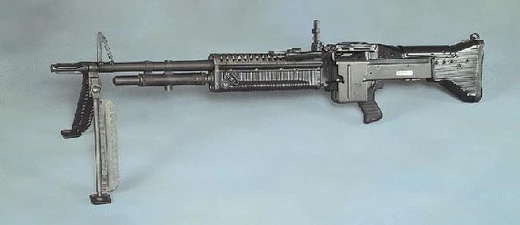
MAC 1934
French aircraft machine gun, compact and reliable, used from 1935.

The MAC 1934 is a French machine gun developed by the Manufacture d'Armes de Châtellerault (MAC) to replace the Darne mod. 1933 machine gun aboard aircraft of the Armée de l'Air. It is effectively the aircraft variant of the Reibel machine gun, using the same 7.5 mm MAS ammunition and operating by gas operation with an open bolt action. The MAC 1934 equipped French aircraft from 1935 until the later 1940s, but proved too light for combat in World War II.
Quick Facts
- Origin
- France
- Is Ranged
- yes
- Wars
- World War II / Algerian War
- Manufacturer
- Manufacture d'armes de Châtellerault
- Weight
- 10.7 kg
- Length
- 1030 mm
- Part Length
- 851 mm
- Cartridge
- 7.5 mm MAS
- Caliber
- 7.5 mm
- Action
- Gas
- Rate
- 1200-1450 rounds per minute
- Velocity
- 830 m/s (2,722.4 ft/s)
Facts from the source article.
Lore & Background
Development of the MAC 1934 was completed in 1934 by the Manufacture d'Armes de Châtellerault to replace the Darne mod. 1933 machine gun on French aircraft. It was essentially a faster-firing variant of the mitrailleuse mle 1931, sharing common parts with two main variants: the type tourelle (turret model) fed from 100-round replaceable magazines and used in flexible mountings, often fitted with an Alkan 1935 reflector gunsight; and the type aile (wing model) fed from 300- or 500-round drum magazines for fixed mountings. Because it used an open bolt action, the MAC 34 could not be fitted with synchronization gear, and was more expensive to manufacture than comparable weapons, but it was compact and had excellent reliability. A weakness was its operation at high altitudes: at altitudes past 20,000 ft the guns had a tendency to freeze, so heaters were added on the Morane-Saulnier M.S.406 to allow high altitude use.
Reader's Guide
The MAC 1934 machine gun served as the standard rifle-caliber aircraft armament for the Armée de l'Air from 1935 into the later 1940s. Its compact size and excellent reliability were offset by several drawbacks: the open bolt action prevented synchronization for firing through propellers, and the drum magazine feed system required too frequent reloadings for dorsal gunners and was impractical for wing mountings. This led to the development of the belt-fed MAC 1934 M39, introduced in 1939. Like other rifle-calibre machine guns, the MAC 34 proved too light for combat in World War II. Plans for heavier variants, including an 11 mm version, could not be completed before the Armistice. Post-war, the MAC 1934 saw use in Algeria on Morane-Saulnier MS.500 light aircraft for anti-guerilla operations around 1957, with the MAC 1934T installed as a defensive weapon aimed through the back window, though some aircraft were modified to fire through side windows.
Did You Know?
- It could not be fitted with synchronization gear due to its open bolt action.
- A belt-fed variant, the MAC 1934 M39, was introduced in 1939 to address the limitations of drum magazines.
Origins and the Cost-Conscious Design Philosophy
The Darne machine gun traces its lineage to a French gun-making firm celebrated for its innovative shotguns. In 1915, the French government brought this company into military small-arms production by contracting it to manufacture Lewis machine guns. Just a year later, in 1916, the firm announced a wholly indigenous belt-fed machine gun of its own. The design brief was deliberately austere: produce a weapon that could be built quickly and cheaply, shedding the ornamental refinements typical of most contemporary firearms. The resulting gun had a frankly crude external finish, yet it functioned well in the field and carried a price tag far below any comparable weapon of the era. The French Army ran trials on these guns between 1917 and 1918, but the armistice intervened before production contracts could be signed. That same philosophy of minimizing cost while preserving combat effectiveness would guide the company's subsequent offerings well into the inter-war decades.
Aircraft Service and the Transition to the MAC 1934
Although the Army's testing window closed with the end of the Great War, the Darne company continued refining an aircraft variant throughout the 1920s and 1930s. This improved version was adopted by the French Air Force and several allied air services to serve as an observer's gun aboard military aircraft. The aircraft variant remained in French service until 1935, when it was superseded by the MAC 1934 for Air Force use. The French Navy, however, retained the Darne in its naval aircraft well into the Second World War, making it one of the last platforms to carry the weapon. Critics frequently cited reliability shortcomings in the aircraft role, and the 7.5mm rounds it fired proved too light for effective aerial combat during WWII. Even so, the Darne's aircraft variant occupied a meaningful niche in French aviation armament, bridging the gap between the Lewis gun era and the MAC 1934 standard.
Mechanical Design and Engineering Choices
The Darne machine gun was gas operated and fired exclusively in full automatic mode from an open bolt position. Its bolt-locking arrangement was distinctive: the rear section of the bolt tilted upward into a mortise cut into the receiver's roof, a principle closely resembling that of the M1918 Browning Automatic Rifle. One of the weapon's most unusual features was its belt-feed mechanism, positioned between the gas piston and the barrel. This employed a two-stage cartridge feed system, first withdrawing the round rearward from the belt and then pushing it forward into the chamber. Most configurations included a belt box mounted directly beneath the receiver to improve handling. Chamberings varied across the production run, with early examples firing 8mm Lebel and .303 British rounds before the transition to the newer 7.5mm French military cartridge. Export models also appeared in 8mm Mauser and several other calibers to suit diverse international buyers.
International Service and Operational Footprint
The Darne machine gun saw service across a remarkably wide range of nations. Beyond France, it was exported to Brazil, Spain, Yugoslavia, Italy, and Lithuania. Italy specifically acquired one thousand units in .303 caliber in 1924, designating them as Darne cal. 7,7. Following the occupation of France, German forces pressed captured Darnes into coastal defense duty, cataloging them as 7.5 or 8 mm l.MG 106(f). Production logistics also shifted over time: while the earliest guns were manufactured by Darne in France, later output was outsourced to Spain, where costs could be kept lower. On the ground, infantry and vehicle-mounted versions featured a pistol grip with a rifle-style trigger, a wooden buttstock, and either a folding bipod or a compact lightweight tripod. Some alternate configurations substituted a metal skeletonized grip and a top-folding shoulder stock. Though the inter-war infantry and vehicle variants found no buyers, the weapon's broad international footprint testifies to its appeal as an affordable, functional machine gun.
Frequently Asked Questions
What is the MAC 1934?
The MAC 1934 is a French aircraft machine gun built by the Manufacture d'Armes de Châtellerault to replace the Darne mod. 1933 on Armée de l'Air fighters. It entered service in 1935 and stayed in use through the late 1940s.
What caliber and action does the MAC 1934 use?
It fires 7.5 mm MAS ammunition and cycles via a gas-operated, open-bolt mechanism. In essence, it is the aircraft adaptation of the Reibel machine gun.
What variants of the MAC 1934 exist?
The main versions are the type tourelle (turret model) fed by a 100-round drum and the type aile (wing model) using 300- or 500-round drums. A belt-fed revision, the MAC 1934 M39, was introduced in 1939.
How did the MAC 1934 perform in World War II?
Although compact and dependable, the gun was judged too light for the stresses of WWII aerial combat. It nonetheless continued to arm French aircraft well into the late 1940s.
How does the MAC 1934 relate to the Reibel machine gun?
The MAC 1934 is effectively the aircraft-mounted derivative of the Reibel, sharing the same 7.5 mm MAS cartridge and gas-operated open-bolt design. It was developed specifically to overcome the shortcomings of the earlier Darne mod. 1933 in an aerial role.
More in Machine Guns, Part 5 1-24
Spotted an error? Know more?
Reader corrections go straight into our review queue. Suggest an edit · How this site is sourced