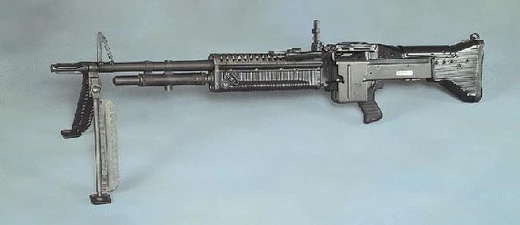
MG 42
German general-purpose machine gun with a distinctive high cyclic rate.

The MG 42—short for *Maschinengewehr 42*—was a German general-purpose machine gun that saw heavy use by the Wehrmacht and Waffen-SS in the latter half of World War II. Production began in 1942, with the goal of supplementing and eventually replacing the older MG 34, which cost more and took longer to manufacture. In practice, both guns were built until the war ended. Chambered for the standard German 7.92×57mm Mauser round, the MG 42 was designed to be cheaper and simpler to produce while remaining reliable and easy to operate. Its most striking feature was an extremely high cyclic rate for a weapon firing full-power ammunition: roughly 1,200 rounds per minute, compared to about 850 for the MG 34 and 450–600 for other common machine guns like the M1919 Browning, FM 24/29, or Bren gun. This rate made it exceptionally good at laying down suppressive fire, and its distinctive sound earned it the nickname "Hitler's buzzsaw."
After the war, the MG 42 was adopted by several armed forces, both as a licensed copy and as a direct influence on new designs. Its lineage continued with the nearly identical MG1 (also called the MG 42/59), rechambered for 7.62×51mm NATO, which later evolved into the MG1A3, the Bundeswehr's MG 3, the Italian MG 42/59, and the Austrian MG 74. In Yugoslavia, an unlicensed near-copy was produced as the Zastava M53. The MG 42 also contributed design elements to the Swiss MG 51 and SIG MG 710-3, the French AA-52, the American M60, the Belgian MAG, and the Spanish 5.56mm Ameli light machine gun.
Quick Facts
- Origin
- Nazi Germany
- Is Ranged
- yes
- Service
- 1942–present
- Designer
- Werner Gruner
- Design Date
- 1942
- Manufacturer
- Großfuß AG · de · Metall- und Lackwarenfabrik Johannes Großfuß / Mauser Werke AG / Wilhelm Gustloff Stiftung / Steyr-Daimler-Puch / MAGET (Maschinenbau und Gerätebau GmbH, Berlin-Tegel)
- Production Date
- 1942–1945 (Nazi Germany)
- Number
- 423,600
- Variants
- MG 45/MG 42V · MG 1 · MG 2 · Rheinmetall MG 3 · M53 · MG 74
- Weight
- 11.6 kg
- Length
- 1220 mm
- Part Length
- 530 mm
Facts from the source article.
Lore & Background
The MG 42 was developed to address the drawbacks of the MG 34, which was sensitive to extreme weather, dirt, and mud, and was comparatively complex and expensive to produce. A draft specification led to a contest in February 1937, with three companies submitting designs: Metall und Lackierwarenfabrik Johannes Großfuß AG, Rheinmetall-Borsig AG, and Stübgen AG. Großfuß AG's entry, designed by Dr.-Ing. Werner Gruner, employed a unique recoil-operated roller locking mechanism, while the competitors used gas-actuated systems. Gruner, who had no prior experience in weapons manufacture, attended an army machine gunner's course and incorporated feedback from soldiers, recycling an existing Mauser operating system.
The design made extensive use of pressed and stamped carbon steel, spot welding, and riveting, requiring considerably less machining and fewer high-grade steel alloys. It took 75 man hours to complete versus 150 for the MG 34, used 27.5 kg of raw materials versus 49 kg, and cost 250 RM versus 327 RM. The initial prototype was presented in April 1938, and an improved MG 39 prototype followed in February 1939. A limited run of about 1,500 MG 39/41 pre-mass-production models was completed in 1941 and tested in combat. The final model was officially accepted in early 1942, and first deployed in May 1942 by the Deutsches Afrikakorps, being introduced on all fronts by mid-1942.
The MG 42 was designed to use the standard German 7.92×57mm Mauser round and was highly reliable and easy to operate. Its cyclic rate averaged about 1,200 rounds per minute, compared to around 850 for the MG 34 and 450–600 for other common machine guns like the M1919 Browning, FM 24/29, or Bren gun. The weapon could be fired from a bipod or a Lafette 34 tripod, and was fed by belted ammunition or a 50-round Gurttrommel belt drum.
Reader's Guide
The MG 42's significance extends well beyond World War II. After the war, it was adopted by several armed organizations and was both copied and built under licence. Its lineage continued with the nearly identical MG1 (MG 42/59) chambered in 7.62×51mm NATO, which evolved into the MG1A3, and later the MG 3, Italian MG 42/59, and Austrian MG 74. In Yugoslavia, an unlicensed near-identical copy was produced as the Zastava M53.
The MG 42 also lent many design elements to other notable machine guns, including the Swiss MG 51 and SIG MG 710-3, French AA-52, American M60, Belgian MAG general-purpose machine guns, and the Spanish 5.56×45mm NATO Ameli light machine gun. Its legacy is thus seen in numerous post-war designs that incorporated its roller-locking system and stamped construction methods, making it one of the most influential machine gun designs of the 20th century.
Did You Know?
- The MG 42's high cyclic rate of about 1,200 rounds per minute earned it the nickname 'Hitler's buzzsaw'.
- It took 75 man hours to produce an MG 42, compared to 150 man hours for the MG 34.
- Over 400,000 MG 42 units were produced during World War II.
Postwar Rebirth and Design Evolution
After the war ended, the original technical drawings for the 7.92-millimeter MG 42 fell into Soviet hands and were subsequently passed on to Czechoslovakia and Yugoslavia. This meant Rheinmetall could not simply resume production from blueprints; instead, the company had to reverse-engineer the design from a captured physical example. The Bundeswehr's 1958 request for a NATO-standard general-purpose machine gun triggered the MG 1, chambered for the 7.62×51mm round. Subsequent iterations refined the weapon steadily: the MG 1A1 added a chrome-lined barrel and recalibrated sights, while the MG 1A2 introduced a heavier 950-gram bolt to slow the cyclic rate to 700–900 rounds per minute, a new friction ring buffer, bolt-bounce prevention catches, and compatibility with both German DM1 and American M13 belts. The MG 1A3 further improved the muzzle device, bipod, and bolt. By 1968, the MG 3 consolidated these advances with an improved belt-retaining pawl, an anti-aircraft sight, and a redesigned ammunition box. Throughout this entire lineage, a high degree of parts interchangeability with the original wartime MG 42 was deliberately preserved.
Global Proliferation and Enduring Service
The MG 3 and its family of derivatives have found a home in the armed forces of more than forty nations. Production rights were licensed or purchased by a wide range of countries: Italy produced the MG 42/59, while Greece, Iran (designating it the MGA3), Pakistan (as the MG 1A3), Sudan, Spain, and Turkey all established their own manufacturing lines. In Germany itself, Rheinmetall produced MG 3s for both domestic and export markets until 1979, with Heckler & Koch also contributing additional output. The weapon's operational footprint in the Bundeswehr is vast: it serves as the standard secondary armament on major platforms like the Leopard 2 tank, the PzH 2000 self-propelled howitzer, and the Marder infantry fighting vehicle, while also acting as the primary weapon on lighter vehicles such as the ATF Dingo and MAN gl-trucks. Even as the German military began supplementing the MG 3 with the Heckler & Koch MG5 starting in 2015, plans announced in 2019 called for manufacturing several thousand new receivers to sustain vehicle-mounted and turret-mounted MG 3 roles in low-level anti-aircraft and general-purpose capacities.
Operational Doctrine and Barrel Discipline
German military doctrine treats the MG 3 as a weapon demanding strict discipline rather than sustained pouring of fire. In the bipod-mounted light machine gun role, operators are trained to deliver short bursts of three to five rounds, carefully adjusting aim between successive bursts. When mounted on a tripod in the medium machine gun role, the doctrine permits longer bursts of twenty to thirty rounds, again with aim optimization between them. The effective rate of fire under these controlled conditions is approximately 250 rounds per minute, well below the gun's mechanical cyclic rate. Perhaps the most critical aspect of MG 3 employment is barrel management: soldiers are instructed to swap the barrel after just 150 live rounds, or 100 blank rounds, of sustained heavy fire. A replaced barrel may only be reused once it has cooled to the point where a soldier can hold it bare-handed for thirty seconds. The procedure is deliberately simple, but the stakes are high—neglecting this rule renders the barrel prematurely unusable, and after extended cyclic fire the barrel can approach white-hot temperatures. Crew members performing hot barrel changes are issued protective asbestos gloves or a cloth to shield their hands from severe burns.
Reliability Trials and Critical Assessment
The MG 3's reputation for mechanical simplicity and ease of maintenance has not been immune to critical scrutiny. In 1974, the US Army conducted a comparative trial pitting German-made MG 3s against eight other contemporary general-purpose machine gun designs, seeking a replacement for the M219 Tank Machine Gun, which had proven unacceptably unreliable. The results were sobering: the MG 3 placed third worst in mean rounds between failure, fourth worst in mean rounds between stoppage, and last in both cookoff rate and accuracy when compared to the M60 and FN MAG. Its overall unweighted ranking was sixth out of nine candidates, and the assessment concluded that no reasonable weighting of the evaluated attributes would have elevated it to first place. However, the MG 3 did outperform both the M60 and FN MAG in three specific categories: ease of training, ease of barrel changing, and safety. This mixed picture—excellent in operator-friendliness but lagging in raw reliability metrics under test conditions—encapsulates the nuanced legacy of a design that prioritized simplicity and interchangeability over peak mechanical endurance.
Frequently Asked Questions
What is the MG 42?
The MG 42 (Maschinengewehr 42) is a German general-purpose machine gun that entered service in 1942 and became a primary infantry weapon for the Wehrmacht and Waffen-SS during the final stretch of World War II.
How fast does the MG 42 fire?
It cycles at roughly 1,200 rounds per minute, an unusually high rate for a general-purpose gun of that era that gave it a distinctive, almost tearing sound on the battlefield.
Why did Germany develop the MG 42?
It was conceived as a cheaper, faster-to-build successor to the labor-intensive MG 34, aiming to cut manufacturing time and cost while keeping reliability and ease of operation. In practice, both weapons continued to be produced side by side until the war ended.
How many MG 42s were produced during the war?
More than 400,000 units were manufactured, with each one costing around 250 Reichsmarks—well below the price tag of its predecessor.
What round does the MG 42 chamber?
It fires the standard 7.92×57mm Mauser cartridge, the same round that powered most German small arms of the period.
More in Machine Guns, Part 5 1-24
Spotted an error? Know more?
Reader corrections go straight into our review queue. Suggest an edit · How this site is sourced